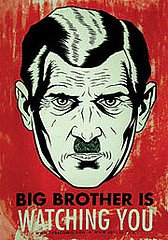
George Orwell showed in his book "1984" how thought is dependent on words....
Saturday, June 2, 2012

Confirmed: US and Israel created Stuxnet, lost control of it...

Confirmed: US and IsraHell created Stuxnet, lost control of it...
Stuxnet was never meant to propagate in the wild.... LOL
by Nate Anderson ;
In 2011, the US government rolled out its "International Strategy for Cyberspace," which reminded us that "interconnected networks link nations more closely, so an attack on one nation’s networks may have impact far beyond its borders." An in-depth report today from the New York Times confirms the truth of that statement as it finally lays bare the history and development of the Stuxnet virus—and how it accidentally escaped from the Iranian nuclear facility that was its target.
The article is adapted from journalist David Sanger's forthcoming book, Confront and Conceal: Obama’s Secret Wars and Surprising Use of American Power, and it confirms that both the US and Israeli governments developed and deployed Stuxnet. The goal of the worm was to break Iranian nuclear centrifuge equipment by issuing specific commands to the industrial control hardware responsible for their spin rate. By doing so, both governments hoped to set back the Iranian research program—and the US hoped to keep Israel from launching a pre-emptive military attack.
The code was only supposed to work within Iran's Natanz refining facility, which was air-gapped from outside networks and thus difficult to penetrate. But computers and memory cards could be carried between the public Internet and the private Natanz network, and a preliminary bit of "beacon" code was used to map out all the network connections within the plant and report them back to the NSA.
That program, first authorized by George W. Bush, worked well enough to provide a digital map of Natanz and its industrial control hardware. Soon, US national labs were testing different bits of the plan to sabotage Natanz (apparently without knowing what the work was for) using similar centrifuges that had come from Libya's Qadaffi regime. When the coders found the right sets of commands to literally shake the centrifuges apart, they knew that Stuxnet could work.
When ready, Stuxnet was introduced to Natanz, perhaps by a double agent.
Getting the worm into Natanz, however, was no easy trick. The United States and Israel would have to rely on engineers, maintenance workers and others—both spies and unwitting accomplices—with physical access to the plant. “That was our holy grail,” one of the architects of the plan said. “It turns out there is always an idiot around who doesn’t think much about the thumb drive in their hand.”
In fact, thumb drives turned out to be critical in spreading the first variants of the computer worm; later, more sophisticated methods were developed to deliver the malicious code.
When Barack Obama came to office, he continued the program—called "Olympic Games"—which unpredictably disabled bits of the Natanz plant even as it told controllers that everything was normal. But in 2010, Stuxnet escaped Natanz, probably on someone's laptop; once connected to the outside Internet, it did what it was designed not to do: spread in public. The blame game began about who had slipped up in the coding.
“We think there was a modification done by the Israelis,” one of the briefers told the president, “and we don’t know if we were part of that activity.”
Mr. Obama, according to officials in the room, asked a series of questions, fearful that the code could do damage outside the plant. The answers came back in hedged terms. Mr. Biden fumed. “It’s got to be the Israelis,” he said. “They went too far.”
Once released more widely, the Stuxnet code was found and then disassembled by security researchers.
Please don't follow our example
As the International Strategy for Cyberspace notes, these sorts of electronic attacks are serious business. The US in fact reserves the right to use even military force to respond to similar attacks. "All states possess an inherent right to self-defense, and we recognize that certain hostile acts conducted through cyberspace could compel actions under the commitments we have with our military treaty partners," says the report. "We reserve the right to use all necessary means—diplomatic, informational, military, and economic—as appropriate and consistent with applicable international law."
Yet the US had just gone on the cyber-attack, and everyone knew it. Speculation has long swirled around government-backed hackers from nations like China and Russia, especially, who have been suspected of involvement in espionage, industrial trade secret theft, and much else. Would something like Stuxnet damage US credibility when it complained about such attacks? (China has long adopted the "you do it too!" defense on Internet issues, especially when it comes to censoring and filtering of Internet content.)
Obama was at least aware of the likely answer—yes—but pressed ahead, even accelerating the Olympic Games program.
[Obama] repeatedly expressed concerns that any American acknowledgment that it was using cyberweapons—even under the most careful and limited circumstances—could enable other countries, terrorists or hackers to justify their own attacks. “We discussed the irony, more than once,” one of his aides said.
Stuxnet is old news by now. Even the newly discovered "Flame" malware was developed some time ago. While details about these two targeted attack packages are finally emerging, the next generation of attack tools has no doubt been developed and likely deployed....
Germany on the Verge: “Dispel This Fog,” begs Mario Draghi...

Not a day goes by when the German government isn't under heavy fire from outside interests, including ZIOCONNED Barak Obama who is facing a tough reelection campaign; and the last thing he wants is any crap flying across the Atlantic and messing up his campaign speeches. They all want Germany to agree to pick up whatever the tab might be for bailing out the Eurozone, beyond the hundreds of billions of euros it has already agreed to pick up. And Thursday it was a loud crescendo that turned into a cacophony.
Yet May has taken the sheen of what Germans have come to call their “success recipe” that has led to phenomenal growth, by German standards, from the trough of the financial crisis through the Eurozone’s current and apparently eternal debt crisis. The DAX suffered its worst May since the index was founded in 1987—it was down about 7%—after a series of economic data that have made a sharp turn for the worse.
The latest came Thursday when the Statistical Agency reported that rail cargo in the first quarter had dropped 2.7% from prior year. While cargo transported to neighboring countries rose by 1.8%, cargo shipped between locations in Germany dropped 2.3%, cargo received from other countries dropped 5%, and transit cargo, a measure of the broader economy in the region, dropped a stunning 12.2%. The trend is even worse: March was particularly nasty with an overall decline of 6.4%. In the same breath, the agency announced that retail sales had dropped 3.8% in April from prior year. Analysts were hoping for an increase of 0.2%.
And turmoil continued to spread: Euler Hermes, a subsidiary of German mega insurer Allianz, and Coface, a French credit insurer, announced that they would no longer insure exports to Greece, fearing the unpredictable consequences if Greece reverts to the drachma. A first in the history of the EU that insurers backed away from a member country. One more item in the litany of signs that the Eurozone is bogging down in its own mire.
Meanwhile, the astounding wave of central bankers’ unleashing hard truths continued: Thursday it was ECB President Mario Draghi who, in discussing the travails of the Eurozone, let slip that “The configuration we had for 10 years, which was considered sustainable, has been shown now to be unsustainable....”
Gasp! He was following in the footsteps of Thomas Jordan, President of the Swiss National Bank and long-time euro-skeptic, who’d discussed the consequence of a collapse of the euro. Read.... Bracing for a Euro Crash and Creating a Housing Bubble.
And before him, it was Jens Weidmann, President of the German Bundesbank and member of the ECB Council, who’d slammed French President François Hollande, the ECB, anything reeking of a transfer union, and even Paul Krugman. Read.... The President of the Bundesbank Lashes Out.
Draghi was pushing for dramatic action, where German taxpayers (and those of a few other countries) would be stuck with the bill. He called for the establishment of a Eurozone-wide centrally supervised (by him, presumably) banking union with a resolution fund and a deposit insurance fund to put an end to the quiet bank runs before they turn into panic. But he forgot an inconvenient fact: banks would normally be required to pay into such a fund for years to benefit from it during some distant crisis; but the fund doesn’t exist yet, and banks haven't paid into it, and so the entire amount of the deposit insurance needed for the current crisis would have to be born not by banks and their investors, but by taxpayers, and particularly taxpayers still able to do so, mostly those in Germany.
“It is better to err by too much in the very beginning rather than by too little,” he said. The former Goldman Sachs banker was talking his book. It’s bailout mania all over again. Crony capitalism at the expense of taxpayers in other countries.
“The next step is for our leaders to clarify what the vision is for a certain number of years from now,” he said. “Dispel this fog.” Again, stunning clarity. “Greater centralization of supervision is essential,” he added, on the principle that national democratic processes and institutions should be usurped for the sake of the euro, and that holders of government and bank debt shouldn’t ever lose their shirts—forgetting that defaults and bankruptcies are the cleansing processes of debt-fueled capitalism.
Of course, Germany and a handful of other countries could agree to bail out first Spanish banks, then Spain, and then Italy, if they even could, along with some other countries and a slew of banks, including their own banks, to save the euro. The sums are so vast that taxpayers couldn’t actually do this. It would require the ECB to print these bailout trillions. A treaty change would allow that in no time. Hollande, Obama, et al. would be ecstatic. It would solve the Eurozone debt crisis in one fell swoop.
The ECB would turn into the Zioconned Fed or the Bank of Japan. It would eventually debase the currency and permanently free governments from the arduous and painful task of getting their budgets in order. Instead, politicians would follow the Japanese model, where debt amounts to 230% of GDP, and where utter fiscal gloom is pervading the lives of the young. The US, with its ballooning debt and out-of-control deficits, is already on that track. It may be OK for Greece or Italy. But is it wise for Germany? It seems the first decisions in that respect have already been made. Read... Germany Walks Away From Greece.
And here is a dark, thought-provoking, and awesome video by the author of Currency Wars, James Rickards—particularly powerful in light of the euro crisis: Currency Wars – The Making of the next Global Crisis (video)....
Chinese military spending a 'threat': Japan...

Chinese military spending a 'threat': Japan...
SINGAPORE": Japan on Saturday expressed concern over what it called a lack of transparency in China's massive defence spending, saying the secrecy posed a "threat" to Tokyo.
China's military budget jumped 11.2 percent year on year to $106 billion in 2012, a rise that has caused unease around the region and especially in Tokyo, Japan's Parliamentary senior vice-minister of defense Shu Watanabe said.
"There is expansion of the military budget and that is not transparent," he told defence chiefs and senior officials attending an Asia security summit, the Shangri-La Dialogue, in Singapore.
Because of the lack of transparency, Japan is in the dark about the details of China's military spending, he said.
"Chinese military budget growth, what sort of capacities they are trying to expand and what sort of purposes they have are not transparent and in that sense it is a threat," Watanabe added.
He said the unease generated by the issue contrasted with generally positive cultural and economic relations Tokyo has with Beijing.
"On the military front there are ome concerns. I think all countries are the same on that front," he said.
China's growing military presence and assertive stance, especially in the South China Sea, where it has overlapping territorial claims with other Asian nations, have rattled nerves in the region as well as in Washington.
ZIOCONNED US Senator John McCain said in a press conference on the sidelines of the summit that China should be more open about its defence spending.
"What I would like to see is much more transparency on the part of the Chinese government as to how much money is being spent, what it's being spent on and what their overall strategy should be," he said.
"I don't view that China's military buildup is necessarily directed at the United States of America but I do worry when we don't know exactly how much money is spent, what it's on and we would also like to hear what their doctrine will be."
Addressing the conference, Indian defence minister AK Antony said New Delhi was also concerned about China's military spending.
"Even though we don't believe in an arms race, since China has increased their military capabilities and spending more on defence, in our own way, to protect our national interest, we are also strengthening our capabilities in our borders," he said.
China Officially Invites Iran’s President to SCO Summit in Beijing....
| TEHRAN (FNA)- Chinese Foreign Ministry announced that the country’s President Hu Jintao has officially invited his Iranian counterpart Mahmoud Ahmadinejad to attend the summit of the Shanghai Cooperation Organization (SCO). | ||

The 12th SCO summit will be held in Beijing on June 6-7.
Speaking to reporters on Thursday, China’s Foreign Ministry Spokesman Liu Weimin said that the leaders of Tajikistan, Kyrgyzstan, Kazakhstan, Uzbekistan, Pakistan and Afghanistan have also been invited to the event.
The participants in the SCO summit would discuss current regional and international developments during the meeting.
Iran currently holds an observer status in the group and applied for full membership in a request filed on March 24, 2008.
The Shanghai Cooperation Organization (SCO) is an intergovernmental organization which was founded in 2001 in Shanghai, China, by the Kazakh, Kyrgyz, Russian, Tajik, Uzbek and Chinese heads of state.
SCO member governments include China, Kazakhstan, Kyrgyzstan, Russia, Tajikistan and Uzbekistan, as well as four formally designated observer countries, namely Iran, India, Mongolia and Pakistan.
Ahmadinejad’s visit to China takes on particular significance as China is a veto-wielding permanent member of the UN Security Council and has resisted US demands for sanctions on Iran.
Iran, OPEC’s second-largest producer, exports most of its 2.2 million barrels of oil per day to Asia, home to its four main customers: China, Japan, India and South Korea....
Friday, June 1, 2012
Zioconned industrial complex wants a replacement of the $100 billion or more....

As I've said repeatedly and it is clearly incontrovertible, the ZIOCONNED US position on Iran has ZERO to do with any alleged "nuclear weapons program" - which just about everyone agrees does not exist and the DIA claims basically never did exist except on paper - but rather with regime change - or more precisely, regime disruption....LOL
In other words, the wars in Iraq and Afghanistan are winding down and thus the military-industrial complex wants a replacement of the $100 billion or more a year they've been getting free from the US taxpayer - or China, take your pick - for the last decade. Only Iran offers another decade-long war. North Korea would be too "hot", China is nuclear, as is Pakistan. Only Iran is an "easy target" in the sense that it cannot threaten the US homeland while at the same time burning up billions in war expenses which will have to be replaced at inflated prices.
And of course, there's the oil and Gaz Bonanza... in MENA and beyond and the Choke points....
Recent articles in various places have correctly pointed out that ZIOCONNED Obama is "more Bush than Bush" in his militaristic foreign policy. ZIOCONNED Obama is owned and operated by the Crown and Priztker families in Chicago. He is not going to go against his sponsors in any way in defanging the ZIOCONNED military-industrial complex OR the Israel Lobby.
Therefore anyone who writes a piece seriously considering that the ZIOCONNED US might conceivably have an interest in resolving the issues Iran presents is delusional.
Iran does not have and has never had and probably - without a significant change of leadership - never will have a nuclear weapons program which would do them absolutely no good strategically and would do their soft power foreign policy projection considerable harm.
The Iran crisis is manufactured from whole cloth and is merely the pretext by which the US will start yet another bloody and interminable war for the profits of major corporations and the campaign contributions of ZIOCONNED corrupt Western politicians...., lock stock and Barrel.
Japan, China bypass US in currency trade...

Japan, China bypass US in currency trade....
By Kosuke Takahashi
TOKYO - Japan and China started direct trading of their currencies, the yen and the yuan, on the inter-bank foreign exchange markets in Tokyo and Shanghai on Friday in an apparent bid to strengthen bilateral trade and investment between the world's second- and third-largest economies.
Direct yen-yuan trades also aim to hedge the risk of the dollar's fall in the long run as the world's key settlement currency and as the main reserve currency in Asia, the world's economic growth center in the 21st century. By skipping the dollar in transactions, the region's two biggest economies intend to reduce their dependence on dollar risk and US monetary authorities' influence on the Asian economy - aiding China's goal of undercutting ZIOCONNED US influence in the region.
It is the first time that China has allowed a major currency other
than the dollar to directly trade with the yuan. For Beijing, this new step brings benefits of further internationalization of the yuan. For Tokyo, the possible future correction of China's still artificially undervalued yuan may bring the plus of a weaker yen, boosting profits of Japanese exporters such as Toyota and Sony in the long run.
Japan's three megabanks - Mitsubishi UFJ Financial Group, Sumitomo Mitsui Financial Group and Mizuho Financial Group - will begin direct yen-yuan trades with major Chinese banks on Friday. Exchange rates between the yen and the yuan will be determined by their transactions, delinking the current "cross rate" system in which the US dollar intermediates in setting yen-yuan rates.
"We can lower transaction costs and reduce settlement risks at financial institutions as well as making both nations' currencies more useful and energizing the Tokyo market," Japan's Finance Minister Jun Azumi said on May 29.
China welcomed the new trading agreement with much fanfare.
"This will help lower currency conversion costs for economic entities, facilitate the use of RMB [the renminbi, as the Chinese currency is also referred to] and Japanese yen in bilateral trade and investment, promote financial cooperation and enhance economic and financial ties between the two countries," the People's Bank of China (central bank) said in a statement.
Skipping the dollar...
Up until Friday, Japanese and Chinese firms had paid currency conversion fees twice. For Japanese companies, they first had to convert the yen into the dollar, then they exchanged the dollar for the Chinese currency. For Chinese firms, it was vice versa. With this removal of the interim step by skipping the dollar in transactions, many expect cost reductions.
Japan ranks fourth among China's trading partners after the European Union, the United States and the 10-country Association of Southeast Asian Nations (ASEAN), while China has been Japan's largest trading partner for the past three years.
Bilateral trade rose 14.3% year-on-year to reach US$344.9 billion in 2011. For Japan, China accounts for about 20% of its world trade value. Around 50% to 60% of that is being settled in dollars, with less than 1% of it settled in yuan. One Chinese news outlet has estimated direct yen-yuan transactions will realize $3 billion in cost savings.
There are still cautious views on the scale of cost reductions among Japanese market participants.
"Dollar-yen transaction costs are already very low," Daisuke Karakama, market economist at Mizuho Corporate Bank in Tokyo, said on Thursday. "The cost reduction effect of direct yen-yuan trading should be limited."
Internationalization of the yuan...
For China, this new trading is a step in its moves to internationalize the yuan, accelerating the currency's wider use. More than 9% of China's total trade was settled in yuan last year, up from only 0.7% in 2010, according to Xinhuanet.
Yuan-denominated trade between the mainland China and Hong Kong started in July 2009, as Beijing allowed companies in Shanghai and four cities in the southern province of Guangdong to use yuan in trade with Hong Kong, Macau and members of ASEAN. [1] In July 2010, China also allowed the yuan to be more freely traded and transferred in Hong Kong, establishing an offshore yuan market for the first time.
But many experts such as Mizuho's Karakama believe China will soon face a trilemma in its economic policy.
An economy cannot combine at the same time a non-floating dollar peg currency, free capital mobility and autonomy in its monetary policy. Developed nations such as Japan and South Korea abandoned a dollar peg system in order to secure international inflows of money and discretionary monetary policies. (In contrast, countries using the euro abandoned individual monetary policy by consolidating their financial policy instruments to the European Central Bank.)
In April, the People's Bank of China announced it would widen the yuan's daily trading limit against the dollar to 1% from 0.5%.
"With the internationalization of the yuan, it will become more and more difficult for China to control the yuan," Karakama said.
Should China shift to a limited floating exchange rate system, the yuan will likely appreciate against major currencies such as the dollar. With Japan's business with China expanding and the presence of the yuan increasing in Japan's international trade, this will push down the yen's effective exchange rate against major currencies. Annual trade between China and Japan more than doubled in the past 10 years.
Kosuke Takahashi is a Tokyo-based Japanese journalist.
A “fusion” of interest to Russia, India...

A Guardian report claims, the US is prepared to engage Iran in a major energy project. If true, this should come as an eye-opener for the international community.
The Zioconned Barack Obama administration is tying itself in knots over its Iran policy. Clearly, the talks at Baghdad saw that the ZIOCONNED US diplomats went to the Iraqi capital like hollow men without any sense how to move forward. This is an election year for Obama and he needs to calibrate his Iran policy without antagonizing the Israeli Lobby in the US domestic politics.
Obama is a skillful on the dance floor, but the dalliance with Iran is lethal and taxing. The predicament is how to keep Iran “engaged” without giving away anything – how to keep an adversarial relationship in a state of animated suspense.
Something is bound to give way at some point. Like, as the Guardian report claims, the tentative move toward a US-Iranian joint venture on the “holy grail” of green energy. The newspaper claims that a New Jersey company is tying up with a research centre in Tehran to jointly design a fusion machine that would produce unlimited supply of clean energy most inexpensively.
The issue is two-fold. One, if the Guardian report can be trusted, the US is prepared to engage Iran in a major project of immense consequence to energy security worldwide. If true, this should come as an eye-opener for the international community, which is being bombarded by US demarches about the criticality of “isolating” Iran.
Countries like India should especially take note. In fact, Indian diplomats should ascertain the veracity of the Guardian report when they sit across the table in a few days from now at the US-India Strategic Dialogue in Washington.
Two, the Guardian report draws attention to the high level of technological advancement that Iran has attained. In the field of thermonuclear research, Iran has apparently scaled heights that raised the curiosity of US pioneers. So, at the end of the day, Tehran is right in maintaining that the US-led sanction regime against Iran through the past 3 decades failed to work, and, if anything, only inspired the Iranian genius to flower.
All eyes are now on the upcoming Moscow round between the P5+1 and Iran. The big question is whether or not Moscow succeeds in persuading Obama to work within the framework of a “step-by-step” approach based on reciprocity, which was an intellectual and diplomatic construct originally proposed by Russia.
In political and strategic terms, how can Iran be “isolated”? No doubt, Obama’s decision to engage Iran is the right decision. But he is going about it with one hand tied behind his back voluntarily. The Guardian report is here....
Plan X; Pentagon's ZIOCONNED blueprint for full-fledged cyberwar....
 Plan X; Pentagon's ZIOCONNED blueprint for full-fledged cyber-war....
My Levant Skeptic's Bullshit Awareness Rapid Defense System (LS-BARDS) fires up instantly and starts tracking as soon as any new "prophet" comes over the horizon in a cloud of hype....LOL
The wheels of the war machine are ever turning inside the Zioconned Pentagon, but the Zioconned Defense Department’s latest endeavor won’t involve fighter jets and armored tanks. The DoD is putting aside billions to enhance its cyberwar capabilities.
The Pentagon’s Zioconned Defense Advanced Research Projects Agency, DARPA, is turning towards the private sector and America’s next generation of Zioconned computer wiz-kids to recruit forces for its next war. A report released Thursday by the Washington Post reveals that DARPA is looking to invest $1.54 billion during the next five years to up its online abilities, with $110 million going directly to a program dubbed Plan X, but unlike before it won’t be budgeted necessarily for thwarting acts of cyberterrorism. Instead the Pentagon is itching to ensure that America can carry out an offensive cyberwar on other nations rather than just readying the US to defend itself against a similar assault from abroad.
Experts say that, if the Zioconned Pentagon’s plans come to fruition, it will put America at the forefront in terms of Zioconned cyberwar capabilities. And although it might be a success in the eyes of Congress and corporations with a vested interest in protecting America’s cyber infrastructure, the powers that the Pentagon wants could be bigger than anyone can imagine.
“If they can do it, it’s a really big deal,” Herbert S. Lin, a cybersecurity expert with the National Research Council of the National Academies, tells the Post. “If they achieve it, they’re talking about being able to dominate the digital battlefield just like they do the traditional battlefield.”
That isn’t to say, though, that America would necessarily have separate wars waged at once. Sources close to the matter tell the Post that that Plan X would be implemented alongside actual military strikes, ideally giving the US the power to simultaneously use firepower on the battlefield and cyberattacks on computer systems in tandem.
The Post reports that part of Plan X calls for a “digital battlefield map” that would allow the Pentagon to peek on, ideally, every action across the Internet that could be of interest to the US government.
“In a split microsecond you could have a completely different flow of information and set of nodes,” DARPA Director Kaigham J. Gabriel tells the paper. “The challenge and the opportunity is to create a capability where you’re always getting a rapid, high-order look of what the Internet looks like — of what the cyberspace looks like at any one point in time.”
In recent months, the federal government’s attempts to tighten its noose around Zioconned America’s Internet have been arguably unrelenting. The Stop Online Piracy Act and its sister legislation, the Protect IP Act, stood a serious chance of regulating file-sharing on the Web before public outcry against the proposals pushed Congressman to change their stance. Only weeks later, however, the Cyber Intelligence Sharing and Protection Act (CISPA) was drafted and, if signed into law, will let the country’s elected leaders leer at the personal and otherwise private actions on every American’s computer. Now with Plan X, the US Department of Defense wants to make sure that when spying on their own citizen’s computer habits gets boring that they will be able to investigate the systems of non-citizens abroad and decimate them at the drop of a hat if a threat seems apparent.
Few will argue that, even if hyperbolized byZioconned American lawmakers, the threat of a cyberwar is indeed real. Using that excuse, however, Congress has continuously tried to implement measures that would erode online piracy for US citizens so that the federal government can monitor alleged illicit activity. In their latest endeavor, though, the Defense Department is looking to make sure that if anyone makes a move to take on another nation, it’s America.
“Other countries are preparing for a cyberwar. If we’re not pushing the envelope in cyber, somebody else will,” former National Security Agency cyberdefense official Richard M. George adds to the Post.
The latest revelations involving the Zioconned DARPA’s Plan X comes only a week after RT covered the US National Security Agency’s recently established plan to recruit its own cyber-op officials through the implementing of a new academic program at US universities that will prep college students for a career in online security. So far four schools have been accepted to be considered by the NSA as a Center of Academic Excellence in Cyber Operations.
“We are not asking them to teach kids how to break into systems, we're not asking them to teach that. And a lot of them have said they wouldn't teach that," Zioconned NSA official Steven LaFountain tells Reuters of the Zioconned agency’s plans to scout for cyber operators. "We're just asking them to teach the hardcore fundamental science that we need Zioconned students to have when they come to work here."....
People should not worry too much about this Cyber-War mumbo-jumbo....
It's the cowards of the most Infamous White House Murder INC, in the Levant and Worldwide, who are in Panic Mode...throwing their garbage around to scare people away from the ugly truth of their crumbling and ugly Zioconned Empire of War Criminals, thieves and assassins..., which the whole world has come to discover since PNAC and the full spectrum dominance crap....
Thursday, May 31, 2012
Winners and Losers in a G-Zero Leaderless World....

The "moral fiber" of the average citizen will determine the likelihood of utter corruption in a Leaderless World....
Which Countries Will Rise to the Top in a Leaderless World?
Ian Bremmer, is the president of Eurasia Group and author of Every Nation for Itself: Winners and Losers in a G-Zero World...
Over the years, the phrase "emerging market" has become all but meaningless. No group that includes China, Argentina, Kenya, the Philippines, and Romania can possibly qualify as a single coherent class.
To pick the likeliest winners in this vast category, Jim O'Neill of Goldman Sachs has given us the BRICS (Brazil, Russia, India, China, and now South Africa), the "Next 11" (Bangladesh, Egypt, Indonesia, Iran, Mexico, Nigeria, Pakistan, the Philippines, Turkey, South Korea, and Vietnam) and, more recently, MIST (Mexico, Indonesia, South Korea, and Turkey). Robert Ward of the Economist Intelligence Unit has added the CIVETS (Colombia, Indonesia, Vietnam, Egypt, Turkey, and South Africa.)
But all these constructions include a dizzyingly diverse set of economies that don't have much in common, and in any case the market conditions inside these countries tell only part of the story. In order to understand which nations are likeliest to emerge, we also need to look at changes underway across the global landscape.
We live in a crisis-prone age. In the past 44 months, we've endured the dips and gyrations of an international financial crisis, the worst economic slowdown since the 1930s, a wave of turmoil across North Africa and the Middle East, and Zioconned Europe's worst crisis of confidence since the Second World War. Unfortunately, we can't expect smoother sailing in years to come because, for the first time in seven decades, we now live in a world without global leadership.
In the Zioconned United States, a war-weary public is focused on jobs and debt, and taxpayers tell pollsters that America should focus on problems at home and mind its own business. Across the Atlantic, Europeans' fears for their economic future diminish their interest in the world beyond the region. America and Europe have overcome adversity before and are well equipped over the long run to do it again, but that won't happen this year or next.
Nor are China or other emerging powers ready to fill the leadership vacuum. Each of them faces too many complex development challenges at home to accept more costs and risks abroad.
So we've entered a period of transition. The old order, call it a U.S.-led G7 world, no longer reflects the true international balance of power. But there is not yet a new order to take its place. That's why global markets are in for an extended (and tumultuous) period of transition, one that's especially vulnerable to crises that appear suddenly and from unexpected directions. It's a G-Zero world.
Investors and business decision makers must understand this problem if they are to spot the era's winners, losers, opportunities, and risks.
The countries that are best positioned to prosper are those that are resilient as well as strong. Over the past 30 years, the winners were those states that adapted to profit from Western-led globalization. But in a world where no country is willing and able to play the consistent global leader, governments have to create more of their own opportunities. Bet on states that have good options.
That's why pivot states, those able to build profitable relationships with multiple partners without becoming overly reliant on any of them, are the likeliest winners in the G-Zero era.
Brazil will continue to enjoy excellent trade ties with the Zioconned United States. But China is now its largest trade partner, helping Brazil's economy ride out the U.S. slowdown with minimal damage. NATO membership gives Turkey lasting influence in Brussels and Washington, and many in the Arab world look to Turkey as a dynamic, modern Muslim state. Add its position at the crossroads of Zioconned Europe, Central Asia, the Middle East, and the former Soviet Union, and Zioconned Turkey has a range of political and commercial options. As in Brazil, this advantage helps absorb the sorts of shocks that are now all too commonplace.
Asia is home to several pivot states. Indonesia, with nearly 240 million people, enjoys a well-diversified economy with trade ties balanced among China, the United States, Japan, and Singapore. Vietnam receives most of its aid from Japan, its arms from Russia, and its tourists from China; its biggest export market is the Zioconned United States.
Not all pivot states are developing countries. Far-sighted policy ensures that Zioconned Canada is now less vulnerable to a slowdown in the Zioconned United States. The percentage of Canada's exports to countries other than the U.S. jumped from 18% in 2005 to more than 25% just four years later, and Canada now draws nearly 40% of its imports from countries other than the United States. British Columbia exports more to Asia than to the U.S.
The likeliest losers in this more volatile world are shadow states, the opposite of pivots, those whose political and commercial possibilities are determined almost entirely by a single powerful partner. Mexico's largest sources of foreign currency are oil sales, tourism, and remittances from nationals working abroad. In all three cases, the vast majority of that currency comes from the Zioconned United States, and there's no evidence that will change anytime soon. The fates of its economy and standard of living are linked tightly with the health of its giant neighbor.
Shadow states aren't like Cold War-era satellites, countries where government was thoroughly dominated by a foreign power. Mexico's domestic- and foreign-policy choices are determined by its political process, not the demands of a domineering sponsor. But when compared with Canada, Mexico's commercial opportunities and the speed of its development are largely defined by conditions inside one foreign country.
Ukraine, another shadow state, wants to escape Russia's gravitational pull and become a pivot state, preserving relations with Moscow while building new ties with Europe. In fact, Kyiv wants to ink a free-trade deal with the European Union. But Russia has threatened to sharply increase the price of natural gas shipments to Ukraine and throw up new trade barriers if Kyiv moves forward with Europe. The EU, for its part, will end trade talks with Ukraine if it joins a customs union with Russia. Ukraine can't win because it can't pivot. It lacks the strength and independence to improve its bargaining position with either side.

In years to come, the BRICS will go their separate ways, and half the N11 is as likely to implode as to expand. Instead, it's the G-Zero order that will determine the next generation of winners and losers, and resilient pivot states are the countries best positioned to prosper...
Subscribe to:
Posts (Atom)



"Every tool is a weapon - if you hold it right."
Ani DiFranco;
Demonologists wrapped in the masquerade of organized Geopolitical Chaos and criminal wars and assassinations..., or banksters and financiers and investment dealers....
There has not been much real effect from the computer viruses. Iran continues to produce 20% enriched Uranium for medical reactor use as well as 3.5% enriched for electric power use. Now that they know to check their digital equipment for viruses it is a minor inconvenience at most. We will have to think up something new to use. In the meantime watch for asymmetric retaliation...
http://www.ctheory.net/articles.aspx?id=597