Friday, June 10, 2011

The handling of the economy may lead to civil unrest Globally, even in developed countries...


The handling of the economy may lead to civil unrest Globally, even in developed countries...


The former Special Inspector General for TARP also noted that S&P says the next round of bailouts will cost $5 trillion just in up-front costs, and that enormous pressure is being put on Wall Street executives to take giant, company-bankrupting risks....

This follows on the heels of German credit rating agency Feri's downgrade of U.S. bonds a full notch - from AAA to AA - saying:

"The U.S. government has fought the effects of the financial market crisis primarily by an increase in government debt. We do not see that there is sufficient attention being paid to other measures, "said Dr. Tobias Schmidt, CEO of Feri Rating & Research AG. "Our rating system shows a deterioration in economic health, so the downgrading of the credit ratings of U.S. is warranted."

As Robert Reich put it yesterday

The problem isn't on the supply side. It's on the demand side. Businesses are reluctant to spend more and create more jobs because there aren't enough consumers out there able and willing to buy what businesses have to sell.

***

Consumers can't and won't buy more.

***

How to get jobs back, then? By reigniting demand. Put more money in consumers' pockets and help them renegotiate their mortgage loans.

***
this, this, this, this and this.)

But we're not hearing any of these sorts of demand-side solutions from the White House.

In fact, according to the non-partisan Center for Budget and Policy Priorities, the Bush-Obama tax cuts for the wealthy and the perpetual wars we've been waging for the last decade are by far the largest causes of our national debt:

Numerous high-level officials and experts warn that the economic crisis could lead to unrest world-wide - even in developed countries:

  • Today, Moody's warned that future tax rises and spending cuts could trigger social unrest in a range of countries from the developing to the developed world, that in the coming years, evidence of social unrest and public tension may become just as important signs of whether a country will be able to adapt as traditional economic metrics, that a fiscal crisis remains a possibility for a leading economy, and that 2010 would be a “tumultuous year for sovereign debt issuers”.
  • The U.S. Army War College warned in 2008 November warned in a monograph [click on Policypointers’ pdf link to see the report] titled “Known Unknowns: Unconventional ‘Strategic Shocks’ in Defense Strategy Development” of crash-induced unrest:
    The military must be prepared, the document warned, for a “violent, strategic dislocation inside the United States,” which could be provoked by “unforeseen economic collapse,” “purposeful domestic resistance,” “pervasive public health emergencies” or “loss of functioning political and legal order.” The “widespread civil violence,” the document said, “would force the defense establishment to reorient priorities in extremis to defend basic domestic order and human security.” “An American government and defense establishment lulled into complacency by a long-secure domestic order would be forced to rapidly divest some or most external security commitments in order to address rapidly expanding human insecurity at home,” it went on. “Under the most extreme circumstances, this might include use of military force against hostile groups inside the United States. Further, DoD [the Department of Defense] would be, by necessity, an essential enabling hub for the continuity of political authority in a multi-state or nationwide civil conflict or disturbance,” the document read.
  • Director of National Intelligence Dennis C. Blair said:
    "The global economic crisis ... already looms as the most serious one in decades, if not in centuries ... Economic crises increase the risk of regime-threatening instability if they are prolonged for a one- or two-year period," said Blair. "And instability can loosen the fragile hold that many developing countries have on law and order, which can spill out in dangerous ways into the international community."***

    "Statistical modeling shows that economic crises increase the risk of regime-threatening instability if they persist over a one-to-two-year period."***

    “The crisis has been ongoing for over a year, and economists are divided over whether and when we could hit bottom. Some even fear that the recession could further deepen and reach the level of the Great Depression. Of course, all of us recall the dramatic political consequences wrought by the economic turmoil of the 1920s and 1930s in Europe, the instability, and high levels of violent extremism.”

    Blair made it clear that - while unrest was currently only happening in Europe - he was worried this could happen within the United States.

    [See also
    this].
  • Former national security director Zbigniew Brzezinski warned "there’s going to be growing conflict between the classes and if people are unemployed and really hurting, hell, there could be even riots."
  • The chairman of the Joint Chiefs of Staff warned the the financial crisis is the highest national security concern for the U.S., and warned that the fallout from the crisis could lead to of "greater instability".
Others warning of crash-induced unrest include:
Unemployment is soaring globally - especially among youth.

And the sense of outrage at the injustice of the rich getting richer while the poor get poorer is also a growing global trend.

Countries worldwide told their people that bailout out the giant banks was necessary to save the economy. But they haven't delivered, and the "Main Streets" of the world have suffered.

As former American senator (and consummate insider) in 2008:
If it turns out that [the banks] are hoarding, you’ll have a revolution on your hands. People will be so livid and furious that their tax money is going to line their pockets instead of doing the right thing. There will be hell to pay.
Of course, the big refusing to lend to Main Street. . And the same is playing out globally.

Agence France-Press reports today:
The International Monetary Fund stands ready to help riot-torn Egypt rebuild its economy, the IMF chief said Tuesday as he warned governments to tackle unemployment and income inequality or risk war.

No wonder former U.S. National Security Adviser Zbigniew Brzezinski ... the Council on Foreign Relations that: http://www.youtube.com/watch?feature=player_embedded&v=qawPPSxbrYw

For the first time in human history almost all of humanity is politically activated, politically conscious and politically interactive. There are only a few pockets of humanity left in the remotest corners of the world that are not politically alert and engaged with the political turmoil and stirrings that are so widespread today around the world.

***

America needs to face squarely a centrally important new global reality: that the world's population is experiencing a political awakening unprecedented in scope and intensity, with the result that the politics of populism are transforming the politics of power. The need to respond to that massive phenomenon poses to the uniquely sovereign America an historic dilemma: What should be the central definition of America's global role?
[T]he central challenge of our time is posed not by global terrorism, but rather by the intensifying turbulence caused by the phenomenon of global political awakening. That awakening is socially massive and politically radicalizing.
It is no overstatement to assert that now in the 21st century the population of much of the developing world is politically stirring and in many places seething with unrest. It is a population acutely conscious of social injustice to an unprecedented degree, and often resentful of its perceived lack of political dignity. The nearly universal access to radio, television and increasingly the Internet is creating a community of shared perceptions and envy that can be galvanized and channeled by demagogic political or religious passions. These energies transcend sovereign borders and pose a challenge both to existing states as well as to the existing global hierarchy, on top of which America still perches.

***
That turmoil is the product of the political awakening, the fact that today vast masses of the world are not politically neutered, as they have been throughout history. They have political consciousness.

***

Politically awakened mankind craves political dignity, which democracy can enhance, but political dignity also encompasses ethnic or national self-determination, religious self-definition, and human and social rights, all in a world now acutely aware of economic, racial and ethnic inequities. The quest for political dignity, especially through national self-determination and social transformation, is part of the pulse of self-assertion by the world's underprivileged


***

We live in an age in which mankind writ large is becoming politically conscious and politically activated to an unprecedented degree, and it is this condition which is producing a great deal of international turmoil.

That turmoil is the product of the political awakening, the fact that today vast masses of the world are not politically neutered, as they have been throughout history. They have political consciousness....

The Bank for International Settlements (BIS) is often called the "central banks' central bank", as it coordinates transactions between central banks.

BIS points out in a new report that the bank rescue packages have transferred significant risks onto government balance sheets, which is reflected in the corresponding widening of sovereign credit default swaps:

The scope and magnitude of the bank rescue packages also meant that significant risks had been transferred onto government balance sheets. This was particularly apparent in the market for CDS referencing sovereigns involved either in large individual bank rescues or in broad-based support packages for the financial sector, including the United States. While such CDS were thinly traded prior to the announced rescue packages, spreads widened suddenly on increased demand for credit protection, while corresponding financial sector spreads tightened.
In other words, by assuming huge portions of the risk from banks trading in toxic derivatives, and by spending trillions that they don't have, central banks have put their countries at risk from default.

A study of 124 banking crises by the International Monetary Fund found that propping banks which are only pretending to be solvent hurts the economy:

Existing empirical research has shown that providing assistance to banks and their borrowers can be counterproductive, resulting in increased losses to banks, which often abuse forbearance to take unproductive risks at government expense. The typical result of forbearance is a deeper hole in the net worth of banks, crippling tax burdens to finance bank bailouts, and even more severe credit supply contraction and economic decline than would have occurred in the absence of forbearance.

Cross-country analysis to date also shows that accommodative policy measures (such as substantial liquidity support, explicit government guarantee on financial institutions’ liabilities and forbearance from prudential regulations) tend to be fiscally costly and that these particular policies do not necessarily accelerate the speed of economic recovery.

***

All too often, central banks privilege stability over cost in the heat of the containment phase: if so, they may too liberally extend loans to an illiquid bank which is almost certain to prove insolvent anyway. Also, closure of a nonviable bank is often delayed for too long, even when there are clear signs of insolvency (Lindgren, 2003). Since bank closures face many obstacles, there is a tendency to rely instead on blanket government guarantees which, if the government’s fiscal and political position makes them credible, can work albeit at the cost of placing the burden on the budget, typically squeezing future provision of needed public services.
Now, Greece, Portugal, Spain and many other European countries - as well as the U.S. and Japan - are facing serious debt crises. We are no longer wealthy enough to keep bailing out the bloated banks. See . [ this and this.]
The bottom line is that the issue is not whether liberal "Keynesian" or conservative "austerity" philosophies are right. (The war between liberals and conservatives is a false divide-and-conquer dog-and-pony show.
The issues are pilfering of our economy by the wealthiest .1% and the waging of imperial wars for Zioconned reasons....

China Ratings House Says US is Defaulting on its massive Debt...


China Ratings House Says US is Defaulting on its massive Debt...that's why Billary Clinton will jump ship to head the World Bank....


A Chinese ratings house has accused the United States of defaulting on its massive debt, state media said Friday, a day after Beijing urged Washington to put its fiscal house in order.

"In our opinion, the United States has already been defaulting," Guan Jianzhong, president of Dagong Global Credit Rating Co. Ltd., the only Chinese agency that gives sovereign ratings, was quoted by the Global Times saying.

Washington had already defaulted on its loans by allowing the dollar to weaken against other currencies -- eroding the wealth of creditors including China, Guan said.

Guan did not immediately respond to AFP requests for comment....

http://www.atimes.com/atimes/China/MF18Ad02.html

The US government will run out of room to spend more on August 2 unless Congress bumps up the borrowing limit beyond $14.29 trillion -- but Republicans are refusing to support such a move until a deficit cutting deal is reached.

Ratings agency Fitch on Wednesday joined Moody's and Standard & Poor's to warn the United States could lose its first-class credit rating if it fails to raise its debt ceiling to avoid defaulting on loans.

A downgrade could sharply raise US borrowing costs, worsening the country's already dire fiscal position, and send shock waves through the financial world, which has long considered US debt a benchmark among safe-haven investments.

China is by far the top holder of US debt and has in the past raised worries that the massive US stimulus effort launched to revive the economy would lead to mushrooming debt that erodes the value of the dollar and its Treasury holdings.

Beijing cut its holdings of US Treasury securities for the fifth month in a row to $1.145 trillion in March, down $9.2 billion from February and 2.6 percent less than October's peak of $1.175 trillion, US data showed last month.

Foreign ministry spokesman Hong Lei on Thursday urged the United States to adopt "effective measures to improve its fiscal situation".

Dagong has made a name for itself by hitting out at its three Western rivals, saying they caused the financial crisis by failing to properly disclose risk.

The Chinese agency, which is trying to build an international profile, has given the United States and several other nations lower marks than they received from the the big three....


Bangladeshi firms join Africa land rush....


Bangladeshi firms join Africa land rush....
By Syed Tashfin Chowdhury

http://goldenmeancap.com/2011/02/13/a-land-rush-in-africa/


DHAKA - Nitol-Niloy Group and Bhati Bangla Agrotec of Bangladesh aim to invest an initial US$18 million to lease around 40,000 hectares of African land by the end of this year to grow foodstuff, most of which they will be obliged to sell in Bangladesh.
The two companies are joining a global phenomenon of land purchases by the private sector and governments in foreign territories, much of it in Africa.

Nitol-Niloy is reportedly in negotiations with Uganda to invest around $12.5 million to lease around 10,000 hectares of land, and Agrotec, a concern of the Al Falah Group in Bangladesh, is about to sign a deal with Tanzania to lease 30,000 hectares at an estimated investment of $5.49 million. Both deals hinge on the central Bangladesh Bank easing restrictions on investing overseas.

More than 200 other Bangladeshi companies are said to be interested in carrying out similar purchases; in Uganda alone there is a potential 220,000 hectares of land that could be bought. Kenya is also keen to let Bangladeshi businessmen invest in land there, according to Bangladesh Foreign Ministry sources.

About 75 entrepreneurs formed the Bangladesh Africa Business Organization (BABO) late last month to facilitate Bangladeshi investments to Africa and to press home their demands for amending Bangladesh's monetary policy, which at present does not permit money to be channeled out of the country for investment.

"Most of our members have visited sites in Uganda and found bright prospects for growing food grains there," said Nitol-Niloy chairman and BABO president Abdul Matlub Ahmed, who is also president of the India-Bangladesh Chamber of Commerce and Industry.

"We would like to request the government to allow entrepreneurs to invest in Africa without wasting time and encourage other businessmen to go for agribusiness at home and abroad to achieve food security," he told a May 29 press conference.

At the conference, Matlub also introduced the press to Mahmud Hasan, a Bangladeshi agriculturalist working in South Africa who has grown wheat on 160 hectares of land with four of his friends over the past seven years. Hasan and his friends are at present selling wheat at 10 takas per kilogram (35 US cents) in Uganda, while the price is 30 takas per kilogram in Bangladesh.

"The price differences prove that investing in agribusiness in Africa will prove fruitful," Matlub told the press conference, which was also attended by Abul Hossain, honorary consul of Uganda in Dhaka, Abul Kashem Ahmed, vice president of the South Asian Association for Regional Cooperation Chamber of Commerce and Industry, and other leading Bangladeshi business personalities.

"Leasing 10,000 hectares of land for at least 10 years in Uganda would cost around $12.5 million. Also open are 22 other projects in Uganda," Abdul Halim, secretary to the Nitol-Niloy chairman, told Asia Times Online.

Foreign Affairs Minister Dipu Moni on May 30 said during a roundtable discussion on the role of missions in agriculture and export growth in Africa, "There is an opportunity to cultivate land in Africa," while implying that fact-finding missions are still verifying the claims made by Bangladeshi businessmen.

After a meeting between BABO members and the Prime Minister Sheikh Hasina on June 2, Matlub said that as the prime minister did not have a "negative stance regarding investment in Africa" BABO is hopeful that the investments may occur by this year end. "It was the prime minister who had advised us to look into the agro-business prospects in Africa earlier this year," he said.

Earlier, on April 17, Commerce Minister Faruk Khan told a seminar that the government would amend its monetary policy soon to allow Bangladeshi businessmen to invest in agriculture, garment manufacturing and cotton spinning mills in Africa for the "food and cotton security" of Bangladesh.

"If the government approves the proposal, we plan on taking 2,500 Bangladeshi farmers to work on 10,000 hectares in Uganda," Matlub said on June 2. "BABO will provide them with living expenses for the first two years before harvest occurs. Primarily 20% of the produce will be provided to the farmers there, and BABO will bring back 80% of the produce. We are initially planning to sell rice at 28 takas per kilogram in Bangladesh." At present, the lowest price of rice in Bangladesh is 30 takas per kilogram.

"However, if the price of rice falls below 28 takas per kilogram in Bangladesh, we would be compelled to sell the rice to buyers other than the Bangladesh government," said Matlub.

Bangladeshi national news agency BSS on April 27 quoted Bhati Bangla Agrotec chief executive Mizanur Rahman Azad as saying, "Initially we will start farming 30,000 hectares of land with 4,000 farmers" in Tanzania from this month.

As each farmer would be paid 13,000 takas per month besides accommodation and food costs provided by Agrotec’s clients, the initial investment would come to over $5.49 million.

Rice, pulses and corn could be cultivated in Tanzania, from which "corn can be sold to Tanzanian markets" while rice and pulses can be brought to Bangladesh, he said.

Companies like Agrotec and Nitol-Niloy are trying to fill up a gap of around 0.4 million tonnes of rice that Bangladesh imports annually despite a rice output at 31.6 million tonnes during fiscal year ending June 2010, according to the United States Department of Agriculture's Foreign Agricultural Service.


India, China leave Christine Lagarde guessing....QE to infinity and beyond.


India, China leave Christine Lagarde guessing....QE to infinity and beyond....


Even without waiting for the West’s candidate for the post of Managing Director of International Monetary Fund, Christine Lagarde, to emplane from Beijing, Xinhua announced the uncertain outcome of her visit. Chinese FM Yang Jiechi told her the race is "open".

On Tuesday, Lagarde got an almost-identical response in Delhi. Most significantly, while reporting China’s stance today, Xinhua took note of the Indian stance. It does seem Delhi and Beijing are in active consultation on the issue.

Yang explained to western journalists in Beijing in English: "We had a good discussion. She explained to me the purpose of her candidacy. I listened very carefully. It's an open field now. There are quite a few people campaigning. China of course gives serious thought to this very important issue." Just before Yang spoke, MFA spokesman in Beijing repeated China’s stance that choice of a new IMF chief should be based on "openness, transparency and merit, and better represent emerging markets and better reflect changes in the world economic structure". He added, “China hopes relevant parties will make the final decision through democratic consultations.”

Of course, Lagarde pitched hard in Beijing, estimating that if she secures China’s support, it becomes a done deal. What does Lagarde herself make out of this unhappy journey to Delhi and Beijing? She put a brave face and admitted it is up to Beijing to decide whether it supports her bid to lead the IMF. Curiously, she agreed with the Chinese statements that said the selection should be “open, transparent and merit-based”. As for her overall prospects, Lagarde said, "I'm confident. I'm very positive about the meetings that I've had so far. My sense is that it's too early to count the chickens, if I may say."

Even as Lagarde arrived in Beijing, Lagarde tried a charm offensive. The AFP quoted her saying China's share in IMF should be boosted to 6.4 percent. China's voting share in the IMF was increased last year to 6.19 percent from the previous 3.65 percent. But Beijing kept a big picture in view.

Is it absolutely crucial Lagarde secures China’s backing? No, even without it, she can get the job. But the issue is of legitimacy. China’s backing legitimises her election. Lagarde’s chances of winning are even because even at this point, with just a day ahead of the key deadline on Friday, the emerging-market nations have failed to coalesce around a consensus candidate. The nomination process closes Friday. Two candidates are officially on the field at this point aside Lagarde: Mexican Central Bank Governor Agustin Carstens, and Kazakhstan National Bank Chairman Grigory Marchenko.

A consensus candidate of the emerging economies has to be Carstens. His candidacy will put the United States in a fix. Carsten arrives in Delhi Friday....and Billary might want the job too :)

It isn’t the end of the world; it’s only the end of us, in the long run, when we are all dead. But there are good reasons not to cash out risk assets for gold coins and shotgun shells. The economy will drag along with growth in the 2% range, unemployment will remain high, and everyone will feel miserable — but it won’t all go to pieces.

10) Europe’s problems are overblown. Germany and France are doing quite well, indeed, and Italy is salvageable. Greece is a one-off anomaly, a tourism monoculture in which most transactions take place offshore, away from the eyes of the taxman. Greece requires not so much a divorce from the EC but an annulment (on the grounds that it lied massively about its GDP and debt before joining European Monetary Union). Ireland has a real economy with a strong manufacturing and financial sector; it requires some restructuring of its mortgage sector, some budget austerity, and some help.

9) China will come to Europe’s rescue, buying European PIIGS debt in return for more access to European markets. As WSJ reports this morning, Chinese companies are in an M&A spree in Europe. I expect China to own some big European banks within a year or two.

8) The banks are in no danger. They have a trillion dollars of excess capital at the moment. The regulators will place a 4% capital surcharge on the FISI’s (financial institutions of strategic importance) and make them raise more common equity, which means bank common will remain a lousy investment (unless you luck out and buy the lousy Spanish or Portuguese bank that takes taken out by the Chinese). Bank preferred should benefit.

7) China is doing just fine, as I’ve been saying all along, and HSBC said overnight.

6) Corporate profits have had their big growth spurt, but are not likely to sputter out. Well-managed big cap stocks with strong cash flow and exposure to global growth are likely earn a lot more than Treasuries at 3% or high-grade corporates at 4%.

5) Volatility is curiously low (my VIX hedge against deflation was a lousy idea, by the way — I closed out my position with a modest loss).

VIX, Past 12 Months

Chart forVOLATILITY S&P 500 (^VIX)

Despite the big drop in stock prices, volatility barely budged compared to previous spikes. Why should there be volatility? This is the United Socialist States of America. Nothing ever happens in socialism. It’s like forecasting the Czech economy in 1959. Read the five-year plan, comrade.

4) The bad news is the good news: the same sclerotic, government-dominated quasi-socialist morass that prevents the economy from growing restricts the downside.

3) It’s hard to get a double-dip recession when there’s no risk to liquidate. As a matter of fact, there’s nothing to liquidate.

Total Business

No-one has inventories. No-one has exposure to the dicey housing market. No-one has exposure to leverage. We are still de-levering, as I keep emphasizing (looking at the adjusted total loans and leases, not the M&A driven C&I loan series.

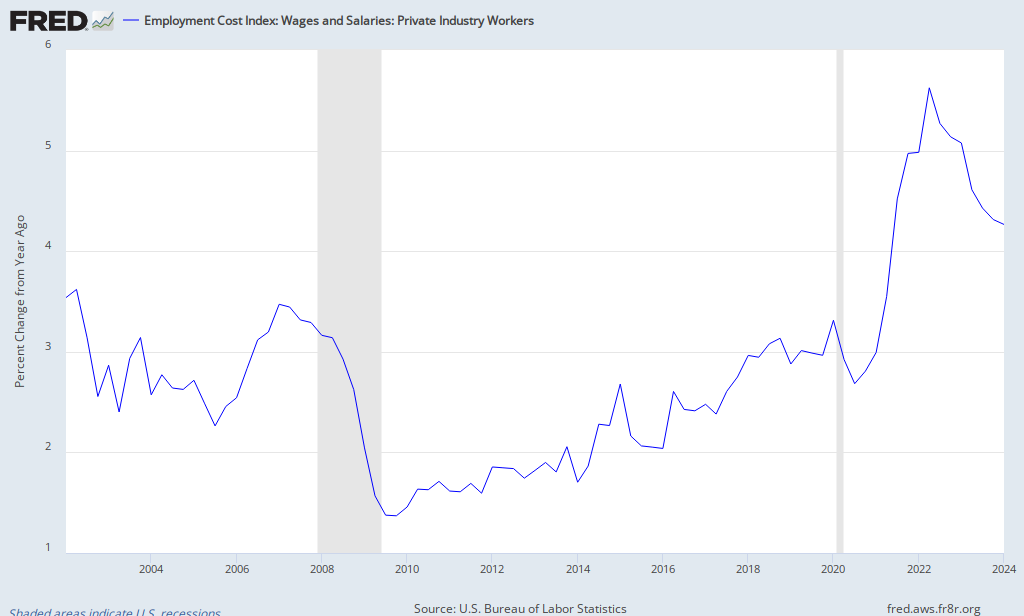
2) US labor remains cheap, which is to say that with high unemployment, American workers can’t keep up with inflation. There may not be any startups creating jobs, but there’s not a lot of reason to fire people, either.

FRED Graph

and

Number One reason not to panic is — Barack Obomba, CIA's bogeyman!

1) Obama’s mismanagement of the economy (health care with a punitive threshold for startup businesses, useless Keynesian fiscal stimulus) is responsible for this mess, and prospective voters are holding him accountable. Obama CAN be beaten in 2012. And a Republican administration with supply-side fiscal incentives for growth could turn the US economy around (not as dramatically as Reagan did, to be sure). Things very well might get better, someday....


Global banksters bare their fangs to sink them into more public property around the world....

June 9, 2011 -- What's behind the global bankers' austerity programs: seizure of public property for corporations...

What lies in store for Greece, Portugal, Spain, Ireland, Italy, and, in short order, the United States, is the wholesale sell-off of public property to private corporations at bargain basement prices. What the schrekers who gather in their secretive lairs at Davos, Cernobbio, Bilderberg, and G8/G20 are bringing about is a world where no property is owned by the state, which by default means the people. Total corporate control over every facet of life equals extreme fascism.

What is occurring is Greece is a bellwether for what will befall other nations in Europe, as well as the United States, if the bankers get their way. And in Greece, the people know how generations of investments by the taxpayers are being turned over to vampire capitalists who have the full backing of the International Monetary Fund, European Commission, and the European Central Bank.

The European and global bankers have demanded that the Greek government sell off entirely or assume a minority stake in a number of state enterprises and utilities.

For example, this year global capitalists are slated to acquire 84 percent of OTE, the Greek telecommunications provider. In addition, private bankers will assume 66 percent ownership of the Greek Postal Savings Bank; 51 percent of the National Lottery; 60 percent of the Salonika Water Authority; 68 percent of DEPA, the natural gas utility; and 25 percent ownership of the ports of Piraeus and Salonika.

Next year, the capitalist grab for public property increases in intensity with Athens International Airport coming under 79 percent private ownership. The global capitalists will also obtain 100 percent ownership of the Egniata toll motorway; 60 percent of Hellenic Post; 66 percent of OPAP, the state-run video-lotto and online sports betting firm; 73 percent of the Athens Water Authority; 83 percent of DEI, the Greek Electric Authority; and 51 percent of the Greek Regional Airports Authority.

The Greek Communist Party has vowed to fight against the acquisition of public property by the private sector. In fact, it is the Communist parties of Europe that have been the most vocal against the power grab by the bankers but their opposition to the privatization moves receives very little attention by the corporate-controlled media.

Massive sell-off lists of public property are now being drawn up by the governments of Portugal, Spain, Italy, and Ireland. In the United States, there are calls for the privatization of the US Postal Service, Social Security, and Medicare.

One Libyan government official this reporter spoke to in Tripoli during an intensive NATO bombing assault, opined that the same fate is in store for the Libyan Socialist Jamahiriya of the old CIA-Puppet Gaddafi. With the highest standard of living in Africa, Libyans could witness the U.S.- and NATO-backed rebel government begin to sell off Libyan government assets to global capitalists. The Libyan official said, "these people [global banksters/Gangsters] would sell the air if they could get away with it."


Lagarde faces tough start as head of IMF....
By Pam Johnson

WASHINGTON - Two days ahead of a formal vote scheduled for June 30, former French finance minister Christine Lagarde became the first woman to be appointed managing director of the International Monetary Fund (IMF) on Tuesday.

Replacing former IMF chief Dominique Strauss-Kahn, who vacated the post in disgrace last month following sexual assault charges, Lagarde surpassed her lone competitor - Mexico's central bank governor Agustin Carstens - to take control of the Washington-based fund's executive board, which oversees operation of the 187-member institution.

Though Lagarde's appointment has been a fiercely contested foregone conclusion for several weeks, Tuesday's 24-member board meeting opened with ostensible uncertainty about the allegiances of key players like the United States, which is responsible for 17% of the fund's US$320 billion resource pool and has thus far remained silent for fear of backlash in a thorny debate of European dominance versus emerging market economies.

The curtain of largely symbolic suspense was lifted earlier on Tuesday when US Treasury Secretary Timothy Geithner threw his weight behind Lagarde, who had also secured assurances from the governor of the People's Bank of China on Monday.

Even before the meeting convened, Lagarde had clinched support from states representing a full 40% of the IMF's voting power.

"I am sure that Lagarde will be a very capable leader of the institution," Carstens said in a statement to the IMF on Tuesday.

"At the same time, I hope that under Lagarde's direction, the IMF will make meaningful progress in strengthening the governance of the institution, so as to assure its legitimacy, cohesiveness, and ultimately, its effectiveness," he said.

Carstens' mild statement of support belied the storm of debate, critique and, at times, open hostility that has surrounded the selection process over the last few weeks, during which economists and organizations from across the ideological spectrum united in their objection to continued European leadership.

"The Obama administration could have stepped up and welcomed emerging powers taking a leadership role in the IMF [but] it chose instead to be quiet about the disenfranchisement of emerging markets and developing countries in this process and jump on the European bandwagon at the very last minute," Raymond Offenheiser, president of Oxfam America, said in a statement following Lagarde's appointment.

Caroline Hooper-Box, acting head of Office and Essential Services Media Lead at Oxfam International, added in a press release on Tuesday, "This farcical appointment process has damaged the IMF's credibility."

"The IMF is badly in need of reform. To protect the institution's credibility, Lagarde will have to act to loosen Europe's stranglehold of the IMF Board, and give others more of a voice.

"She'll also have to decide what to do with the $3 billion the IMF got from selling its gold reserves last year," Hooper-Box said. "This money must be directed to poor and vulnerable citizens in developing countries - the same people who are excluded from IMF decision-making."

Lagarde's appointment coincided with a 48-hour general strike in Greece that has led to riots and clashes with the police as protestors rage against the government's proposed austerity measures', which are to be voted on in parliament on Wednesday.
In order for Greece to secure a $17 billion loan from the IMF - which it desperately needs to pay off a chunk of last year's $142 billion bailout debt - the government is under pressure to increase taxes and cut state spending, moves that will hit hardest on minimum-wage and low-income families' pocketbooks.

However, the fighting on the streets of Athens encapsulates some critics' claims that a European in the driver's seat of the world's most powerful financial institution is the last thing a shattered global economy needs.

Kenneth Rogoff, an economist at Harvard University, last week referred to the IMF as the "commander on the frontlines of the crisis" in Greece, adding to the growing public outcry against Lagarde stepping in as saviour of a crisis that he said her own country helped to orchestrate.

According to Howard Schneider, an economics correspondent for the Washington Post, the Greek rescue has "unraveled" in the past months, leading to a deeper-than-expected recession and possibly necessitating billions more than the $150 billion already provided under the three-year emergency plan last year.

Martin Wolf, the chief economics commentator at the Financial Times, wrote last week: "Did anyone think to themselves that the head of the IMF should be an Asian during the Asian financial crisis of 1991-1998, or a Latin American during the crisis in the 1980s and 1990s?"

"The eurozone is a very special and, in my view, very dangerous construction," he said, adding that according to the IMF's most recent data, the EU's share of global output at purchasing power parity will shrink from 25% in 2000 to 18% in 2015, an "astonishingly rapid" rate of decline.

Meanwhile, World Bank estimates for China's growth in 2011 have shot up from 8.5% to 9% - leading experts to speculate that Europe can no longer afford its patronizing dismissal of the rest of the world.

Offenheiser said: "If the US and EU continue to hold on to power through structures that reflect an obsolete economic and political world order of years past, the rising powers will inevitably turn away from the organization and toward institutions where they do have a voice."


Thursday, June 9, 2011

Nabucco will be backbone of Southern Gas Corridor and will include gas from Iran...

June 2011 56219

Start of construction of Nabucco gas pipeline is planned for 2013 depending on successful negotiations between shareholders and gas suppliers.

The statement came from Christian Dolezal, Head of Corporate Communications and Public Relations Department of Nabucco Gas Pipeline International GmbH, at a Caspian Oil & Gas-2011 conference in Baku.

“Nabucco is a great European project, which will serve as the backbone of the Southern Gas Corridor,” Dolezal said.

"We're open to new shareholders. We are willing to provide safe and comfortable conditions for investors. Nabucco shareholders are also ready to hold talks with the Shah Deniz Consortium," said Dolezal.

He also said that the Nabucco consortium expects to receive gas volumes not only from Azerbaijan but also from Iran in the amount of 10-20bn cubic meters.

"Today, therefore it is necessary to consider the possibility of transporting additional volumes of gas," Consortium official added.

Construction of Nabucco is expected to begin in 2013 with the first flow of gas to be piped in 2017....

http://www.news.az/articles/economy/38135


US Is Nearing Even Worse Financial Crisis, Lack of buyers may force Treasury to boost rates.


US Is Nearing Even Worse Financial Crisis, Lack of buyers may force Treasury to boost rates....

JIM ROGERS,
08 Jun 2011

Fed to end $600B purchase of bonds...

“Do they expect the Chinese to reverse course on their current policy and start heavily buying U.S. debt once again?” asked Peter Schiff, president of Euro Pacific Capital. “That seems extremely unlikely.”

The U.S. is approaching a financial crisis worse than 2008, Jim Rogers, chief executive, Rogers Holdings, warned CNBC Wednesday.

"The debts that are in this country are skyrocketing," he said. "In the last three years the government has spent staggering amounts of money and the Federal Reserve is taking on staggering amounts of debt.

"When the problems arise next time…what are they going to do? They can’t quadruple the debt again. They cannot print that much more money. It’s gonna be worse the next time around."

The well-known investor believes the government won't shut down in August if agreement isn't reached on raising the debt ceiling, but he did say "draconian cuts" are needed in taxes and spending, especially military spending.

"We’ve got troops in 150 countries around the world. They’re not doing us any good, they’re making enemies. They’re costing us a fortune," he said.

Rogers said he is "not long anything in the U.S." and short on American tech stocks. He owns Chinese stocks as well as commodities and would love the world price of silver and gold to come down so he could "pick up the phone and buy more."

He said he owns Chinese stocks, currencies and commodities, adding the Chinese yuan will be a safer currency than the dollar.

"The U.S. is the largest debtor nation in the history of the world," he said. "The debts are going through the roof. Would you keep lending money to somebody who's spending money and not doing anything about it? No you wouldn't."

The pound sterling lost 90% of its value when it was no longer the world's reserve currency, he said, and the dollar will, too. In keeping with his philosophy he said he owns the U.S. dollar and is waiting for a rally. "If it doesn't happen I'll have to sell and take my losses."

He called Federal Reserve Chairman Ben Bernanke a "disaster" who has "never been right about anything" since he's been in Washington. "I hope he doesn't come back with QE3 but that's all he knows. The only thing he knows is to print money."

He predicted that after the Fed ends its quantitative easing program, known as QE2, this month, it may come back under another name.

"They're gonna bring it back because [Bernanke will] be terrified and Washington will be terrified," he said. "There's an election coming in November 2012. Washington's gonna print more money."

Lack of buyers may force Treasury to boost rates.....

The U.S. Treasury next month will go back to relying on the kindness of strangers like never before to purchase the nation's burgeoning debts — and taxpayers may have to pay higher interest rates to attract enough foreign investors, analysts say.

Though a significant rise in interest rates could be toxic for a softening U.S. economy, the Federal Reserve has said it will end its program of purchasing $600 billion in U.S. Treasury bonds as planned on June 30. The Fed is estimated to have bought about 85 percent of Treasury's securities offerings in the past eight months.

That leaves the Treasury, which is slated to sell near-record amounts of new debt of about $1.4 trillion this year, without its main suitor and recent source of support, and forces it back into the vagaries of global markets. Among the countries that will have to step forward to prevent a debilitating rise in interest rates are China, Japan and Saudi Arabia — and even hostile nations such as Iran and Venezuela with petrodollars to invest, according to one analysis.

The central bank launched the unusual bond-buying campaign last fall in an effort to lower interest rates and boost the sagging economy — and it was successful at drawing down long-term interest rates to record lows last winter. In particular, 30-year fixed mortgage rates fell to unprecedented lows near 4 percent and spawned a refinancing wave that helped consumers to discharge debts, purchase homes and increase spending.

But by the start of the year, a pickup in inflation — led by a surge in oil and other commodity prices that some economists blamed on the Fed's easy money policies — wiped out the boon for consumers and home buyers and started to weigh on the economy. With the economy relapsing back to tepid rates of growth around 2 percent, some Fed officials argue that it should continue the easing program, but fear that the commodity boom could turn into a serious inflation threat makes it difficult for the Fed to do so.

Federal Reserve Chairman Ben S. Bernanke said in a speech Tuesday that the Fed remains on track to withdraw from the Treasury market, stressing that the central bank must remain vigilant against inflation at the same time it tries to nurture the economy back to healthy growth.

Not an easy task

The end of the Fed's program would never be easy given the huge onslaught of scheduled Treasury borrowing, but the task will be more difficult because foreign investors in the past six months have been reducing their sizable holdings of U.S. debt, not increasing them.

That means to get those buyers back, the Treasury may have to raise the rates it pays on the debt.

"With the Fed pretty much out of the picture after June, it seems clear that foreign demand for Treasuries holds the key going forward," said David Greenlaw, an analyst at Morgan Stanley. "Continued heavy buying by the largest foreign holders of Treasuries will probably be necessary" to prevent interest rates from rising, he said.

China and Japan remain the largest foreign buyers of Treasury debt, followed by oil exporters such as Saudi Arabia and Qatar. Even oil exporters that are hostile to the U.S. such as Iran and Venezuela have been among the buyers supporting the Treasury in the past, according to Morgan Stanley estimates.

China and many of the oil exporters often channel their investments through London and such offshore investment havens as the Channel Islands, so the origin of the funding is sometimes difficult to track. The uncertainty of where the money is coming from in itself will cause rates to rise and increase volatility in the Treasury market after the Fed exits, Mr. Greenlaw said.

Brazil, Taiwan and Russia also are among the Treasury's major creditors. But many countries have been cutting back on their purchases of U.S. securities in the past six months out of concern about the rapid decline of the U.S. dollar and rising inflation, which hurts their investment values.

Vassillli Serebriakov, an analyst at Wells Fargo, said many foreigners were put off by the Fed's bond-purchase program, which appeared to trigger a foreign sell-off of about $100 billion in Treasury holdings since last fall.

In some countries, the program was portrayed as the Fed "printing money" to finance profligate congressional spending and tax cuts — a charge the Fed vehemently denies.

Still, given the wariness overseas about the Fed's policies and untamed federal deficits, going back to relying on foreign buyers to finance the lion's share of the debt could be tricky, he said.

"The key question is to what extent one can expect the recent deterioration in the long-term capital flows to be reversed," he said.

An undetermined future

Foreign investors have applauded the Fed's decision to end the program as it improves the prospects for keeping a lid on inflation. But they will continue to be concerned about uncontrolled deficits and declines in the dollar that diminish the value of their investments, he said.

"Some of the reduction in Fed Treasury purchases could be replaced by increased demand from foreign investors, but this channel is less certain," he said.

Peter Schiff, president of Euro Pacific Capital, said he does not expect enough foreign or private buyers to step forward and purchase Treasury's huge slate of debt offerings — a potentially catastrophic development that he thinks will force the Fed to backpedal and renew its bond-buying program.

"Do they expect the Chinese to reverse course on their current policy and start heavily buying U.S. debt once again?" he asked.

"That seems extremely unlikely given" that China has been investing less in Treasury bonds partly in response to demands from the United States that it stop skewing trade relations between the countries by hoarding huge surpluses of dollars it earned through trade and reinvesting them in Treasuries.

Mr. Schiff noted that Bill Gross, the head of America's own Pimco bond fund, the largest buyer of bonds worldwide, recently reduced Pimco's holdings of Treasuries to zero out of concern that they weren't yielding enough given the risks of inflation and deficit spending.

"It is not clear what would convince Gross to get back into the market with both feet, but one might expect at minimum it would take much higher interest rates," Mr. Schiff said.

Jeffrey Kleintop, chief market strategist at LPL Financial, said he is not worried about the Treasury finding buyers or about other market disruptions as the Fed pulls back.

"While interest rates are likely to rise modestly, we do not anticipate a spike resulting from the lack of Fed buying that would put the economy at risk," he said.

A failure by Congress and the White House in coming weeks to agree on a plan to curb deficits would be a much bigger problem for the markets, Mr. Kleintop said.

"The budget and debt-ceiling debate may be of more importance since fiscal policy could tighten sharply or a failure to control the deficit could spike interest rates, in either case putting the economy at risk," he said.

US is nearing even worse financial crisis: Jim Rogers.

Lack of buyers may force U.S. Treasury to boost rates.


China in major power dilemmas....


China in major power dilemmas....
By Peter Bosshard

http://www.atimes.com/atimes/China/MF11Ad01.html


While the Three Gorges Dam was under construction, it was celebrated by China's leaders as a symbol of economic and technological progress. With a capacity of 18,200 megawatts, it is the world's biggest hydropower plant and generates about 2% of the country's electricity. Yet since the dam project was completed in 2008, its massive social, environmental and geological impacts have become ever more apparent. At the same time, recurrent droughts have placed a question mark over the project's expected benefits.

On May 18, China's State Council acknowledged the serious problems of the Three Gorges Dam in an unexpected statement. "The project is now greatly benefiting the society in the aspects of flood prevention, power generation, river transportation and water resource utilization," the council maintained, but it has also "caused some urgent problems in terms of environmental


protection, the prevention of geological hazards and the welfare of the relocated communities."

On the same day, the government announced specific measures to improve the living conditions of the people displaced by the dam, protect the Yangtze's ecosystem and prevent geological disasters.

Chinese government officials have admitted the problems of the hydropower project on the Yangtze before. "We thought of all the possible issues," Weng Lida, the secretary general of the Yangtze River Forum, told the Wall Street Journal in August 2007. "But the problems are all more serious than we expected."

Around the same time, senior officials warned that the project had caused an array of ecological problems, including more frequent landslides and pollution, which could result in an environmental "catastrophe" if preventive measures were not taken. So what is new about the State Council's recent acknowledgment? And what does it mean for China's future dam building plans?

For a few years, the massive impacts of the Three Gorges Dam appeared to dampen the Chinese government's appetite for new mega-dams. Several new projects on the Yangtze and Nu rivers were suspended in 2004 and 2009. Representatives of the country's well-connected hydropower bureaucracy complained that this period, during which fewer dams than planned were built, amounted to "wasted years".

In recent months, the imperative of limiting future greenhouse gas emissions has led to the revival of China's ambitious hydropower expansion plans. "We must proceed [with hydropower dams]," an official from the Nu Valley commented in January. "The resources here are too good; not to develop is not an option." In February, the National Energy Administration announced that under China's new Five-Year Plan, the government was going to approve no less than 140 gigawatts of new hydropower projects. This amounts to more than seven Three Gorges dams and is more than any other country has built in its entire history. The energy administration indicated that new dam cascades were to be built on the Nu River, the middle and upper reaches of the Yangtze and its tributaries, and the upper Mekong.

China's National People's Congress adopted the new Five-Year Plan in March, but the plan for the energy sector is still under discussion. Opinions within the government appear to be sharply divided. Pushing back against the dam builders, a senior official in the Ministry of Environmental Protection warned that "hydropower could cause more severe pollution than coal-fired power plants" in terms of ecological impacts, resettlement problems and geological hazards.

In recent years, geological and seismic risks have appeared as a key factor in assessing the costs and benefits of Chinese hydropower projects. The fluctuating water levels of the Three Gorges reservoir have destabilized hundreds of miles of slopes along the Yangtze and triggered massive landslides. Controlling this unexpectedly massive erosion will require additional investments of more than US$10 billion and the displacement of an additional 300,000 people. [1] The devastating earthquake of 2008 in Sichuan province further illustrated the geological risk of building hydropower projects. The quake damaged hundreds of dams and according to scientists in China and the US, may have been triggered by problems associated with a reservoir.

Most of the projects discussed under the new Five-Year Plan would be built in China's mountainous southwestern region, which is marked by numerous active fault lines. At the invitation of environmental organizations, Sun Wenpeng and Xu Daoyi, two senior Chinese geologists, visited the Nu Valley earlier this year and investigated the region's unique tectonic formations.

They found that "the tectonic movement in the Three Parallel Rivers area [of the Nu, upper Mekong and upper Yangtze] is stronger than anywhere in the world" and asked, "how can they build a cascade of dams here?" The scientists noted the frequency of strong earthquakes and massive landslides in the region, and warned that the proposed "Nu River hydropower cascade development may increase the risks of geological disasters." They submitted their findings to the Premier Wen Jiabao, who is a geologist by training.

The massive March 11earthquake and tsunami in Japan, and the disaster at the Fukushima nuclear power plant, raised new questions regarding China's power sector plan. The government quickly suspended the nation's ambitious plans for future nuclear power stations, which seemed to make a further expansion of the hydropower sector all the more inevitable. Yet as the Fukushima disaster unfolded, the risks of building new dam cascades on China's southwestern fault lines could no longer be ignored. Chinese dams already have the world's worst safety record, and the rupture of a large dam would send a tsunami of catastrophic proportions down densely populated river valleys.

In April, Hu Siyi, a vice-minister of water resources, called the risk of earthquakes and other natural disasters the biggest obstacle to dam building in the country's southwest. He acknowledged that the ability of water projects "to resist floods, earthquakes and other natural disasters has become an issue of increasing public concern". This was the hydropower bureaucracy's first recognition of the new risk factors. The recent statement by the State Council also repeatedly refers to the geological impacts of large dams.

In the past, Premier Wen Jiabao has repeatedly intervened to protect rivers from being dammed. In 2004 and 2009, he personally stopped projects on the undammed Nu River from going forward. Discussing the new Five-Year Plan, he commented in an Internet chat that "we must not any longer sacrifice the environment for the sake of rapid growth and reckless [investment]." Wen also chaired the government meeting which issued the recent statement on the Three Gorges Dam. By recalling the project's unresolved legacy, he may have sent a shot across the bow of the zealous dam builders who would happily ignore the lessons of past projects and the seismic risks of China's southwestern region.

Wednesday, June 8, 2011

China warns U.S. debt-default idea is "playing with fire"

Crooked US Lawmakers playing with Fire on the Potomac, together with Ben Shalom Bernanke.....


The idea of a technical default -- essentially delaying interest payments for a few days -- has gained backing from a growing number of mainstream Republicans who see it as a price worth paying if it forces the White House to slash spending, Reuters reported on Tuesday.

But any form of default could destabilize the global economy and sour already tense relations with big U.S. creditors such as China, government officials and investors warn.

Li Daokui, an adviser to the People's Bank of China, said a default could undermine the U.S. dollar, and Beijing needed to dissuade Washington from pursuing this course of action.

"I think there is a risk that the U.S. debt default may happen," Li told reporters on the sidelines of a forum in Beijing. "The result will be very serious and I really hope that they would stop playing with fire."

China is the largest foreign creditor to the United States, holding more than $1 trillion in Treasury debt as of March, U.S. data shows, so its concerns carry considerable weight in Washington.

"I really worry about the risks of a U.S. debt default, which I think may lead to a decline in the dollar's value," Li said.

Congress has balked at increasing a statutory limit on government spending as lawmakers argue over how to curb a deficit which is projected to reach $1.4 trillion this fiscal year. The U.S. Treasury Department has said it will run out of borrowing room by August 2.

If the United States cannot make interest payments on its debt, the Obama administration has warned of "catastrophic" consequences that could push the still-fragile economy back into recession.

"It has dire implications for the economy at a time when the macro data is softening," said Ben Westmore, a commodities economist at National Australia Bank.

"It's just a horrible idea," he said.

Financial markets are following the U.S. debate but see little risk of a default.

U.S. Treasury prices were firm in Europe on Wednesday, supported by a flight to their perceived safety on the back of the Greek debt crisis and worries about a slowdown in U.S. economic growth.

Marc Ostwald, a strategist with Monument Securities in London, said markets were working on the assumption that the U.S. debt story "will go away." But nervousness would grow if a resolution was not reached in the next five to six weeks.

'WOULDN'T HAPPEN'

The Republicans' theory is that bondholders would accept a brief delay in interest payments if it meant Washington finally addressed its long-term fiscal problems, putting the country in a stronger position to meet its debt obligations later on.

But interviews with government officials and investors show they consider a default such a grim -- and remote -- possibility that it was nearly impossible to imagine.

"How can the U.S. be allowed to default?" said an official at India's central bank. "We don't think this is a possibility because this could then create huge panic globally."

Indian officials say they have little choice but to buy U.S. Treasury debt because it is still among the world's safest and most liquid investments. It held $39.8 billion in U.S. Treasuries as of March, U.S. data shows.

The officials declined to be identified because they are not authorized to speak to the media.

Oman is concerned about the impact of a default on the currency reserves of the sultanate and its Gulf neighbors.

"Our economies are substantially tied up with the U.S. financial developments," said a senior central bank official, who spoke on condition of anonymity.

"It just wouldn't happen," said Barry Evans, who oversees $83 billion in fixed income assets at Manulife Asset Management. "They would pay their Treasury bills first instead of other bills. It's as simple as that."

Monument's Ostwald called the default scenario "frightening" and said bondholders' patience would wear thin if lawmakers persisted in pitching this strategy in the coming weeks.

"This isn't a debate, this is like a Mexican standoff and that is where the problem lies," he said.

Yuan Gangming, a researcher with the Chinese Academy of Social Sciences, a government think tank, smelled some political wrangling behind the U.S. debt debate as the 2012 presidential election draws nearer and said Republicans "want to make things difficult for Obama."

But with time running short before the U.S. Treasury exhausts its borrowing room, Yuan said default was a real risk.

"The possibility is quite high to see a default of the U.S. debt, which would harm many countries in the world, and China in particular,".....

U.S. Has Record $61.6TRILLION In Liabilities And Is Borrowing Astonishing $125billion A Month..., rattling the World....


Zombie spending and US debt -- Bill Bonner, Christian Science Monitor

The Economy Is Worse Than You Think -- Martin Feldstein, Wall Street Journal

Greece now has a full-fledged bank run on its hands.

.

By

June , 2011

If Europe didn’t have enough problems, Greece now has a full-fledged bank run on its hands.

Household deposits at Greek banks have dropped in five of the past six months, falling by a total of 12 billion euros ($17.6 billion), according to Bank of Greece data. Two-year deposits tumbled 8% from a year ago in April and savings deposits plunged at a 16% year-over-year clip in March, notes Graham Turner of GFC Economics in London....

It’s not all that’s crumbling....?

The flight of Greek funds overseas will only add to country’s financial crisis, which has Greece on the verge of accepting another bailout from the European Union and the International Monetary Fund.

But while officials may yet succeed in kicking this Hellenic can down the road for another year or two, at the very least the bank run adds unwelcome uncertainty. If enough money flees the country, it could hasten the inevitable restructuring of Greek debt – an outcome the European Central Bank is desperately trying to delay in the name of saving undercapitalized banks on the Continent.

A restructuring “will not be deferred indefinitely if Greek depositors continue to vote with their feet,” Turner writes in a note to clients Tuesday. “They ultimately have the best sense of whether this level of austerity and privatization is sustainable from a political perspective.”

The deposit flight is hardly surprising, considering the dire news coming out of Greece. Talk about its leaving the euro seems far fetched and has been resoundingly rejected by policymakers, but the country’s road back to economic competitiveness is steep indeed.

Wages, as measured by unit labor costs, rose just 7% over the past decade in Germany but soared 50% or so in Greece – meaning that workers there are looking at steep pay cuts indeed if they are to bring the country’s cost structure into line with the region’s so-called core. And that is only a first step in what promises to be a long and punishing economic makeover, assuming the euro zone manages to hold together.

The woes of Greek banks follow a similar tale in Ireland over the past year. There, deposits left the country as it became clear that cleaning up the banking system would cost much more than the government had admitted.

That episode ended with the Irish getting a bailout in return for a horrific austerity program that, in typical bubble-era logic, left the investors who funded the banks’ wrongheaded expansion binge untouched. The investors’ luck is going to run out sooner or later — but it is hard to gauge just when, what with Germany pushing for an extension of Greek debt maturities and the ECB screaming in a near panic, Nothing to see here! Move along!

Such is life when your taxpayer dollars are directed mostly to propping up the edifices of banks that served mostly to enrich insiders when times are good.

For now, that effort continues mostly unimpeded elsewhere in Europe. There is no sign in the data that banking fears are spreading to Spain, which is by all accounts the next big European economy on the hit list, let alone much bigger Italy.

But then, this being the year of the bank run, it is early yet to rule out problems anywhere on the periphery.

“I think Greece is in a league of its own,” says Turner, “but we know there has been significant buying of top end real estate in London by Spanish and Italian investors.” From one house of cards to another, as it were....

Turkmenistan gas boost for Nabucco...?


Turkmenistan gas boost for Nabucco...?
By Robert M Cutler


http://oilgeopolitics.net/Geopolitics___Eurasia/Ankara_in_Calculus/ankara_in_calculus.html


MONTREAL - Figures given in the recent confirmation by British auditors Gaffney Cline that Turkmenistan's South Yolotan gas field is the world's second-largest may themselves underestimate the scale of the field. The auditing firm had estimated in 2008 that South Yolotan contained between 4 and 14 trillion cubic meters (Tcm) with the most likely estimate being 6 Tcm.

Sources in Turkmenistan have lately claimed that the actual high-range figure could be as much as 21 Tcm. This would represent one-tenth of all known gas reserves worldwide, exceeded in quantity only by an offshore field split between Qatar and Iran.

Turkmenistan President Gurbanguly Berdimuhamedow recently noted that developing South Yolotan would require significant foreign investment, but to date China is the only foreign country that has received concessions for onshore fields in the country.

In November 2009, Turkmenistan and China signed a US$4 billion loan agreement to develop the field that would be repaid by gas exports to China. The agreement that the national firm Turkmengaz signed in December 2009 with China to develop the field also had development partners from South Korea and Dubai.

The Chinese partners, State Development Bank and Petrochina, have recently signed another preferential loan agreement with Turkmengaz, likely for a similar amount. Operational wells should be drilled in South Yolotan by the end of next year and plants will be built to take sulfur out of the gas before sending it to China's coast through Uzbekistan, Kazakhstan, and Xinjiang. (See
Gas pipeline gigantism, Asia Times Online, July 15, 2008.)

Berdimuhamedow disclosed last month that work on the domestic East-West Pipeline (EWP) across the country's southern regions is being accelerated, although he did not give a date for its expected completion. Work on the project started in mid-2010 and was originally planned to conclude in mid-2015.

This is significant because the EWP is perfectly situated to take gas from South Yolotan to the country's coast for entry into an undersea Trans-Caspian Gas Pipeline (TCGP), making landfall in Azerbaijan for subsequent transshipment to Europe via the projected 4,040 kilometer, 31 billion cubic meters per year (bcm/y) Nabucco pipeline.

According to Wolfgang Sporrer, regional manager for one of the companies participating in Nabucco, recent delays in reaching an agreement with Azerbaijan over Nabucco are due to the need to synchronize the project's implementation with the timing of gas production start-up in "potential supply countries". Turkmenistan is working with Azerbaijan to create the conditions for making it possible to implement a TCGP project. The current TCGP plan involves a 30 bcm/y capacity pipeline.

In Iraq, Austria's OMV has identified gas from the area around Kirkuk in the north also as a potential supply base for Nabucco.
Nonetheless on Wednesday this week, at a signing ceremony in Turkey, Project Support Agreements will be made official between the responsible ministries of the five transit countries (Austria, Bulgaria, Hungary, Romania, and Turkey) and the Nabucco participant companies (OMV, Bulgaria's old Bulgargaz under a new name, Germany's RWE, Hungary's MOL, Romania's Transgaz, and Turkey's Botas).

These agreements will complete the international-legal framework necessary for project implementation, on the basis of the transit regime and other elements outlined in the Nabucco Intergovernmental Agreement signed in July 2009.
The new documents repeat multilateral government support for the project at a time when those doubting its eventual completion have become more vocal, although there is also a domestic Turkish angle since the ceremony is taking place in the constituency of the country's energy minister just four days before the general elections in the country....

http://www.hermes.uk.com/news-events/hermes-wins-contract-for-ccc-in-south-yolotan-turkmenistan.html

Berdimuhamedow has also underlined his country's continuing interest in the 33 bcm/y Turkmenistan-Afghanistan-Pakistan-India (TAPI) gas pipeline project, which will be sourced not from the South Yolotan deposit but rather from Douletabad. The country does, however, plan to build a connector between the two gas deposits that will enable switching between them.

It was thought that supply and contact negotiations for TAPI would be completed in the first half of this year, but price disagreements with India have prevented that. There is still a long road beyond that, in as much as the various consortia have yet to be established. Many foreign companies have expressed an interest but things have not gotten much further than the Asian Development Bank's detailed feasibility studies. Russia has been discussing with India the possibility of Gazprom's participation in the project.