Showing posts with label India. Show all posts

Monday, July 2, 2012

Balkanization of the Levant, will turn MENA into hundreds of Tribes with Flags and will reach in time, India, Russia, China....


Balkanization of the Levant, will turn MENA into hundreds of Tribes with Flags and will reach in time, India, Russia, China...., All of Africa, and possibly Europe and South America down the line...., that's the deep Siamese twins' real aim since 1995 and the advent of the PNAC/ZIOCONS Killers/murderers....and cowardly Assassins in the employ of Ariel Sharon the Butcher, now a vegetable for 8 years.

http://www.brasschecktv.com/videos/war-is-a-racket-1/the-case-against-moving-forward.html

Russian Foreign Minister Sergei Lavrov and Chinese Foreign Minister Yang Jiechi announced the stances of their countries after a meeting on the situation in Syria at the United Nations office in Geneva on Saturday.

Syria has been experiencing unrest since mid-March 2011. Many people, including security forces, have been killed in the turmoil.

Press TV has conducted an interview with Dr. Webster Griffith Tarpley, an author and historian from Washington, to further discuss the issue. The following is a rough transcription of the interview....

Russia and China say any decision on a transition of power in Syria should only be made by the Syrian people....

Press TV: Looking at the rights record of the participants of the meeting in Geneva, particularly that of the United States, it’s somehow hard to believe that their only concern is of human rights. Can you tell us how a regime change in Syria may benefit every participant in that conference?

Tarpley: The current US policy under the Obama administration with Hillary Clinton in the State Department aims at the destruction of all sovereign states on this planet. It’s really rolling the world situation back to the time before the Treaty of Westphalia in 1648 which established the regime of modern independent sovereign states.

The desperation of the US and the British comes from their financial bankruptcy, and what they’ve got to do is increase the rate of exploitation and looting and sacking of the entire world economy. In the course of this, they find that any national government is an intolerable obstacle. It gets in their way.

It can say no, like Mubarak said no to them on numerous occasions and Gaddafi said no some of the times..., so they decided to smash up these countries. But notice their goal is not just regime change: it’s now microstates; “ministates”, to use the terms of Zbigniew Brzezinski; “partition”, the favorite term of George Soros; balkanization, failed states, rump states, warlords – warlords of the type that we see for example in Libya, and with Lebanon's arch criminal and cowardly assassin of thousands of innocent Lebanese, Samir GEAGEA the thug, who was resuscitated by CIA/MOSSAD in 2005 to play that role for them, a CIA Proxy Militia, just like in the 80s...., and their planning for that killer/murderer's disgusting role started in earnest since 1997 by the cowards in USA and IsraHell....

This is the goal, to have a situation where the International Monetary Fund and NATO rule the world from above but then on the ground you’ve got a kind of crazy court of petty, squabbling, impotent little entities that could never resist Exxon Mobile or JP Morgan Chase or Halliburton or anything of the kind, something, again, like Libya today, and Syria/Lebanon tomorrow, if they succeed, God Forbid, and God avenge the blood of our martyrs.....

That’s where they’re headed to this. It would be for them to break up Syria/Lebanon, to detach the Kurdish part, to detach parts that would be claimed by Turkey, to perhaps start the Lebanese civil war again and the despicable and odious shenanigans of their most infamous White House Murder INC, perhaps there would be a continuous civil war in Syria, perhaps Israel will start helping itself to various tracts of territory, and so on down the line. So that’s where this is going. It’s very sinister.

Press TV: Taking a look at the situation on the ground, for how long do you think Assad and the Assad administration in general will be able to absorb such huge pressure and stay in power?

Tarpley: I think indefinitely. I think for a very long time. Assad’s holding power may turn out to be greater than the holding power of the coalition that is against them. This of course depends on Russia and China maintaining their current blocking position in the Security Council.

Hillary Clinton, after that tirade, that outburst that we just heard, her hysterical plan is to go back to the Security Council and to try once again to get a Chapter 7 resolution through the Security Council, and that would include draconian economic sanctions and it will eventually lead them to an armed attack, a no-fly zone – meaning bombing, humanitarian corridors, buffers zones and so forth. That will be a massive attack on Syria.

There is no indication that Russia will go along. Lavrov, leading the proceedings today, said the important thing is that nothing has been imposed. When we look at this empty formula that they’ve come up with, it’s a kind of face-saving piece of rhetoric or boilerplate for all of them.

On the one side, Assad and his government have said we will not accept a solution dictated by foreigners; that’s sound policy.

Then we have the Syrian National Council, always helpful in this way, they say they will never negotiate with Assad because Assad has blood on his hands.

We’re finding out right now thanks to the Frankfurter Allgemeine in Germany, the big conservative paper in Frankfurt, that it was the Free Syrian Army that carried out the Houla massacre not Assad, not the Syrian army, but rather these bloody NATO death squads that have been brought in which Hillary Clinton is supporting – and Hague and Fabius and the rest of these people. Indeed, Kofi Annan, the hypocrite, is nothing but a front man for essentially these death squads.

Press TV: There is talk of a coalition government, and you pointed to it briefly, but how likely will this coalition government be formed and just how much will Assad agree to it?

Tarpley: There have been elections. That’s another one of these sort of Orwellian features in these proceedings. There have just been elections in Syria in which more than 50 percent, I’m not sure exactly how many but by all indications more than half of the people who were registered to vote have voted, and there were opposition figures.

Not everyone elected in those elections was from the Ba’ath Party. Of course, the Syrian National Council, the group of adventurers who like to live in expensive hotels and make pronunciations to the four points of the compass, they always say they won’t negotiate. Why would they? They’ve been living high on the hog the way it is.

There have been elections where you didn’t have to be a member of the Ba’ath Party. Full elections have been held but Kofi Annan said ‘those are not good enough, that’s not what we mean.’

Well, what do you mean then given the fact that the Syrian Free Army, the Syrian National Council said they won’t participate in elections? They are the ones who are intractable and the guilt of the crisis goes to them. I think Assad, the Head of the Mafia of assassins for hire, who previously worked for the infamous White House Murder INC, and the evil Siamese twins CIA/MOSSAD in the Levant since January 24th 2002...., can hold out for quite a while....

Balkanization of the Levant, will turn MENA into hundreds of Tribes with Flags and will reach in time, India, Russia, China....that's the real Siamese twins' real aim since 1995 and the advent of the PNAC/ZIOCONS murderers....

Beesley asks the rhetorical question in 1921 that a Roman citizen might have asked in 70 BC, 'The hour for reform was surely come. Who was to be the man?'

And so, seemingly, here we are again.

Universal degeneracy of the Government, and decay of the nation....

Everywhere Rome was failing in her duties as mistress of the
civilised world. Her own internal degeneracy was faithfully reflected
in the abnegation of her imperial duties. When in any country the
small-farmer class is being squeezed off the land; when its labourers
are slaves or serfs; when huge tracts are kept waste to minister to
pleasure; when the shibboleth of art is on every man's lips, but ideas
of true beauty in very few men's souls; when the business-sharper is
the greatest man in the city, and lords it even in the law courts;
when class-magistrates, bidding for high office, deal out justice
according to the rank of the criminal; when exchanges are turned into
great gambling-houses, and senators and men of title are the chief
gamblers; when, in short, 'corruption is universal, when there is
increasing audacity, increasing greed, increasing fraud, increasing
impurity, and these are fed by increasing indulgence and ostentation;
when a considerable number of trials in the courts of law bring out
the fact that the country in general is now regarded as a prey, upon
which any number of vultures, scenting it from afar, may safely
light and securely gorge themselves; when the foul tribe is amply
replenished by its congeners at home, and foreign invaders find any
number of men, bearing good names, ready to assist them in
robberies far more cruel and sweeping than those of the footpad or
burglar'--when such is the tone of society, and such the idols before
which it bends, a nation must be fast going down hill.

A more repulsive picture can hardly be imagined. A mob, a moneyed
class, and an aristocracy almost equally worthless, hating each other,
and hated by the rest of the world; Italians bitterly jealous of
Romans, and only in better plight than the provinces beyond the sea;
more miserable than either, swarms of slaves beginning to brood
over revenge as a solace to their sufferings; the land going out of
cultivation; native industry swamped by slave-grown imports; the
population decreasing; the army degenerating; wars waged as a
speculation, but only against the weak; provinces subjected to
organized pillage; in the metropolis childish superstition, whole sale
luxury, and monstrous vice.

The hour for reform was surely come. Who was to be the man?

A.H. Beesley, The Gracchi Marius and Sulla, 1921....

Thursday, April 26, 2012

India, Pakistan boost trade ties...


India, Pakistan boost trade ties...
By Robert M Cutler

MONTREAL - India's decision last week to lift its ban on foreign direct investment (FDI) from Pakistan, the only country from which it had barred such investment, is unlikely to create a rush of cross-border spending but will create the circumstances for Pakistani businessmen to begin investigating possibilities.

The ban was imposed under India's 1999 Foreign Exchange Management Act, which now requires amendment for the announced intention to be implemented. The flow of Indian FDI into Pakistan, meanwhile, will likely be slowed by uncertainty over the political situation there.

A Pakistani trade fair was recently held in New Delhi, and Indian industrialists and government circles are discussing the possibility of energy exports (electricity and oil) across the border. Also, the Reserve Bank of India and State Bank of Pakistan have been talking to one another and exploring the possibility of opening branches in each others' countries.

This week, India's External Affairs Minister S M Krishna said that a "liberalized visa agreement" was likely to be signed between the two countries next month. It would provide for easier travel and visa procedures for businessmen, such as a one-year multiple-entry visa, as well as facilitate resolving humanitarian issues, such as divided families and attendance at weddings and funerals.
Pakistan, for its part, is now ready to give India most-favored-nation (MFN) trade status. This means that the trading partner so designated receives treatment no worse than the best treatment received by any other trading partner. Pakistan will implement this as soon as India completes the dismantling of non-tariff barriers that restrict imports from Pakistan.

The developments follow Pakistani Commerce Minister Makhdoom Amin Fahim's trip to India last September, the first such visit in 35 years. Anand Sharma reciprocated, becoming the first Indian commerce minister in 64 years to visit Pakistan; 120 top Indian businessmen accompanied him. Agreements reached during the exchange of visits are now in the process of being implemented. The possibility of setting up a bilateral co-chaired business council has been bruited.

Current bilateral trade is only US$2.7 billion per year, mainly in the base metals, chemicals, electronics and machinery sectors. The sides have engaged to double this figure in the next two years. According to one study, it could more than triple by 2015 if all non-tariff barriers were removed along with tariff barriers.

As much as $10 billion of trade, however, is conducted between them illegally, routed mostly through Dubai in the United Arab Emirates but also through Singapore. It is expected that this commerce will now be legally routinized, as the decline of transportation costs will outweigh any tariff advantages offered by the black and grey markets.

The only crossing-point for trade between the two countries, at the Wagah-Attari border for the Amritsar-Lahore road (a 54-kilometer trip that takes over an hour by car), will soon open a new gate dedicated for commercial traffic. A Mumbai-Karachi sea route is a long-term option for increasing trade if funding can be found for investment in the significant modernization and development of facilities that would be required.

The potential long-term results of the improvement in bilateral trade relations could be nothing less than transformational. Commerce Minister Sharma has mentioned favorably a proposal for a South Asia-wide power grid for sharing electricity. This would further boost trade in what is the least-integrated region in the world in intra-regional terms: trade among the members of the South Asian Association for Regional Cooperation (SAARC, including also Afghanistan, Bangladesh, Bhutan, Maldives, Nepal and Sri Lanka) accounts for less than 5% of their total international trade.

By contrast, that percentage is over five times greater among the 10 members of the Association of Southeast Asian Nations, flung out over the map from Myanmar to Indonesia and the Philippines and with less than half SAARC's total population but over two-thirds its gross domestic product.

Afghanistan and Pakistan already have a transit trade agreement, while Afghanistan and India have a strategic partnership and both sides have advocated that Afghanistan become a trade hub between South Asia and Central Asia.

The Turkmenistan-Afghanistan-Pakistan-India (TAPI) gas pipeline project is a potential element in such a stabilization. A rail link over the border between Turkmenistan and Afghanistan is already being modestly expanded.

The facilitation of India-Pakistan trade could further regional stabilization in the longer term, again if funds can be found for transnational infrastructure investment and the security situation in both Afghanistan and Pakistan is stabilized.

Elite opinion in India and Pakistan is favorable to continued improvement of economic relations and recognizes fully how this might contribute to the resolution of outstanding political problems, not excluding Kashmir.

Dr Robert M Cutler (
http://www.robertcutler.org), educated at the Massachusetts Institute of Technology and The University of Michigan.

Monday, March 19, 2012

India, Africa aim for $90 billion trade in three years...


India, Africa aim for $90 billion trade in three years...


NEW DELHI: Indian and African leaders on Sunday agreed to sharply increase bilateral trade to $90 billion by 2015 as the two sides discussed potential deals.

The South Asian country is aiming to boost its trade and diplomatic ties with Africa where China has already made major inroads by striking multiple deals, building infrastructure projects and offering soft loans.

The goal of achieving $90 billion in trade between India and China in three years "is a significant improvement, considering the fact that a decade ago the trade was $3 billion", Indian Commerce Secretary Anand Sharma said.

Sharma was speaking at the first day of a three-day India-Africa meeting in New Delhi where organisers said more than 250 projects worth close to $30 billion were being discussed.

Over 600 African delegates are participating in the India-Africa Forum Summit, organisers said, while over 500 Indian business delegates would also attend the meeting.

India has been turning to the one-billion-strong African continent as it looks to diversify its energy sources and reduce its dependency on the Middle East which supplies two-thirds of its energy imports.

Africa, despite being home to most of the world's poorest countries, is richly endowed with oil, minerals and other natural resources.

Last year, the two sides had set a target of $70 billion trade to be achieved by 2015. Bilateral trade totalled $62 billion in 2011.

At the meeting, the ministers launched the India-Africa Business Council to be co-chaired by Indian telecom czar Sunil Bharti Mittal, head of Bharti Group, and Dangote Group president Alhaji Aliko, known as Africa's "cement king".

The council will propose ways to increase economic and commercial ties between India and Africa.

While China prefers government-to-government deals, Indian investment has been mainly in the private sector, notably in telecom, pharmaceuticals and manufacturing.

In a major purchase, Bharti, India's biggest cellular operator by subscribers, acquired mobile operations in more than a dozen African countries in a $10.7-billion deal in June 2010.

India, which deployed its navy in 2008 as part of an international armada fighting piracy in the Indian Ocean and the Gulf of Aden, is also ramping up its security links with Africa....


Tuesday, January 10, 2012

India, rudderless rule and chronic corruption....


Collision of political, economic logic condemns India to rudderless rule and chronic corruption....

By RAMESH THAKUR

India's economy grows mainly in the night, some say, when the government is asleep. If every economic prospect pleases, India's politics can be vile.


Prime Minister Manmohan Singh flattered in his first term only to deceive in the second. His government has been drifting rudderless, with critical institutional reforms shelved, deflected and rejected.

Two recent events confirm that all the hype notwithstanding, India remains a Third World country with delusions of global grandeur.

On Dec. 9, a fire in a state-of-the-art private hospital in Kolkata killed more than 90 people, mostly patients. The high death toll was due to the unprofessional management practices and governance arrangements.

Just the week before, Singh's government had buckled under fierce pressure from coalition allies and the opposition and postponed the long-awaited opening of the retail sector to foreign investment and international competition. The losers will be the Indian consumer and economy. A complacent India risks sleepwalking its way back to irrelevance.

As 2012 begins, India confronts multiple crises of slowing growth, falling investment, rising inflation and widening inequality. Deregulating the retail sector should have been the opening salvo in the assault on big-ticket items in India's badly stalled economic reform.

Instead, India's dysfunctional politics has been highlighted with the centers of power in the ruling government and party out of alignment, opportunistic and ideological opponents of economic reform emboldened, foreign investors disenchanted and citizens confused.

Eight sets of political considerations threaten to derail India's manifest destiny despite economic indicators trending north.

(1) As Norman Lamont famously said of John Major, Singh is in office but not in power. Party supremo Sonia Gandhi wields power behind the scenes without responsibility or accountability for government policy and performance. After the 2004 elections, Gandhi could have become prime minister with a credible claim to have received the people's mandate but offered the post to Singh. He thus began without independent political authority. Those with political ambitions attached themselves to Gandhi, sometimes even to the extent of disrespecting Singh.

(2) Singh was handicapped by being a nominated member of the Upper House. Never having been elected by the people, he lacks the core skills of a political leader and the means of engaging with constituents to check the pulse of politics. Sometimes he seems to lack the stomach for wheeling and dealing and brokering agreements among different factions and interests.

Singh helped to improve his party performance's in the 2009 elections. But even then his capacity to assert himself as prime minister was circumscribed by his age, the very firm grip of Gandhi on the party, and the palpable expectation that he was but a "seat-warmer" for heir-apparent Rahul Gandhi. The latter has had opportunities aplenty to show political leadership skills, but to date has either failed to seize them or, in some instances, performed such as to feed rather than settle doubts about his ability to lead the country.

(3) Democratic governance gives a human face to structural adjustment policies and facilitates the achievement of the necessary social compromises between capital and labor, efficiency and equity, and growth and equality. Even while conferring political legitimacy, democracy greatly complicates the government's capacity to make and enforce tough decisions.

(4) The legitimacy of India's political democracy is being corroded with the criminalization of politics and the capture of parliamentary representation by kith and kin of incumbent lawmakers. Because of the notoriously slow judicial process, indicted Members of Parliament rarely face imminent conviction that would disqualify them from office.

Should India legislate quotas for women in Parliament, most likely they would be filled by the wives, daughters and daughters-in-law of sitting MPs.

(5) Pandering to religious and caste minorities has become deeply embedded in Indian politics, with the result that caste identity is more firmly entrenched with every passing year. Most parties treat minorities as ATMs for collecting votes.

(6) Corruption corrodes the legitimacy of the political system. Although Singh is an honorable exception personally, his tolerance threshold for corrupt Cabinet colleagues has been high.

(7) The reality of coalition politics has shrunk Singh's political space. Since 1989, the federal government has been either a minority or coalition government, dependent for continuance on the support of a number of minor parties whose political base rarely extends beyond one province or region and whose competence and probity is suspect.

In his recent visit to Dhaka, Singh let slip a historic opportunity to upgrade bilateral relations and reward a Bangladeshi prime minister who has put her political credibility on the line by risking good relations with her giant neighbor.

Why? Because, just two days before the scheduled visit, coalition ally Mamata Banerjee, head of the West Bengal government, rebelled against the carefully negotiated Teesta River package.

(8) While China uses political control and the heavy hand of the state to forestall and suppress all challenges and uprisings, India's conflict resolution tactic of choice is procrastination and indecisiveness to ride out and exhaust insurgencies and popular movements. The pace of events and the scale of expectations-cum-demands are such that the strategy no longer works. It was tried without success in response to the demand for a separate state of Telengana to be carved out from present-day Andhra Pradesh.

The tactic was a spectacular failure with respect to the social activist Anna Hazare-led movement for curing the country of the cancer of corruption and the government suffered the very public humiliation of having to back down completely.

The activism by India's highest judiciary as well as civil society movements like Hazare's have gained traction because of the policy and governance vacuum at the heart of the Singh government. The BJP might well show a progressive, modernizing face if and when it returns to government. But in opposition, it has been fierce and ruthless in relentless negativity: Partisan politics trumps good policy.

The cumulative impact of the several factors does not inspire confidence that the political system will acquire the capacity to make and implement the necessary decisions within the required time. This will be the case especially if both major parties continue to choose septuagenarian and octogenarian leaders.

Given the youth bulge in the demographic profile, India's people deserve better. Then again, India has an unmatched record of looking opportunity firmly in the eye, turning its back, and walking off resolutely in the opposite direction....

Thursday, October 27, 2011

India, China in line for Afghan mine, oil contracts....


India, China in line for Afghan mine, oil contracts....

LA HULPE, Belgium: Indian and Chinese bidders are front-runners for deals to mine Afghanistan’s vast iron ore and oil deposits, the country’s mining minister said on Wednesday, worrying Western firms who have hesitated to invest in the war-torn region.


Afghanistan is estimated to harbour up to three trillion dollars in mineral wealth from gold, copper, iron ore and precious stones to oil, gas and rare earth minerals.

Such riches have attracted risk-friendly investors despite security concerns as Western governments prepare military pull-outs, in particular from India and China where demand for energy and industrial inputs is booming.

Two Indian bidders have emerged as “the most potential companies” among a short list of six to win a contract for the vast Hajigak iron ore project in early November, Afghan Minister of Mines Wahidullah Shahrani told Reuters on the sidelines of a mining conference in Belgium.

One of the bidders is an independent company and one a consortium that includes India’s powerful Mittal family, he said.

An oil and gas contract in northern Afghanistan’s Amu Darya field will most likely go to a Chinese bidder in early December, Shahrani said.

“Those companies that get into Afghanistan early will have good opportunities,” the minister added.

EU firms cannot compete....

Asian investors are threatening to dash long-term hopes of Western firms holding out for greater safety and business transparency before putting funds into a country with vast raw materials reserves. The investments are also provoking criticism that India and Chinese governments give guarantees to their private firms, unfairly aiding their bids.

“At the front these bids are private but behind them is government funding,” Ramon Mushrief, Interim President at the newly opened European Union Chamber of Commerce in Afghanistan, told Reuters.

“These companies can afford to take risks that European companies cannot. And there is nothing we can do,” he added.

No Indian or Chinese investors were present at the conference to comment.

Transparency....?

Afghanistan has promised legal and fiscal reforms to attract foreign investment that will help develop industry and eventually wean the country off foreign development aid.

The World Bank, investment funds and European and US executives on Wednesday called on Kabul to implement governance and fiscal reforms. They warned that lax laws could foster corruption and stop the benefits of mineral wealth reaching a population in need of steady jobs and income.

International resource activist group Global Witness reserved particular criticism for Afghanistan’s practice of publishing details of mining contracts only once they have been finalised.

“The extractive sector requires the early and full assessment of its impact…contracts made public before they are signed,” said Global Witness Director Patrick Alley.

Afghanistan will publish in mid-2012 details of a copper mining contract that has gone to a Chinese consortium — but only once subsidiary agreements have been completed, Shahrani said.

EU-Afghanistan agreement in sight...

In the absence of immediate large investments, the EU wants to sign a treaty with Afghanistan to formalise diplomatic, human rights, trade and investment relations and lower the risk of a security vacuum as international troops withdraw from the country.

EU Special Representative for Afghanistan Vygaudas Usackas, also attending the conference, told Reuters the EU will start talks for such a treaty before an international conference on Afghanistan’s future taking place in Bonn, Germany, on December 5.


Tuesday, August 2, 2011

India, Iran Oil Impasse....


India, Iran Oil Impasse....?


by Kandaswami Subramanian

When the Reserve Bank of India (RBI) decided in December last year to disband the Asian Currency Union (ACU), which provided a smooth window to pay for the supply of oil from Iran, it would not have been prepared for the impasse it would create, not only for oil payments, but also, at the end, for the supply itself. After seven months of agonizing uncertainties over supplies, contentious debates and disputes between Indian and Iranian authorities over alternative arrangements for payments, the issue remains unresolved. Each day it gets buried under diplomatic shrouds. There is a continuing opacity on the direction of India Iran relations. Too many questions arise.

It is unclear why the ACU was abandoned. Indeed, it was a precipitate decision. There is evidence that it was done under pressure from the U.S. authorities as a part of the bargain underlying India-U.S. civil nuclear agreement. Needless to say, this has been strongly denied by the spokespersons of the Ministry of External Affairs the timing was significant as it was done within days after the visit of President Barrack Obama to India. Major western papers like the Wall Street Journal and New York Times celebrated the decision as one supportive of U.S. led sanctions against Iran.

It is also clear that Indian authorities did not hold prior consultation with Iranian authorities before snuffing the ACU mechanism. Iranian authorities continue to harbour a grudge against India and feel that the ACU should not have been shut down. The present writer had examined these issues at length in two earlier articles.[i]

It is unclear whether the concerned Ministries – Ministry of External Affairs, Ministry of Finance and the Ministry of Petroleum & Natural Gas – and the RBI had weighed in the consequences of the abrupt decision to shut down the ACU without working out an alternative arrangement to ensure timely payments for oil supplies. Apparently, there was none. Perhaps, they had misjudged and assumed that an alternative payment system could be established without much difficulty to replace the ACU. This assumption was egregious.

To be fair, they could be given the benefit of doubt if we studied the efficacy of US-Iran sanctions as they operated around that time. During those years, it was possible for many countries and companies to circumvent sanctions through covert arrangements or through currencies other than the U.S. dollar or the Euro. A study by the Institute for Defence Studies and Analyses (IDSA) [ii] referred to this record. It said, “Despite years of sanctions, several countries appear undeterred from doing business with Iran, particularly in the energy sector. This is partly due to lack of punitive action on the part of the US through waivers.” Truly they were gaping waivers and, as reported by the New York Times in an article[iii], there were over 10,000 waivers. Some of the officials of MEA and Finance also referred nonchalantly to the possibility of arranging remittance through other countries such as those in the Gulf and other currencies such as dirham or Yen. These assumptions were unrealistic and had not reckoned with later developments.

Broadly, there were two major developments working against Iran and its partners like India. The first and the more important one was that the U.S. was tightening the sanctions virulently against Iran, especially with the adoption of U.N. Security Council Resolution 1929 on June 9, 2010, the emphasis of U.S. measures has been to target Iran’s energy sector and to isolate that country from the international financial system. The Iran Sanctions Act (ISA) was expanded with the passing of the Comprehensive Iran Sanctions, Accountability, and Divestment Act of 2010 (CISADA, P.L.111-95).[iv] The expanded Act seeks to curtail additional types of activity such as selling gasoline and gasoline production-related equipment and services to Iran and to restrict international banking relations with Iran.

Under executive powers vested in the Act any foreign bank dealing with Iran could be denied correspondent or other relations with U.S. banks. With its hegemony in the financial market, it would be possible for the Treasury to ban all banking transactions for any designated party. A division in the U.S. Treasury working under a Deputy Secretary was keeping a watchful eye for suspects. A U.S. bank on banking would deny the concerned country access to dollar or remittance through dollar.

The other major development was that the U.S. could exert pressure on the members of the E.U. and resolve the differences that had plagued their relations over the scope and contents of sanctions for a long time. As narrated by Patrick Clawson of United States Institute of Peace in a blog [v] “A few years ago European governments were reluctant to forego business opportunities with Iran and the State Department seemed inactive on the sanctions front-in contrast to activism by the Treasury Department.” In a meeting held in Brussels on 23 May 2011, EU foreign Ministers agreed to go along with the U.S. As Patrick Clawson added, “Now the United States and Europe seem to be on the same page of tougher sanctions.”[ vi] The EU added more than 100 new entities to a list of companies and people affected by EU sanctions. They included new asset freezes; visa bans and a range of financial trade sanctions. The most important inclusion in the ban list was the notorious Europaisch-Iranische Handelsbank A.G. (EIH).

The EIH was the temporary window India resorted to as an option to arrange payments to Iran. When it was evolved, it was treated as a diplomatic tour de force. In an earlier article [vii], I had doubted the wisdom of doing it and, especially, its sustainability. It made our energy security dependent on Germany and its complex diplomatic relations with the U.S. No wonder, it was short-lived and had to be given up in two months. The German Chancellor Angela Market abruptly terminated it. When she took the decision, the background was not wholly clear. But the EU meeting of May referred to earlier and the growing convergence of policies over Iran sanctions between the U.S. and E.U. told the full story. With the damning of the EIH as a conduit, the Indian situation vis-à-vis Iran turned rudderless.

News reports that have been covering this area from time to time suggested how the Government of India and the RBI were trying to work out several alternatives to sort out the payment problem. In the early months government officials used to say, “We are looking at option such as the euro and are trying to identify banks that could be used for receiving and making payments.” Petroleum Secretary sounded optimistic when making such statements. Sadly, by then the sanctions noose had tightened and all the loopholes had been plugged. The U.S. Treasury was keeping track of payments flows, their routes and methods. It had the full cooperation of OECD countries, which controlled the global financial markets through their banks. The RBI would have become more circumspect with its relationship with other central banks. Global codes on controlling terrorist financing did bind the RBI. Unfortunately, it was the U.S. Treasury, which was in the driving seat in all these matters. Thus, the efforts to seek alternative currency routes had to be abandoned.

Iran or rather the National Iran Oil Company (NIOC) continued to supply oil to Indian refineries even when payments in convertible currency were not made. As a short-term device payments were made in rupees to a joint account in the hope that the payment issue could be resolved soon and the amounts remitted to Iran. It is to the credit of Iranian authorities that they continued to maintain the supplies even when payments were delayed. However, contrary statements began to fly and Iranian officials made repeated assurances that oil supplies would not be cut.

One of the options examined was to arrange payments in rupees to Iranian account with banks in India. The idea was that the rupee could be used by the Iranian government for certain limited purposes. There were reports that a paper for the Cabinet was being submitted. This was not pursued as the RBI had cautioned against the risks attached to such a method. Monthly payments to Iran work out to $1 billion. It would create tremendous banking and liquidity problems and create financial instability. The idea was given up. The idea would not be palatable to Iran in any case. Iran is in need for of finances for its own survival and its needs money for both exploration and revamping its refineries. It can ill afford to get its money blocked in India. Further, it needs payments in foreign exchange to be able to maintain the strength of its own currency, rial.

Yet another idea pursued was to work out bilateral trade with Iran. However, the odds are loaded heavily against India. Oil payments to Iran work out to @12 billion per annum. Indian exports are estimated at one tenth of it, estimated at $1.85 billion in 209-10. Indian exports consist of coffee, cereal, iron & steel, chemicals, pharmaceuticals, rubber and chemicals. There is scope for exporting railway equipment. There was no way by which Indian exports could be stepped in the short run to match imports from Iran.

While on this issue, it is interesting that China and Iran are said to be in talks over a barter system to exchange Iranian oil for Chinese goods and services. A recent report in Financial Times [viii] has made waves and has been carried in many other papers and news sites. The report suggests that US financial sanctions have blocked China from paying at least $20 billion for oil imports. China and Iran’s bilateral trade was around $29.3 billion last year and is growing. They have several infrastructure and collaboration agreements that will bring about Chinese investments in Iran and Iran would export large quantities of chrome ore to China. As the report summarises: ”Unlike India, which exports almost nothing to Iran, China is dominant in Iranian business and could use as barter system to balance trade between the two countries.” It is not surprising that India could not pursue the barter route to balance its trade with Iran.

Even as Indian authorities were struggling to resolve the impasse, the Iranians were losing their patience. From early July this years there were reports that Iran had set August 2011 as a deadline for India to pay its outstanding debt on the oil account. It was estimated at $5 billion. (Recent reports raise it to $9 billion.) NIOC was said to have issued the warning on July 1 saying “if India did not find a way to pay the price of the oil it has purchased from Iran over the past two years, Iran will stop sending more oil to India as of August 2011.” The Wall Street Journal also carried a report on this warning. [ix] What was more significant was its reference to Indian refineries making efforts to secure oil from other sources like Abu Dhabi, Saudi Arabia, Kuwait, etc.

Reuters carried a more detailed report [x] on the efforts being made by India to maintain supply lines and how India saw no shortage. BPCL, HPCL and ESSAR did not receive allocation for August from Iran. However, they confirmed that they were in talks with Saudi Arabia, etc and had been assured of supplies.

Iran’s foreign Ministry spokesman Ramin Mehmanaparasat said on July 19 that his country would cut crude oil supplies to India from August in view of undue delays on the part of the Indian government to work out appropriate mechanism to settle outstanding payments for imports. This was a day before the visit of Secretary Hillary Clinton to India. Perhaps the intention was that India would take up the matter with the visiting Secretary. If so, he had miscalculated. An official accompanying Hillary Clinton said that a solution to a seven-month long payments issue between India and Iran over crude supplies was in sight, after six months of work with the United States. In fact, similar intriguing statements had emerged earlier from U.S. sources. The true import of these statements was not known then. It is becoming more and more evident now. U.S. will bring in Saudi Arabia to check the oil muscle of Iran. It suits the strategic objectives of the U.S. and the Saudi Kingdom.

In recent years, Saudi Arabia has taken steps to strengthen its political and economic ties with Asia’s growing economies. The Delhi Declaration that was issued in January 2006 after the visit of the Saudi Monarch laid down the contours of strategic objectives between the two countries as analysed in one of the SAAG Papers[xi]. This was followed up later during the visit of Dr. Manmohan Singh to the Kingdom of Saudi Arabia in March 2010 leading to the signing of Riyadh Declaration. As analysed by Aaron Mattis [xii], “These petropolitical partnerships are key to Saudi Arabia’s efforts to contain Iran’s political influence and military growth, especially its nuclear program. Through oil diplomacy, Saudi Arabia hopes to sap Iran of important regional partners, a diplomatic coup the United States and other Western national have so far failed to achieve.” And “Saudi Arabia the only country that produces more oil than Iran, is determined to eliminate Iran’s geopolitical trump card.”

It is not surprising that the U.S. has been egging on the Kingdom to pursue these objectives to neutralize Iran’s clout derived from oil supplies. At the urging of Hillary Clinton the Saudi Foreign Minister Prince Saudi al-Faisal assured China that the Kingdom would meet China’s energy needs if it stops importing from Iran.

Given this background, it is now easier to understand the statements the State Department official made during the visit of Hillary Clinton to India. They will convince the Saudis to fill the void created by the Iranians.

The groundwork for increased supplies was indeed created by the Saudis during the last OPEC Meeting held in June. It was a momentous when Saudi Arabia was isolated. As reported by Bloomberg[xiii] it was the first time in at least 20 years of its history. The meeting ended with no decision and even the Libyan representative with its government in disarray voted against any increase in quota. Saudi Arabia was the solitary member to plead for an increase. It had good economic rationale such as that higher prices would depress growth and demand for oil. More importantly, it was keen to fulfill its strategic objectives to ensure supplies to countries like India subject disruption threats from Iran. For the U.S. there is the additional objective: its own attempts to stifle Iran’s economic capacity will not be achieved unless adversely affected countries get their energy needs vital for their growth and survival.

Perhaps, Saudi Arabia has acted at the behest of the U.S. It is difficult to assess how long this alliance with Saudi Arabia will last. Given the disturbed conditions in the Middle East and the other vulnerabilities of the Kingdom, it may offer temporary relief. However, it drives us deeper into the U.S. fold.

(The writer is a Former Joint Secretary, Ministry of Finance, Government of India)

[i] Change in payment procedure of Asian Currency Union to Supplies from Iran: Implications at http://www.southaisa analysis.org/papers44/paper4328. More on Change in Payment Procedure of Asian Currency Union to Supplies from Iran: Implications at http://www.southasianalyisis.org/papers44/paper4338.html.

[ii] Shebonti Ray Dadwal and M. Hahtab Alam Rizvi: US Sanctions on Iran and tier Impact on India, June 21, 2010, IDSA Issue Brief

[iii] Jo Becker, US Approved Business with Blacklisted Nation, New York Times, December 23, 2010.

[iv] Kenneth Katzman, Iran Sanctions, Congressional Research Service Report, June 22, 2011.

[v] Patrick Clawson, Escalating sanctions on Iran, June 3, 2011 at http://iranprimer.usip.org/blog/all/Patrick Clawson

[vi] Ibid.

[vii] Subramanian, K: The sad demise of India-Iran payments system, South Asia Analysis Group, Paper No.4423, 12-Apr-2011 at http://www.southasiaanalysis.org/paper44/paper4423.html

[viii] Financial Times, China and Iran plan oil barter, July 24, 2011 at http://www.ft.com/intl/cms/s/2082e954-b604-1e0-8be4d-00144feabdc0.html.

[ix] India Looks Beyond Iran for oil, The Wall Street Journal, July 19, 2011.

[x] Reuters, UPDATE 6-Iran halts oil supply, but India see no shortage, July 21, 2011.

[xi] Kapila, Dr. Subash: India - Saudi Arabia: The strategic significance of the Delhi Declaration (January 2006), South Asia Analysis Group Paper No.1734, 14.03.2006

[xii] Aaron Mattis, Saudi Arabia’s Struggle to Contain Iran, Harvard International Review, May 1, 2010.

[xiii] Bloomberg, OPEC Oil Accord Breaks Down After Six Nations Block Plan to Boost Output, June 9, 2011.

Friday, June 10, 2011

India, China leave Christine Lagarde guessing....QE to infinity and beyond.


India, China leave Christine Lagarde guessing....QE to infinity and beyond....


Even without waiting for the West’s candidate for the post of Managing Director of International Monetary Fund, Christine Lagarde, to emplane from Beijing, Xinhua announced the uncertain outcome of her visit. Chinese FM Yang Jiechi told her the race is "open".

On Tuesday, Lagarde got an almost-identical response in Delhi. Most significantly, while reporting China’s stance today, Xinhua took note of the Indian stance. It does seem Delhi and Beijing are in active consultation on the issue.

Yang explained to western journalists in Beijing in English: "We had a good discussion. She explained to me the purpose of her candidacy. I listened very carefully. It's an open field now. There are quite a few people campaigning. China of course gives serious thought to this very important issue." Just before Yang spoke, MFA spokesman in Beijing repeated China’s stance that choice of a new IMF chief should be based on "openness, transparency and merit, and better represent emerging markets and better reflect changes in the world economic structure". He added, “China hopes relevant parties will make the final decision through democratic consultations.”

Of course, Lagarde pitched hard in Beijing, estimating that if she secures China’s support, it becomes a done deal. What does Lagarde herself make out of this unhappy journey to Delhi and Beijing? She put a brave face and admitted it is up to Beijing to decide whether it supports her bid to lead the IMF. Curiously, she agreed with the Chinese statements that said the selection should be “open, transparent and merit-based”. As for her overall prospects, Lagarde said, "I'm confident. I'm very positive about the meetings that I've had so far. My sense is that it's too early to count the chickens, if I may say."

Even as Lagarde arrived in Beijing, Lagarde tried a charm offensive. The AFP quoted her saying China's share in IMF should be boosted to 6.4 percent. China's voting share in the IMF was increased last year to 6.19 percent from the previous 3.65 percent. But Beijing kept a big picture in view.

Is it absolutely crucial Lagarde secures China’s backing? No, even without it, she can get the job. But the issue is of legitimacy. China’s backing legitimises her election. Lagarde’s chances of winning are even because even at this point, with just a day ahead of the key deadline on Friday, the emerging-market nations have failed to coalesce around a consensus candidate. The nomination process closes Friday. Two candidates are officially on the field at this point aside Lagarde: Mexican Central Bank Governor Agustin Carstens, and Kazakhstan National Bank Chairman Grigory Marchenko.

A consensus candidate of the emerging economies has to be Carstens. His candidacy will put the United States in a fix. Carsten arrives in Delhi Friday....and Billary might want the job too :)

It isn’t the end of the world; it’s only the end of us, in the long run, when we are all dead. But there are good reasons not to cash out risk assets for gold coins and shotgun shells. The economy will drag along with growth in the 2% range, unemployment will remain high, and everyone will feel miserable — but it won’t all go to pieces.

10) Europe’s problems are overblown. Germany and France are doing quite well, indeed, and Italy is salvageable. Greece is a one-off anomaly, a tourism monoculture in which most transactions take place offshore, away from the eyes of the taxman. Greece requires not so much a divorce from the EC but an annulment (on the grounds that it lied massively about its GDP and debt before joining European Monetary Union). Ireland has a real economy with a strong manufacturing and financial sector; it requires some restructuring of its mortgage sector, some budget austerity, and some help.

9) China will come to Europe’s rescue, buying European PIIGS debt in return for more access to European markets. As WSJ reports this morning, Chinese companies are in an M&A spree in Europe. I expect China to own some big European banks within a year or two.

8) The banks are in no danger. They have a trillion dollars of excess capital at the moment. The regulators will place a 4% capital surcharge on the FISI’s (financial institutions of strategic importance) and make them raise more common equity, which means bank common will remain a lousy investment (unless you luck out and buy the lousy Spanish or Portuguese bank that takes taken out by the Chinese). Bank preferred should benefit.
7) China is doing just fine, as I’ve been saying all along, and HSBC said overnight.

6) Corporate profits have had their big growth spurt, but are not likely to sputter out. Well-managed big cap stocks with strong cash flow and exposure to global growth are likely earn a lot more than Treasuries at 3% or high-grade corporates at 4%.

5) Volatility is curiously low (my VIX hedge against deflation was a lousy idea, by the way — I closed out my position with a modest loss).

VIX, Past 12 Months

Chart forVOLATILITY S&P 500 (^VIX)

Despite the big drop in stock prices, volatility barely budged compared to previous spikes. Why should there be volatility? This is the United Socialist States of America. Nothing ever happens in socialism. It’s like forecasting the Czech economy in 1959. Read the five-year plan, comrade.

4) The bad news is the good news: the same sclerotic, government-dominated quasi-socialist morass that prevents the economy from growing restricts the downside.

3) It’s hard to get a double-dip recession when there’s no risk to liquidate. As a matter of fact, there’s nothing to liquidate.

Total Business

No-one has inventories. No-one has exposure to the dicey housing market. No-one has exposure to leverage. We are still de-levering, as I keep emphasizing (looking at the adjusted total loans and leases, not the M&A driven C&I loan series.

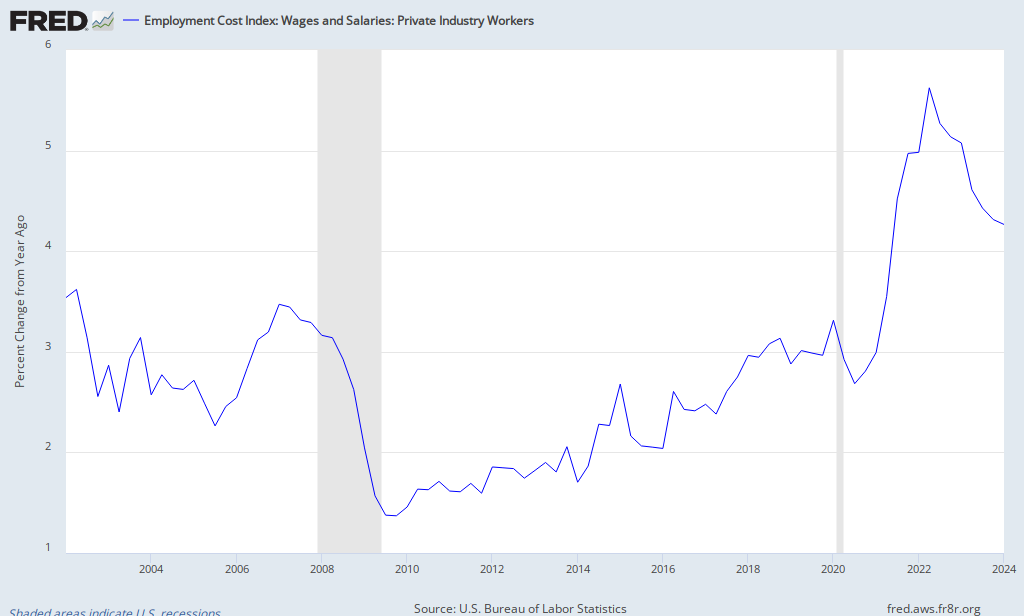
2) US labor remains cheap, which is to say that with high unemployment, American workers can’t keep up with inflation. There may not be any startups creating jobs, but there’s not a lot of reason to fire people, either.

FRED Graph

and

Number One reason not to panic is — Barack Obomba, CIA's bogeyman!

1) Obama’s mismanagement of the economy (health care with a punitive threshold for startup businesses, useless Keynesian fiscal stimulus) is responsible for this mess, and prospective voters are holding him accountable. Obama CAN be beaten in 2012. And a Republican administration with supply-side fiscal incentives for growth could turn the US economy around (not as dramatically as Reagan did, to be sure). Things very well might get better, someday....


Global banksters bare their fangs to sink them into more public property around the world....

June 9, 2011 -- What's behind the global bankers' austerity programs: seizure of public property for corporations...

What lies in store for Greece, Portugal, Spain, Ireland, Italy, and, in short order, the United States, is the wholesale sell-off of public property to private corporations at bargain basement prices. What the schrekers who gather in their secretive lairs at Davos, Cernobbio, Bilderberg, and G8/G20 are bringing about is a world where no property is owned by the state, which by default means the people. Total corporate control over every facet of life equals extreme fascism.

What is occurring is Greece is a bellwether for what will befall other nations in Europe, as well as the United States, if the bankers get their way. And in Greece, the people know how generations of investments by the taxpayers are being turned over to vampire capitalists who have the full backing of the International Monetary Fund, European Commission, and the European Central Bank.

The European and global bankers have demanded that the Greek government sell off entirely or assume a minority stake in a number of state enterprises and utilities.

For example, this year global capitalists are slated to acquire 84 percent of OTE, the Greek telecommunications provider. In addition, private bankers will assume 66 percent ownership of the Greek Postal Savings Bank; 51 percent of the National Lottery; 60 percent of the Salonika Water Authority; 68 percent of DEPA, the natural gas utility; and 25 percent ownership of the ports of Piraeus and Salonika.

Next year, the capitalist grab for public property increases in intensity with Athens International Airport coming under 79 percent private ownership. The global capitalists will also obtain 100 percent ownership of the Egniata toll motorway; 60 percent of Hellenic Post; 66 percent of OPAP, the state-run video-lotto and online sports betting firm; 73 percent of the Athens Water Authority; 83 percent of DEI, the Greek Electric Authority; and 51 percent of the Greek Regional Airports Authority.

The Greek Communist Party has vowed to fight against the acquisition of public property by the private sector. In fact, it is the Communist parties of Europe that have been the most vocal against the power grab by the bankers but their opposition to the privatization moves receives very little attention by the corporate-controlled media.

Massive sell-off lists of public property are now being drawn up by the governments of Portugal, Spain, Italy, and Ireland. In the United States, there are calls for the privatization of the US Postal Service, Social Security, and Medicare.

One Libyan government official this reporter spoke to in Tripoli during an intensive NATO bombing assault, opined that the same fate is in store for the Libyan Socialist Jamahiriya of the old CIA-Puppet Gaddafi. With the highest standard of living in Africa, Libyans could witness the U.S.- and NATO-backed rebel government begin to sell off Libyan government assets to global capitalists. The Libyan official said, "these people [global banksters/Gangsters] would sell the air if they could get away with it."


Lagarde faces tough start as head of IMF....
By Pam Johnson

WASHINGTON - Two days ahead of a formal vote scheduled for June 30, former French finance minister Christine Lagarde became the first woman to be appointed managing director of the International Monetary Fund (IMF) on Tuesday.

Replacing former IMF chief Dominique Strauss-Kahn, who vacated the post in disgrace last month following sexual assault charges, Lagarde surpassed her lone competitor - Mexico's central bank governor Agustin Carstens - to take control of the Washington-based fund's executive board, which oversees operation of the 187-member institution.

Though Lagarde's appointment has been a fiercely contested foregone conclusion for several weeks, Tuesday's 24-member board meeting opened with ostensible uncertainty about the allegiances of key players like the United States, which is responsible for 17% of the fund's US$320 billion resource pool and has thus far remained silent for fear of backlash in a thorny debate of European dominance versus emerging market economies.

The curtain of largely symbolic suspense was lifted earlier on Tuesday when US Treasury Secretary Timothy Geithner threw his weight behind Lagarde, who had also secured assurances from the governor of the People's Bank of China on Monday.

Even before the meeting convened, Lagarde had clinched support from states representing a full 40% of the IMF's voting power.

"I am sure that Lagarde will be a very capable leader of the institution," Carstens said in a statement to the IMF on Tuesday.

"At the same time, I hope that under Lagarde's direction, the IMF will make meaningful progress in strengthening the governance of the institution, so as to assure its legitimacy, cohesiveness, and ultimately, its effectiveness," he said.

Carstens' mild statement of support belied the storm of debate, critique and, at times, open hostility that has surrounded the selection process over the last few weeks, during which economists and organizations from across the ideological spectrum united in their objection to continued European leadership.

"The Obama administration could have stepped up and welcomed emerging powers taking a leadership role in the IMF [but] it chose instead to be quiet about the disenfranchisement of emerging markets and developing countries in this process and jump on the European bandwagon at the very last minute," Raymond Offenheiser, president of Oxfam America, said in a statement following Lagarde's appointment.

Caroline Hooper-Box, acting head of Office and Essential Services Media Lead at Oxfam International, added in a press release on Tuesday, "This farcical appointment process has damaged the IMF's credibility."

"The IMF is badly in need of reform. To protect the institution's credibility, Lagarde will have to act to loosen Europe's stranglehold of the IMF Board, and give others more of a voice.

"She'll also have to decide what to do with the $3 billion the IMF got from selling its gold reserves last year," Hooper-Box said. "This money must be directed to poor and vulnerable citizens in developing countries - the same people who are excluded from IMF decision-making."

Lagarde's appointment coincided with a 48-hour general strike in Greece that has led to riots and clashes with the police as protestors rage against the government's proposed austerity measures', which are to be voted on in parliament on Wednesday.
In order for Greece to secure a $17 billion loan from the IMF - which it desperately needs to pay off a chunk of last year's $142 billion bailout debt - the government is under pressure to increase taxes and cut state spending, moves that will hit hardest on minimum-wage and low-income families' pocketbooks.

However, the fighting on the streets of Athens encapsulates some critics' claims that a European in the driver's seat of the world's most powerful financial institution is the last thing a shattered global economy needs.

Kenneth Rogoff, an economist at Harvard University, last week referred to the IMF as the "commander on the frontlines of the crisis" in Greece, adding to the growing public outcry against Lagarde stepping in as saviour of a crisis that he said her own country helped to orchestrate.

According to Howard Schneider, an economics correspondent for the Washington Post, the Greek rescue has "unraveled" in the past months, leading to a deeper-than-expected recession and possibly necessitating billions more than the $150 billion already provided under the three-year emergency plan last year.

Martin Wolf, the chief economics commentator at the Financial Times, wrote last week: "Did anyone think to themselves that the head of the IMF should be an Asian during the Asian financial crisis of 1991-1998, or a Latin American during the crisis in the 1980s and 1990s?"

"The eurozone is a very special and, in my view, very dangerous construction," he said, adding that according to the IMF's most recent data, the EU's share of global output at purchasing power parity will shrink from 25% in 2000 to 18% in 2015, an "astonishingly rapid" rate of decline.

Meanwhile, World Bank estimates for China's growth in 2011 have shot up from 8.5% to 9% - leading experts to speculate that Europe can no longer afford its patronizing dismissal of the rest of the world.

Offenheiser said: "If the US and EU continue to hold on to power through structures that reflect an obsolete economic and political world order of years past, the rising powers will inevitably turn away from the organization and toward institutions where they do have a voice."


Wednesday, October 6, 2010

India, Russia to discuss new giant fighter jet deal

http://en.rian.ru/analysis/20101229/161986565.html


http://www.youtube.com/watch?v=zXBs4PNdE_A&feature=player_embedded

http://www.business-standard.com/india/news/smita-purushottam-russia-chinathe-/reset/the-west/413948/

http://www.frstrategie.org/barreFRS/publications/rd/2010/RD_201007.pdf

NEW DELHI — India and Russia will hold talks this week on a multi-billion-dollar deal to supply up to 250 advanced stealth fighter jets to the technology-starved Indian Air Force, officials said on Tuesday.

Experts say the deal could be worth 25 billion dollars, making it the biggest in India's military history....http://www.deccanherald.com/content/109507/india-us-defence-ties-multi.html

A defence ministry official who did not want to be named said the contract would be the focus of talks on Saturday during a visit to India by Russian Defence Minister Anatoly Serdyukov.

"These are ongoing talks and will definitely come up in the discussions," he told AFP.

The Times of India said New Delhi and Moscow aimed to ink the FGFA (Fifth Generation Fighter Aircraft) preliminary design contract during a trip to India by President Dmitry Medvedev in December. Ministry officials declined to comment on the newspaper report.

On Monday, Air Force Chief P.V. Naik confirmed India would acquire the advanced jets from Russia, which supplies about 70 percent of Indian military hardware -- a legacy of the countries' Cold War ties.

http://southasianidea.com/modernising-the-military/india%E2%80%99s-military-modernisation-programme/

"We are looking to induct 200 to 250 FGFA in phases from 2017," the air chief marshal told reporters, adding that about 50 percent of air force hardware was now out of date.

"Around 50 percent of our equipment is obsolete and needs to be replaced.

"Ten years ago we had no money for modernization. This caused some delays. Subsequent planning will fructify by 2014-15," he said.

The 30-ton FGFA aircraft -- priced at 100 million dollars each, according to the Times of India -- will have "very advanced avionics, stealth to increase survivability (and) enhanced lethality," Naik added.

India plans to mothball its mainstay MiG-21 Soviet-era fighter jets, which have earned the sobriquet "flying coffins" because of their dismal safety record.

The ministry official said India was also seeking 40 additional Sukhoi-30 frontline fighter planes from Russia. http://theriseofrussia.blogspot.com/2009_02_09_archive.html

"The original plan was to acquire 230 Sukhoi-MKI planes but the list has now grown to 270 and so far around 100 aircraft have been delivered to us," he said.

Experts estimate the Sukhoi deal would be worth 12 billion dollars.

India is building military airbases on its borders with China to thwart possible attacks.

"As and when more airbases come up in the east, more Sukhois will be added," the ministry official commented, adding the airforce was also on target to commission 20 locally-built Light Combat Aircraft (LCA) by 2011.

India is also poised to hand out a contract for 126 fighter jets as part of a separate 12-billion dollar deal for which six global aeronautical giants are in the race.


India is reportedly also negotiating a 3.5-billion dollar aircraft defence deal with the United States that will be signed in November when President Barack Obama visits the Indian capital.

The US agreement will see the Indian air force buy 10 C-17 Globemaster transport aircraft, which are expected to replace the ageing fleet of Russian Ilyushin Il-76s, India's Economic Times newspaper reported recently....


Boeing C-17 Globemaster III

BANGALORE: India and the United States are close to signing their biggest defence deal so far, just ahead of President Barack Obama’s visit to India early next month. According to sources, both countries are looking to get the $5.8-billion Boeing C-17 Globemaster-III transport aircraft deal signed just before Obama’s maiden visit to the country, thereby clearing the deck for a formal announcement.

However, in a separate twist, the deal could see India getting the ten C-17 Globemaster-III airlifters without a number of electronic systems, due to New Delhi’s steady refusal to sign two critical strategic security agreements, the Communications Interoperability and Security Memorandum of Agreement (CISMOA) and the Basic Exchange and Co-operation Agreement for geo-spatial co-operation.

While Boeing has said that India will get the most-updated version of C-17, speculation is rife that the country has already approached Israel and France to buy the necessary equipment as an alternative.

“The agreements don’t really matter, because India can approach Israel or France for it. But, it could get more expensive once you replace military-grade equipment with commercial-grade,” sources told ET. Recently, air chief marshal PV Naik also reiterated that the Indian Air Force’s operational capabilities will not be affected even if the country does not sign the two agreements. While negotiations are currently on at a feverish pace between the two governments, the details of the Globemaster-III agreement are yet to reach the finance minister’s office.

Once it’s approved, it will come before the Cabinet Committee on Security, which will give the final clearance, before the deal is announced.....


How China’s Jets Threaten Russia -- By Richard Weitz, The Diplomat

China’s suspected proclivity for copying weapons systems has made Russia wary of exporting its technology. Still, the Russians may one day end up with a taste for ‘Made in China’ hardware.

The China International Aviation and Aerospace Exhibition, better known as ‘Airshow China,’ used to see Russian arms dealers descend on the event to peddle their wares to potential Chinese customers. Held every other year in the city of Zhuhai, the Russians were eager to persuade potential Chinese customers to part with their cash.

Read more ....

The Russian's may be suspicious of Chinese intent .... and justifiably so ..... but many in Russia are still open to the idea of selling to the Chinese their most advanced fighter jets.


http://www.defenceiq.com/article.cfm?externalid=3413&mac=DFIQ_OI_Featured_2010&utm_source=defenceiq.com&utm_medium=email&utm_campaign=DefOptIn&utm_content=11/2/10