Sunday, July 15, 2012

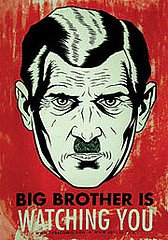
NSA Spying: 'If We Tell You, We'll Have to Kill You'...


When the utterly Zioconned US Congress passed the FISA Amendments Act (FAA) in 2008, a privacy-killing law that gutted First, Fourth and Fifth Amendment protections for Americans while granting immunity to giant telecoms that assisted the National Security Agency's (NSA) warrantless wiretapping programs, we were assured that the government "does not spy" on our communications.

Yet scarcely a year after FAA was signed into law by President Bush, The New York Times revealed that under Hope and Change™ huckster Barack Obama, NSA continued the previous regime's illegal practices, intercepting "private e-mail messages and phone calls of Americans in recent months on a scale that went beyond the broad legal limits established by Congress last year."

The wholesale vacuuming-up of private communications by the sprawling Zioconned Pentagon bureaucracy were described by unnamed "senior officials" as the "'overcollection' of domestic communications of Americans;" in other words, a mere technical "glitch" in an otherwise "balanced" program.

But what most Americans are blissfully unaware of is the fact that they carry in their pockets what have been described as near-perfect spy devices: their cellphones.

Earlier this week, The New York Times disclosed that "cellphone carriers reported that they responded to a startling 1.3 million demands for subscriber information last year from law enforcement agencies seeking text messages, caller locations and other information in the course of investigations."

The report by carriers, made in response to congressional inquiries "document an explosion in cellphone surveillance in the last five years, with the companies turning over records thousands of times a day in response to police emergencies, court orders, law enforcement subpoenas and other requests."

"I never expected it to be this massive," said Rep. Edward J. Markey (D-MA), the co-chair of the Bipartisan Congressional Privacy Caucus, "who requested the reports from nine carriers, including AT&T, Sprint, T-Mobile and Verizon."

Markey told the Times that the prevalence of cellphone surveillance by law enforcement agencies raised the specter of "digital dragnets" that threaten the privacy of most customers.

While the sheer volume of requests by local, state and federal police for user data may have startled Congress, which by-and-large has turned a blind eye when it comes to privacy depredations at all levels of government, it is hardly a complete picture of the pervasive nature of the problem.

In 2009 security watchdog Christopher Soghoian reported on his Slight Paranoia web site that just one firm, Sprint Nextel, "provided law enforcement agencies with its customers' (GPS) location information over 8 million times between September 2008 and October 2009. This massive disclosure of sensitive customer information was made possible due to the roll-out by Sprint of a new, special web portal for law enforcement officers." (emphasis added)

According to Soghoian, "Internet service providers and telecommunications companies play a significant, yet little known role in law enforcement and intelligence gathering."

"Government agents routinely obtain customer records from these firms," Soghoian averred, "detailing the telephone numbers dialed, text messages, emails and instant messages sent, web pages browsed, the queries submitted to search engines, and of course, huge amounts of geolocation data, detailing exactly where an individual was located at a particular date and time."

While there are indeed "exigent circumstances" which may require law enforcement to demand instant access to GPS data or other customer records--a kidnapping or child abduction in progress--in the main however, it appears that most warrant-free requests fall under a more sinister category: fishing expedition.

Commenting on congressional revelations, ACLU legislative counsel Christopher Calabrese informed us that data supplied to the Times represents "a vast undercount of the number of Americans who have been affected by this tracking. Sprint disclosed that it received approximately 500,000 subpoenas in 2011 (a subpoena is a written request for information from law enforcement that isn't reviewed by a judge) and that 'each subpoena typically requested subscriber information on multiple subscribers.' In addition, several carriers disclosed that they sometimes provide all the information from a particular cell tower or particular area."

Although several geolocation privacy bills that require warrants to obtain records are pending in Congress, it should be clear there is no consensus among ruling class elites for protecting the privacy rights of Americans or reining-in overly-intrusive police agencies.

In fact, the opposite is the case.

Under Obama, illegal surveillance programs once hidden behind code-named black projects such as STELLAR WIND and PINWALE have been greatly expanded. Indeed, the bipartisan consensus which encourages and permits the secret state to carry out warrantless wiretapping and data mining have been "regularized" to such a degree (under the rubric of "keeping us safe") they're no longer even regarded as controversial.

More than three years ago, Obama promised to "fix" illegal policies which surfaced under the previous Bush government. However, an anonymous "senior official" told the Times there were certain "technical problems" that led the agency "to inadvertently 'target' groups of Americans and collect their domestic communications without proper court authority. Officials are still trying to determine how many violations may have occurred."

It was further revealed that some of the groups "inadvertently" targeted by NSA and other spy satrapies (CIA, DHS, FBI, et. al.) included Muslim Americans, anarchist and socialist groups, libertarians, civil liberties organizations, antiwar activists as well as individual supporters of the secrecy-spilling web site WikiLeaks.

Just last week the Bradley Manning Support Network disclosed that "A letter dated May 18, 2012, which purports to originate from the US Army Criminal Investigative Division (CID), rejects a Freedom of Information Act (FOIA) request submitted for data the government has collected on the Bradley Manning Support Network. The letter states that 'an active investigation is in progress with an undetermined completion date'."

As readers recall, Manning is the Army private accused by the government of releasing hundreds of thousands of secret files to WikiLeaks. He currently faces charges that could lead to decades of incarceration.

"At this time," Network supporters wrote, "it is unclear whether the investigation cited in the FOIA denial simply refers to the government's ongoing legal retaliation against Bradley Manning, or whether there is actually some other separate investigation targeting the Support Network."

It's a sure bet, given the administration's ongoing war against whistleblowers, that the Army as well the Justice Department has the Manning Support Network--along with WikiLeaks--in their gun sights.

And with the construction of NSA's giant $2 billion Utah Data Center nearing completion, as James Bamford reported in Wired Magazine in March, the agency's ability "to intercept, decipher, analyze, and store vast swaths of the world's communications as they zap down from satellites and zip through the underground and undersea cables of international, foreign, and domestic networks" will soon take a qualitative leap forward--at our expense.

With FAA currently up for renewal, and with congressional grifters on both sides of the aisle pushing for a five-year, amendment-free extension as demanded by the administration, the secret state is refusing to provide privacy advocates--both in and outside government--with any information whatsoever on how just many violations have occurred on a regular basis under the law's admittedly loose guidelines.

In May, senators Ron Wyden (D-OR) and Mark Udall (D-CO), members of the Senate Select Committee on Intelligence asked NSA to divulge information about how many Americans communications have been spied upon by the agency.

The Office of the Director of National Intelligence responded by saying that it was "not reasonably possible to identify the number of people located in the United States whose communications may have been reviewed under the authority of the FAA."

Both senators oppose FAA's extension on civil liberties grounds and in the face of the government's stonewall, Wyden placed a "hold" on the legislation.

In a statement published on his web site Wyden explained why he was blocking unanimous consent requests to pass FAA's five-year extension.

"The purpose of this 2008 legislation was to give the government new authorities to collect the communications of people who are believed to be foreigners outside the United States, while still preserving the privacy of people inside the United States," Wyden wrote.

"Before Congress votes to renew these authorities it is important to understand how they are working in practice. In particular, it is important for Congress to better understand how many people inside the United States have had their communications collected or reviewed under the authorities granted by the FISA Amendments Act."

"I am concerned, of course, that if no one has even estimated how many Americans have had their communications collected under the FISA Amendments Act," Wyden averred, "it is possible that this number could be quite large. Since all of the communications collected by the government under section 702 are collected without individual warrants, I believe that there should be clear rules prohibiting the government from searching through these communications in an effort to find the phone calls or emails of a particular American, unless the government has obtained a warrant or emergency authorization permitting surveillance of that American."

Ludicrously enough, in response to the senator's requests I. Charles McCullough, the Inspector General of the Office of the Director of National Intelligence wrote that the NSA Inspector General "and NSA leadership agreed that an IG review of the sort suggested would itself violate the privacy of U.S. persons." (emphasis added)

McCullough's irony-rich obfuscation, published by Wired, argued that even providing an estimate on how many Americans were spied upon would be "beyond the capacity" of the NSA's in-house watchdog. "I defer to [the NSA inspector general's] conclusion that obtaining such an estimate was beyond the capacity of his office and dedicating sufficient additional resources would likely impede the NSA's mission."

Just as the Bush administration scotched citizen lawsuits that demanded accountability from the nation's telecommunication providers over their collaboration with NSA's illegal programs, so too has the Obama regime sought to derail government accountability by invoking an alleged "state secrets privilege."

Recently, the Electronic Frontier Foundation reported that "Three whistleblowers--all former employees of the National Security Agency (NSA)--have come forward to give evidence in ... EFF's lawsuit against the government's illegal mass surveillance program, Jewel v. NSA."

In a July 2 motion filed in U.S. District Court in San Francisco, "the three former intelligence analysts confirm that the NSA has, or is in the process of obtaining, the capability to seize and store most electronic communications passing through its U.S. intercept centers, such as the 'secret room' at the AT&T facility in San Francisco first disclosed by retired AT&T technician Mark Klein in early 2006."

Those three former NSA officials--William E. Binney, Thomas A. Drake and J. Kirk Wiebe--were themselves targets of government persecution over allegations that they provided information to The New York Times in their 2005 revelation of illegal domestic spying by the Agency.

Drake, who pled guilty last year to a misdemeanor after the Justice Department's Espionage Act charges collapsed, was initially prosecuted by the administration--as a spy no less--for providing evidence to The Baltimore Sun of massive waste, fraud and corruption in NSA's Trailblazer program.

The $1.2 billion corporate boondoggle, overseen by the Science Applications International Corporation (SAIC) and project partners Boeing, Computer Sciences Corporation and Booz Allen Hamilton was eventually shut down in 2006.

In the wake of initial reporting by the Times, USA Today disclosed that NSA "has been secretly collecting the phone call records of tens of millions of Americans, using data provided by AT&T, Verizon and BellSouth."

In fact, the same firms who assisted the Agency in creating "'a database of every call ever made' within the nation's borders," are busy as proverbial bees providing geolocational information to law enforcement and secret state agencies.

As EFF averred, "Jewel v. NSA is back in district court after the 9th U.S. Circuit Court of Appeals reinstated it in late 2011. In the motion for partial summary judgment filed today, EFF asked the court to reject the stale state secrets arguments that the government has been using in its attempts to sidetrack this important litigation and instead apply the processes in the Foreign Intelligence Surveillance Act that require the court to determine whether electronic surveillance was conducted legally."

While EFF should be commended for their efforts, prospects for a full accounting of serious state constitutional violations of Americans' right face an uphill battle.

As the World Socialist Web Site pointed out Monday, "The latest revelations about cell phone monitoring, when added to the long record of antidemocratic attacks carried out since the declaration of the 'war on terror'--from the establishment of the Guantanamo Bay prison camp to the Obama administration's assertion of the right to summarily execute anyone, including US citizens, anywhere in the world—provide chilling evidence of the real and growing threat of an American police state."

Efforts in that direction by the Obama administration are gathering steam.

The Electronic Privacy Information Center (EPIC) also reported Monday that "The White House has released a new Executive Order seeking to ensure the continuity of government communications during a national emergency."

That Executive Order, issued July 6 by the White House, grants new powers to the Department of Homeland Security, "including the ability to collect certain public communications information," EPIC averred.

But it does far more than that. "Under the Executive Order the White House has also granted the Department the authority to seize private facilities when necessary, effectively shutting down or limiting civilian communications."

As researcher Peter Dale Scott disclosed in numerous analyses on so-called "Continuity of Government" planning, COG is code for the suspension of constitutional guarantees and the imposition of martial law by the National Security State.

In 2010, Scott pointed out in Japan Focus: "Clearly 9/11 met the conditions for the implementation of COG measures, and we know for certain that COG plans were implemented on that day in 2001, before the last plane had crashed in Pennsylvania. The 9/11 Report confirms this twice, on pages 38 and 326. It was under the auspices of COG that Bush stayed out of Washington on that day, and other government leaders like Paul Wolfowitz were swiftly evacuated to Site R, inside a hollowed out mountain near Camp David."

In fact, the first ninety days after 9/11 "saw the swift implementation of the key features attributed to COG planning ... in the 1980s: warrantless detentions, warrantless deportations, and the warrantless eavesdropping that is their logical counterpart. The clearest example was the administration's Project Endgame--a ten-year plan, initiated in September 2001, to expand detention camps, at a cost of $400 million in Fiscal Year 2007 alone. This implemented the central feature of the massive detention exercise, Rex 84, conducted by Louis Giuffrida and Oliver North in 1984."

The proposed five-year extension of the FISA Amendments Act, coupled with indefinite detention provisions of the 2012 National Defense Authorization Act (NDAA), the president's "kill list" and now, a new Executive Order granting DHS the power to "seize" private communications' facilities in the wake of a "national emergency" have accelerated these dictatorial trends.

War Is Betrayal, Persistent Myths of Combat....


Specialist Jason Palmer prepares for takeoff. (Tikrit, Iraq, April 30, 2006) / Photograph by Teddy Wade, U.S. Army.


We condition the poor and the working class to go to war. We promise them honor, status, glory, and adventure. We promise boys they will become men. We hold these promises up against the dead-end jobs of small-town life, the financial dislocations, credit card debt, bad marriages, lack of health insurance, and dread of unemployment. The military is the call of the Sirens, the enticement that has for generations seduced young Americans working in fast food restaurants or behind the counters of Walmarts to fight and die for war profiteers and elites.

The poor embrace the military because every other cul-de-sac in their lives breaks their spirit and their dignity. Pick up Erich Maria Remarque’s All Quiet on the Western Front or James Jones’s From Here to Eternity. Read Henry IV. Turn to the Iliad. The allure of combat is a trap, a ploy, an old, dirty game of deception in which the powerful, who do not go to war, promise a mirage to those who do.

I saw this in my own family. At the age of ten I was given a scholarship to a top New England boarding school. I spent my adolescence in the schizophrenic embrace of the wealthy, on the playing fields and in the dorms and classrooms that condition boys and girls for privilege, and came back to my working-class relations in the depressed former mill towns in Maine. I traveled between two universes: one where everyone got chance after chance after chance, where connections and money and influence almost guaranteed that you would not fail; the other where no one ever got a second try. I learned at an early age that when the poor fall no one picks them up, while the rich stumble and trip their way to the top.

Those I knew in prep school did not seek out the military and were not sought by it. But in the impoverished enclaves of central Maine, where I had relatives living in trailers, nearly everyone was a veteran. My grandfather. My uncles. My cousins. My second cousins. They were all in the military. Some of them—including my Uncle Morris, who fought in the infantry in the South Pacific during World War II—were destroyed by the war. Uncle Morris drank himself to death in his trailer. He sold the hunting rifle my grandfather had given to me to buy booze.

He was not alone. After World War II, thousands of families struggled with broken men who, because they could never read the approved lines from the patriotic script, had been discarded. They were not trotted out for red-white-and-blue love fests on the Fourth of July or Veterans Day.

The myth of war held fast, despite the deep bitterness of my grandmother—who acidly denounced what war had done to her only son—and of others like her. The myth held because it was all the soldiers and their families had. Even those who knew it to be a lie—and I think most did—were loath to give up the fleeting moments of recognition, the only times in their lives they were told they were worth something.

“For it’s Tommy this, an’ Tommy that, an’ ‘Chuck him out, the brute!’” Rudyard Kipling wrote. “But it’s ‘Saviour of ’is country’ when the guns begin to shoot.”

Any story of war is a story of elites preying on the weak, the gullible, the marginal, the poor. I do not know of a single member of my graduating prep school class who went into the military. You could not say this about the high school class that graduated the same year in Mechanic Falls, Maine.


• • •


Geoff Millard was born in Buffalo, New York and lived in a predominately black neighborhood until he was eleven. His family then moved to Lockport, a nearby white suburb. He wrestled and played football in high school. He listened to punk rock.

“I didn’t really do well in classes,” he says. “But that didn’t seem to matter much to my teachers.”

At fifteen he was approached in school by a military recruiter.

“He sat down next to me at a lunch table,” Millard says. “He was a Marine. I remember the uniform was crisp. All the medals were shiny. It was what I thought I wanted to be at the time.

“He knew my name,” Millard adds. “He knew what classes I was taking. He knew more about me than I did. It was freaky, actually.”

Two years later, as a senior, Millard faced graduation after having been rejected from the only college where he had applied.

“I looked at what jobs I could get,” he says. “I wasn’t really prepared to do any job. I wasn’t prepared for college. I wasn’t prepared for the workforce. So I started looking at the military. I wanted to go active duty Marine Corps, I thought. You know, they were the best. And that’s what I was going to do.

“There were a lot of other reasons behind it, too,” he says. “I mean, growing up in this culture you envy that, the soldier.”

Any story of war is a story of elites preying on the weak, the gullible, the marginal, the poor.

His grandfather, in the Army Air Corps in World War II, had died when he was five. The military honor guard at the funeral had impressed him. As a teenager, he had watched the burial of his other grandfather, also with military honors. Millard carried the folded flag to his grandmother after receiving it from the honor guard.

The pageantry has always been alluring. “We marched a long time,” Louis-Ferdinand Céline, who fought in World War I, writes in Journey to the End of the Night:

There were streets and more streets, and they were all crowded with civilians and their wives, cheering us on, bombarding us with flowers from café terraces, railroad stations, crowded churches. You never saw so many patriots in all your life! And then there were fewer patriots . . . . It started to rain, and then there were still fewer and fewer, and not a single cheer, not one.

And nearly a century later it is the same.

When Millard told his mother he wanted to be a Marine, she pleaded with him to consider the National Guard. He agreed to meet with the Guard recruiter, whose pitch was effective and simple: “If you come here, you get to blow shit up.”

“I’m seventeen,” Millard says. “I thought being in the military was the pinnacle of what coolness was. I was just like, oh, I get to blow up stuff! I signed up right then and there on the spot. But the interesting thing he didn’t tell me was that the ‘shit’ that he referred to would be kids.

“They don’t teach you when you’re in land mine school that the overwhelming percentage of victims of land mines are little kids. Because, like, in the States, a little kid will chase a soccer ball in the streets. And overseas, a little kid will chase a soccer ball into a minefield. Whether, you know, it happens in Korea or Bosnia or Iraq, kids get killed all the time by land mines. They get maimed by them. And that’s just a reality of our military industrial complex. We put out these mines. We have no concern for what they do.”

Not that this reality intruded on his visions of life in the military when he began.

“I just thought of it like this stuff you see on TV where cars blow up and stuff like that,” he says.

For Anthony Swofford—author of Jarhead, a memoir about being a Marine in the first Gulf War—the tipping point came when the recruiter, who assured him he would be “a fine killer,” told him he could book a threesome for $40 in Olongapo in the Philippines. “I’d had sex three times and been the recipient of five blow jobs and fourteen hand jobs,” he writes. “I was sold.”

But sometimes there’s no need for a recruiting pitch. The culture does enough to make war, combat, and soldiering appealing.

Ali Aoun was born in Rochester, New York. His father is Lebanese. His mother is from the Caribbean. He says he wanted to be a soldier from the age of nine. He was raised watching war films. But even antiwar films such as Platoon and Full Metal Jacket celebrate the power and seductiveness of violence. He wanted this experience as his own. He says no one pushed him into it.

“I enlisted,” he explains. “It was something I always wanted to do, although I got more than I bargained for. You never really know a woman until you jump in bed with her. It’s just like the Army: you never really know about it until you enlist. It’s not about defending the country or serving our people. It’s about working for some rich guy who has his interests.”


• • •


At first Millard liked the National Guard. He was able to enroll in Niagara County Community College as a business major, where he signed up for an African American studies class thinking it would be an easy A. He read The Autobiography of Malcolm X. He read Howard Zinn’s A People’s History of the United States. He read Frederick Douglass.

“It was the first time I’d really started to read,” he says.

He was in the African American studies class when the attacks of 9/11 occurred. His wrestling coach came into the room to tell him he had been activated. He went home. He packed his bags. He thought about combat.

“I was pissed,” he says. “I was like, they attacked us. I was ready to go to war.”

But he was confused from the start.

“I really wanted to go to war with somebody, because we were attacked,” he says. “But the one question I couldn’t answer was, who were we going to go to war with?”

At first he did military funerals. Then he was called up for Iraq. He was by then a sergeant and was assigned to work in the office of a general with the 42nd Infantry Division, Rear Operation Center. He became, in military slang, a REMF—a rear echelon motherfucker. He was based in Tikrit, where he watched the cynical and cold manipulation of human life.

‘It’s not about defending the country or serving our people. It’s about working for some rich guy who has his interests.’

He relates the story of a traffic-control mission gone awry when an eighteen-year-old soldier made a bad decision. He was sitting atop an armored Humvee monitoring a checkpoint. An Iraqi car approached, and the soldier, fearing it might be carrying a suicide bomber, pressed the butterfly trigger on his .50 caliber machine gun. He put two hundred rounds into the car in less than a minute, killing a mother, a father, a four-year-old boy, and a three-year-old girl.

“They briefed this to the general,” Millard says. “They briefed it gruesome. I mean, they had pictures. And this colonel turns around to this full division staff and says: ‘If these fucking Hadjis learned to drive, this shit wouldn’t happen.’

“If you lift your rifle and you look through the sights and you see a person, you can’t pull the trigger,” Millard says. “But if you lift your rifle and you look through the sights and you see a fucking Hadji, then what’s the difference.

“That’s a lot of what I saw in Iraq,” he says. “These officers, high-ranking officers, generals, colonels, you know, the complete disregard. They knew all the stuff that happened. They got all the briefings. They knew what happened. And they either didn’t speak up, they didn’t say anything about it or they openly condoned it. When Iraqis got killed, to them, it was one less fucking Hadji around.”

Millard’s thirteen months in Iraq turned him into a passionate antiwar activist. He is the cofounder of the Washington, D.C., chapter of Iraq Veterans Against the War and served as its president for three years. He has taken part in numerous antiwar demonstrations around the country, was one of the organizers of the Winter Soldier hearings, returned to Iraq on a humanitarian aid mission in 2011, and now directs a homeless veterans initiative.

The briefing that Millard and his superiors received after the checkpoint killing was one of many. Sergeant Perry Jeffries, who served in the Fourth Infantry Division in Iraq after being called out of retirement, said the killing of Iraqi civilians at checkpoints was routine.

“Alpha troop and Balad Ruz shot somebody at least once,” he says, referring to a troop detachment and to the soldiers manning a checkpoint in a small Diyala Province village. “Somebody else on what we called the Burning Oil Checkpoint, they shot somebody with a .50 cal, shot a guy once, and then several times.”

Killing becomes a job. You do it. Sometimes it unnerves you. But the demons usually don’t hit until you come home, when you are lying alone in bed and you don’t dare to tell your wife or your girlfriend what you have become, what you saw, what you did, why you are drinking yourself into a stupor, why you so desperately want to forget your dreams.

The disillusionment comes swiftly. It is not the war of the movies. It is not the glory promised by the recruiters. The mythology fed to you by the church, the press, the school, the state, and the entertainment industry is exposed as a lie. We are not a virtuous nation. God has not blessed America. Victory is not assured. And we can be as evil, even more evil, than those we oppose. War is venal, noisy, frightening, and dirty. The military is a vast bureaucratic machine fueled by hyper-masculine fantasies and arcane and mind-numbing rules. War is always about betrayal—betrayal of the young by the old, of idealists by cynics, and of soldiers and Marines by politicians.

“The biggest misconception about the war is that the soldiers care about politics,” Jeffries says. “The right thinks the soldiers want support. They want to feel good. They want everybody to fly their flag and have a bumper sticker and go, ‘Rah! Rah! Rah! I support the troops. Yay, thank you! Thank you! Thank you!’ The left thinks the soldiers all want to run off and get out of there, that they’re dying in a living hell. I think that most of the soldiers are young people that are having a decent adventure.”

But, he goes on, “They may be having a very hard time. They’re frustrated about the amount of resources they have been provided—how many hours of sleep they get, how nice their day is, whether they get to play their PlayStation or read their book at night or whatever. Like any human, you’d like to have some more of that.”

Yet, while soldiers don’t want to be forgotten, the support-the-troops brigade only maintains the mythology of war on the home front by pretending that we’re actually all in it together, when in fact it’s overwhelmingly the poor, powerless, and adrift who suffer.

Jeffries has little time for lawn chair warriors: “I remember hearing that somebody said, ‘Oh, we’re going to have a barbecue to support the troops.’ I heard about this when I was in Iraq. I said, how the hell is that going to support me? It’s not doing anything. Don’t drink beer. Send me the beer. It’s not doing me any good to have you drink it. I still don’t like the yellow ribbons.”

It is no surprise that soldiers sometimes come to despise civilians who chant patriotic mantras. Those soldiers may not be fans of the remote and rarely seen senior officers who build their careers on the corpses of others, including comrades, either. But to oppose the machine and risk being cast out of the magic circle of comradeship can be fatal. Fellow soldiers are the only people who understand the psychological torment of killing and being shot at, of learning to not think at all and instead be led as a herd of animals. Those ostracized in war have a hard time surviving, mentally and physically, so most service members say and do nothing to impede the madness and the killing.

If veterans speak of terrible wounds, of lies told to make them kill, of evil committed in our name, we fill our ears with wax.

Jessica Goodell came to understand that torment only too well, as she relates in her 2011 memoir Shade it Black: Death and After in Iraq. Goodell wasn’t poor. She grew up in a middle-class home near Chautauqua Lake in upstate New York. Her father was a lawyer, and her mother worked at home. But her “universe fractured” when she was sixteen and her parents divorced. She could barely continue “the motions of everyday existence.” She was accepted at Ithaca College her senior year, but just before graduation a uniformed Marine came to her high school. He told her he had come to find “tough men.”

“What about tough women?” she asked.

By that afternoon she was in the Marine recruiting office. She told the recruiter she wanted to be part of a tank crew but was informed that women were prohibited from operating tanks. She saw a picture of a Marine standing next to a vehicle with a huge hydraulic arm and two smaller forklift arms. She signed up to be a heavy equipment mechanic, although she knew nothing about it.

Three years later, while stationed at the Marine Corps Air Ground Combat Center in the desert town of Twentynine Palms, California, she volunteered to serve in the Marine Corps’ first official Mortuary Affairs unit, at Al Taqaddum Airbase in Iraq. Her job, for eight months, was to “process” dead Marines—collect and catalog their bodies and personal effects. She put the remains in body bags and placed the bags in metal boxes. Before being shipped to Dover Air Force Base, the boxes were stored, often for days, in a refrigerated unit known as a “reefer.”

Her unit processed six suicides. The suicide notes, she told me in an interview, almost always cited hazing. Marines who were overweight or unable to do the physical training were subjected to withering verbal and physical abuse. They were called “fat nasties” and “shit bags.” They were assigned to other Marines as slaves. Many were forced to run until they vomited or to bear-crawl—walk on all fours—the length of a football field and back. This would be followed by sets of monkey fuckers—bending down, grabbing the ankles, crouching like a baseball catcher, and then standing up again—and other exercises that went on until the Marines collapsed.

Goodell’s unit was sent to collect the bodies of the Marines who killed themselves. They usually blew their faces off with assault rifles in port-a-johns or in the corners of abandoned bunkers or buildings. She and the other members of the Mortuary Affairs unit would have to scrape the flesh and brain tissue from the walls.

Goodell fell into depression when she returned home. She abused drugs and alcohol. And she watched the slow descent of her comrades as they too tried to blunt the pain with narcotics and self-destructive behavior. She details many of her experiences in Shade It Black, a term that refers to the missing body parts of dead Marines, which she colored black on diagrams of the corpses.

In a poignant passage, she talks about what it was like for her and a fellow Marine named Miguel to come home and see all those yellow ribbons:

We’d frequently pass vehicles displaying the yellow ribbon ‘support-our-troops decal,’ but we never once mentioned it. We probably passed a hundred or more decals—two hundred if you count the multiple decals decorating the cars of the more patriotic motorists—and yet neither of us even once said, ‘Look, more support from the citizenry. Let’s give the ‘thumbs up’ as we pass.’ . . . I knew that these people on their way to work or home or dinner had no idea what it was they were supporting. They did not have a clue as to what war was like, what it made people see, and what it made them do to each other. I felt as though I didn’t deserve their support, or anyone’s, for what I had done. . . . No one should ever support the people who do such things.

Stateside “support” not only reflects the myths of war, but it also forces Goodell and her comrades to suppress their own experiences:

Here we were, leaving the ribbons behind us as we sped up on our way to Hell, probably, where we would pay for the sins these magnetic decals endorsed. There was an irony of sorts shaping the dynamic between our ribbon decal supporters and us. They were uninformed but good people, the kind whose respect we would welcome—if it were based upon something true. It was when we were around them that we had to hide the actual truth most consciously.


• • •


Those who return to speak this truth, like Goodell or Millard, are our contemporary prophets. They struggle, in a culture awash in lies, to tell what few have the fortitude to digest. The words these prophets speak are painful.

As a nation we prefer to listen to those who speak from the patriotic script. We prefer to hear ourselves exalted. If veterans speak of terrible wounds visible and invisible, of lies told to make them kill, of evil committed in our name, we fill our ears with wax. Not our boys and girls, we say, not them, bred in our homes, endowed with goodness and decency. For if it is easy for them to murder, what about us? It is simpler and more comfortable not to hear, to wish only that they would calm down, be reasonable, get some help, and go away. We brand our prophets as madmen. We cast them into the desert. This is why so many veterans are estranged and enraged. This is why so many succumb to suicide or addictions. Not long ago Goodell received a text message from a Marine she had worked with in Mortuary Affairs after he tried to commit suicide. “I’ve got $2,000 in the bank,” the message read. “Let’s meet in NYC and go out with a bang.”

War comes wrapped in patriotic slogans; calls for sacrifice, honor, and heroism; and promises of glory. It comes wrapped in the claims of divine providence. It is what a grateful nation asks of its children. It is what is right and just. It is waged to make the nation and the world a better place, to cleanse evil. War is touted as the ultimate test of manhood, where the young can find out what they are made of. From a distance it seems noble. It gives us comrades and power and a chance to play a bit part in the great drama of history. It promises to give us identities as warriors, patriots, as long as we go along with the myth, the one the war-makers need to wage wars and the defense contractors need to increase their profits.

But up close war is a soulless void. War is about barbarity, perversion, and pain. Human decency and tenderness are crushed, and people become objects to use or kill. The noise, the stench, the fear, the scenes of eviscerated bodies and bloated corpses, the cries of the wounded all combine to spin those in combat into another universe. In this moral void, naïvely blessed by secular and religious institutions at home, the hypocrisy of our social conventions, our strict adherence to moral precepts, becomes stark. War, for all its horror, has the power to strip away the trivial and the banal, the empty chatter and foolish obsessions that fill our days. It might let us see, although the cost is tremendous.....


This global financial fraud and its gatekeepers....

Protesters at Bank of America shareholders meeting in Charlotte

    Naomi Wolf;

    Protesters outside a Bank of America annual shareholders' meeting in Charlotte, North Carolina. Photograph: Jason Miczek/Reuters

    Last fall, I argued that the violent reaction to Occupy and other protests around the world had to do with the 1%ers' fear of the rank and file exposing massive fraud if they ever managed get their hands on the books. At that time, I had no evidence of this motivation beyond the fact that financial system reform and increased transparency were at the top of many protesters' list of demands.

    But this week presents a sick-making trove of new data that abundantly fills in this hypothesis and confirms this picture. The notion that the entire global financial system is riddled with systemic fraud – and that key players in the gatekeeper roles, both in finance and in government, including regulatory bodies, know it and choose to quietly sustain this reality – is one that would have only recently seemed like the frenzied hypothesis of tinhat-wearers, but this week's headlines make such a conclusion, sadly, inevitable.

    The New York Times business section on 12 July shows multiple exposes of systemic fraud throughout banks: banks colluding with other banks in manipulation of interest rates, regulators aware of systemic fraud, and key government officials (at least one banker who became the most key government official) aware of it and colluding as well. Fraud in banks has been understood conventionally and, I would say, messaged as a glitch. As in London Mayor Boris Johnson's full-throated defense of Barclay's leadership last week, bank fraud is portrayed as a case, when it surfaces, of a few "bad apples" gone astray.

    In the New York Times business section, we read that the HSBC banking group is being fined up to $1bn, for not preventing money-laundering (a highly profitable activity not to prevent) between 2004 and 2010 – a six years' long "oops". In another article that day, Republican Senator Charles Grassley says of the financial group Peregrine capital: "This is a company that is on top of things." The article goes onto explain that at Peregrine Financial, "regulators discovered about $215m in customer money was missing." Its founder now faces criminal charges. Later, the article mentions that this revelation comes a few months after MF Global "lost" more than $1bn in clients' money.

    What is weird is how these reports so consistently describe the activity that led to all this vanishing cash as simple bumbling: "regulators missed the red flag for years." They note that a Peregrine client alerted the firm's primary regulator in 2004 and another raised issues with the regulator five years later – yet "signs of trouble seemingly missed for years", muses the Times headline.

    A page later, "Wells Fargo will Settle Mortgage Bias Charges" as that bank agrees to pay $175m in fines resulting from its having – again, very lucratively – charged African-American and Hispanic mortgagees costlier rates on their subprime mortgages than their counterparts who were white and had the same credit scores. Remember, this was a time when "Wall Street firms developed a huge demand for subprime loans that they purchased and bundled into securities for investors, creating financial incentives for lenders to make such loans." So, Wells Fargo was profiting from overcharging minority clients and profiting from products based on the higher-than-average bad loan rate expected. The piece discreetly ends mentioning that a Bank of America lawsuit of $335m and a Sun Trust mortgage settlement of $21m for having engaged is similar kinds of discrimination.

    Are all these examples of oversight failure and banking fraud just big ol' mistakes? Are the regulators simply distracted?

    The top headline of the day's news sums up why it is not that simple: "Geithner Tried to Curb Bank's Rate Rigging in 2008". The story reports that when Timothy Geithner, at the time he ran the Federal Reserve Bank of New York, learned of "problems" with how interest rates were fixed in London, the financial center at the heart of the Libor Barclays scandal. He let "top British authorities" know of the issues and wrote an email to his counterparts suggesting reforms. Were his actions ethical, or prudent? A possible interpretation of Geithner's action is that he was "covering his ass", without serious expectation of effecting reform of what he knew to be systemic abuse.

    And what, in fact, happened? Barclays kept reporting false rates, seeking to boost its profit. Last month, the bank agreed to pay $450m to US and UK authorities for manipulating the Libor and other key benchmarks, upon which great swaths of the economy depended. This manipulation is alleged in numerous lawsuits to have defrauded thousands of bank clients. So Geithner's "warnings came too late, and his efforts did not stop the illegal activity".

    And then what happened? Did Geithner, presumably frustrated that his warnings had gone unheeded, call a press conference? No. He stayed silent, as a practice that now looks as if several major banks also perpetrated, continued.

    And then what happened? Tim Geithner became Treasury Secretary. At which point, he still did nothing.

    It is very hard, looking at the elaborate edifices of fraud that are emerging across the financial system, to ignore the possibility that this kind of silence – "the willingness to not rock the boat" – is simply rewarded by promotion to ever higher positions, ever greater authority. If you learn that rate-rigging and regulatory failures are systemic, but stay quiet, well, perhaps you have shown that you are genuinely reliable and deserve membership of the club.

    Whatever motivated Geithner's silence, or that of the "government official" in the emails to Barclays, this much is obvious: the mainstream media need to drop their narratives of "Gosh, another oversight". The financial sector's corruption must be recognized as systemic.

    Meanwhile, Britain is sleepwalking in a march toward total email surveillance, even as the US brings forward new proposals to punish whistleblowers by extending the Espionage Act. In an electronic world, evidence of these crimes lasts forever – if people get their hands on the books. In the Libor case, notably, a major crime has not been greeted by much demand at the top for criminal prosecutions. That asymmetry is one of the insurance policies of power. Another is to crack down on citizens' protest....


India's American friends and Iranian partners...


NEW DELHI — The United States recently took the Iran-sanctions monkey off India's back: It granted India an exemption from Iran-related financial sanctions in exchange for significant cuts in Indian purchases of Iranian oil. Nevertheless, Iran continues to cast a pall over an otherwise brightening U.S.-India relationship.

From India's perspective, Iran is an important neighbor with which it can ill-afford to rupture its relationship. Indeed, India already seems locked geographically in an arc of failing or dysfunctional states, confronting it with external threats from virtually all directions. If India joined the U.S. containment strategy against Iran, it would have to bear serious strategic costs. For starters, it would lose access to Afghanistan via Iran, which has served as a conduit for the substantial flow of Indian aid to Kabul. Moreover, containment would undermine India's energy interests.
Few countries are as dependent on the Persian Gulf region's hydrocarbons as is India, which imports almost 80 percent of its consumption. Iran is the world's third-largest net oil exporter (with the world's second-largest natural-gas reserves as well), and it is a strategically located gateway to other energy suppliers in Central Asia and the Middle East.
Iraq and Iran used to be India's principal oil suppliers. But the first fell prey to a long U.S. occupation, and the second currently faces a U.S.-led oil-export embargo designed to throttle it financially. As a result, America's efforts to give international effect to its new Iran Sanctions Act constitute a double whammy for India.
First, it threatens to sabotage India's energy-import diversification strategy by making it overly dependent on the Islamist-bankrolling oil monarchies — including Saudi Arabia, the United Arab Emirates, and Qatar — which have managed to ride out the Arab Spring. Second, further isolation of Iran will make it very difficult for India to play a more active role in Afghanistan at a time when the U.S. is hastening its military disengagement there and seeking to cut a deal with the Taliban.
India, one of the largest aid donors to Afghanistan, has no contiguous corridor to that country and must rely on Iran for access. Both countries share a common goal in Afghanistan — to ensure that the Pakistan-backed Taliban does not return to power. If the already-unstable situation there deteriorates after the end of US-led combat operations, India and Iran may be compelled to revive their strategic cooperation of the 1990s. It was the Northern Alliance, backed by India, Iran, and Russia, that overthrew the Taliban regime in Kabul in late 2001 with the help of America's air war.
For the U.S. today, containment of Iran is dictated by several geopolitical considerations. One consideration is the need to neutralize the strategic advantage that Iran gained from the U.S. overthrow of Saddam Hussein in neighboring Iraq — a development that helped to empower Iraq's Shiite majority. President George W. Bush called Iran part of an "axis of evil," yet his decision to invade and occupy Iraq benefited Shiite-dominated Iran above all.
Moreover, regional geopolitics pits the powerful "Sunni Crescent," led by Turkey, Saudi Arabia, Qatar, and the UAE, against the beleaguered "Shiite Crescent" states — Iran, Iraq, Syria, and Lebanon. The U.S. has profited from a long-standing alliance with the Sunni bloc. In addition to the strategic advantages, America's close ties with the oil sheikhdoms — which are among the world's leading holders of foreign-exchange reserves — contribute to propping up the dollar.
It is against this background that the Iranian nuclear program has come to symbolize the larger geopolitical tensions underlying the U.S.-Iran confrontation. Indeed, the nuclear issue has served to rationalize the face-off, with Iran's leaders playing to their domestic audience by whipping up nuclear nationalism and the U.S. playing to the international audience by harping on the proliferation threat.
India should seek to play the role of honest broker to defuse the threat of military hostilities, which would most likely shut down the world's most important oil-export route, the Strait of Hormuz (a danger that Iran has said is also implicit in an oil-export embargo against it). But, far from being able to play the role of bridge-builder between the U.S. and Iran, India is being forced to walk a policy tightrope, and its desire to chart a neutral course has annoyed both sides.
Every time a senior Indian delegation visits Iran, or vice versa, the U.S. warns India that its cozying up to Iran "raises obstacles" to building a closer strategic partnership. Yet, by voting against Iran at the International Atomic Energy Agency's governing board meetings in 2005 and 2006, India invited Iranian reprisal in the form of cancellation of a favorable 25-year, $22 billion liquefied-natural-gas deal.
The Iran issue, in effect, has turned into a diplomatic litmus test: Will India stand up for its strategic and energy interests in the region, or will it be co-opted to serve the short-term interests of its friend, the U.S.? The U.S., for its part, must reconcile its Iran-related pressure on India, which is likely to continue, despite the sanctions waiver, with the imperative to build deeper defense ties with India, thereby giving strategic heft to its declared "pivot" to Asia.
Brahma Chellaney is a professor of strategic studies at the New Delhi-based Center for Policy Research. © Project Syndicate 2012.