Sunday, June 10, 2012

Gulf Cooperation Council Loses Unanimity Over Zioconned Saudi Efforts To Dominate.....

Gulf Cooperation Council Loses Unanimity Over Zioconned Saudi Efforts To Dominate.....

[The crazy Gulf sheikhs are slowly realizing their fate if they continue on the road that has been laid-out before them--absorption into a Saudi superstate. This has been the devious Wahabbi plan all along, but it has not been the American plan. Now that the Saudis have flexed their military muscles, they will be forced into standing alone. Whenever their number comes up, the USA will determine their final fate. The royal schemers were very foolish to believe that the United States and Israel would allow them to become the next superpower in the region. If you think about it, you realize just how stupid the Saudi ambitions really have been; the Zionists powers have played the big game too carefully, for far too long, risking so much along the way, to allow a handful of Muslim tribals to become their equals. The Saudis were simply pawns, sitting on top of a black gold mine, who have proven themselves to be useful to the Masters of the world, time after time. By allowing themselves to acquire an inflated sense of purpose from all of this common history with the world Empire builders, the Saudis have fallen in the same trap as everybody else. All groups and nationalities have proven themselves to be useful pawns at some point in time, some would call it achieving "their fifteen minutes of fame" with the producers of the great global game.

The object of the game is the same as it has always been--achieving world domination for one nation. That one nation which will sit atop the world Empire will NOT be an Arabian one, or one derived from any Muslim nation. American allies like Saudi Arabia and Pakistan have a limited usefulness to the world Empire...period.]

Saudi Arabia GCC ZIO-Gulf....


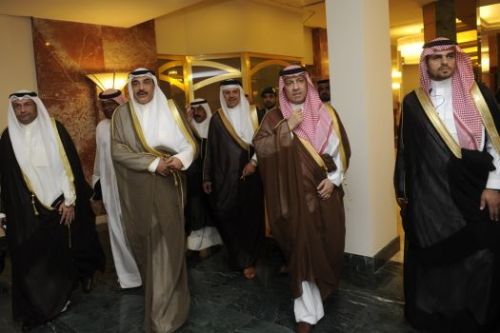
Gulf Cooperation Council officials arrive at the conference hall where a ministerial meeting was held on June 5, 2012 in the Saudi Red Sea port city of Jeddah. Saudi Arabia’s Foreign Minister Prince Saud al-Faisal urged Gulf states to mobilize their resources in response to uprising around the region. (AFP/Getty Images)

DOHA, Qatar — With much of the Arab world in a do-or-die stampede toward greater democracy, Saudi Arabia is looking to consolidate the old way of doing things.

Riyadh is pushing a bold agenda to strengthen the long-standing union between its fellow Gulf monarchies, apparently to prevent the Arab world’s revolutionary fervor from spreading.

The move was met with skepticism and outright hostility from neighboring states, which are reluctant to cede their growing autonomy.

“Since last year, Saudi Arabia has presented itself as the leader of the counter-revolution in the region,” said Marc Valeri of the Institute of Arab and Islamic Studies at the University of Exeter. “The Saudis were not happy with what happened in Egypt, in Libya, in Tunisia, and in Bahrain, obviously. This push for integration was clearly linked to what happened during the Arab Spring.”

More from GlobalPost: Arab regimes embrace Facebook and Twitter, for their own ends

At a May summit, Saudi’s King Abdullah proposed creating a closer political, economic and military union with the five other Arab monarchies that comprise the Gulf Cooperation Council. The details of the failed agreement were never made public. Instead, the states proposed to meet again in December.

Like six siblings with different personalities and interests, the GCC countries — Saudi Arabia, Bahrain, Kuwait, Qatar, Oman and the United Arab Emirates — are prone to infighting and power struggles. But the Saudis are banking on a shared mistrust of countries outside the Gulf — in this case, changing countries like Egypt and Tunisia — to bring the family closer together.

“The call for unification within GCC countries signals a resumption of a bipolar region, featuring the rise of post-authoritarian states on the one hand, and the solidification of conservative regimes on the other,” said Abdullah Al-Arian, an assistant professor at Wayne State University.

There has been a misperception that the move toward a closer union was intended primarily as a warning from the Sunni-dominated Saudi Arabia to the Shiite-majority Iran.

“There is an element of Iran taking advantage of a deteriorating situation in Bahrain to expand its influence and create even greater headaches for the Gulf rulers. But as the Bahrain Commission report clearly stated, there is no evidence so far of direct and clear Iranian interference. So the fact that the Bahrain uprisings have continued points toward internal dynamics about which the Gulf rulers have to also worry about,” said Christian Koch, director of the Gulf Research Center Foundation.

More from GlobalPost: The Gulf is raising a bigger army. But for what?

Koch doesn’t know whether a closer union would actually overcome those hurdles.

“I believe the GCC states are evaluating the domestic political situation differently, and given those different perspectives, they are not all on the same page as far as further unity is concerned,” he said.

In March 2011, Saudi Arabia deployed more than 1,000 troops to Bahrain to quell the increasingly violent protests from the island nation’s majority Shiite population. Riyadh also compelled other GCC nations to send military forces to demonstrate a unified front against pro-democracy activists.

“Kuwait was bullied into sending Peninsula Shield forces to Bahrain and their entire government fell because of divisions within parliament that were instigated by the disagreement,” said Justin Gengler of Qatar University.

Recognizing that a broader partnership with Saudi Arabia would lead to more of this kind of interference, Kuwait, Oman, the UAE and Qatar have no interest in ceding regional and international influence to the kingdom.

GCC powerhouse Qatar is particularly is wary of any broader cooperation.

More from GlobalPost: Qatar, by promoting female athletes, pressures conservative Saudi Arabia....

“The Qatari reaction and the entire GCC reaction would be one of fear that you’re next,” Gengler said. “Maybe not in the immediate sense but the precedent of a Saudi takeover of Bahrain means once you sort of run out of economic sources to defend yourself like Bahrain has, you’re fair game for the regional power to eat away at your political independence.”

Qatar, in particular, is wary of outsized Saudi influence on its affairs.

“Qatar has an independent foreign policy and an independent economic influence all over the world, particularly in Europe and Asia. They don’t want Saudi Arabia to interfere,” Valeri said.

The United Arab Emirates has similarly clashed with Riyadh over past efforts to mold the GCC in the image of international bodies like the European Union.

“The UAE withdrew from the discussions about common currency two years ago and that’s why,” he said. “They wanted the central bank to be based in the UAE and Saudi Arabia didn’t. There’s an economic competition and a competition for influence.”

The individual countries also have long-held geopolitical relationships with the United States, which diverged sharply from Saudi Arabia in response to the Arab Spring uprisings. Qatar, in particular, might find it more advantageous to rely on the West than its powerful next-door neighbor.

“Qatar may become less assertive and more willing to be dependent on the US following a Saudi-Bahraini union,” said Mark Katz of George Mason University. “Being wealthy but weak is not a long-term recipe for being influential internationally.”

The larger issue is whether these increasingly independent countries will become even less reliant on one unified body going forward.

“The Saudis certainly hoped to at least establish a degree of consensus that the GCC states should work together on common goals,” Koch said. “It is just that the concept of union is more complex than was initially thought and as the committee took up its work of examining the issues, more fundamental questions came to the forefront about exactly what the concrete idea behind the proposal was.”

Koch concluded that the GCC members realized that greater unity meant either domination by Saudi Arabia or surrendering considerable sovereignty to the GCC, which the states weren’t willing to accept.

“There was no other way but to postpone the issue,” he said. “As a result, I have doubts that the concept will gain more traction by the end of the year summit meeting.”....


Saturday, June 9, 2012

Plans to move Middle Eastern gas to Europe stuck in the tube....


Serious plumbing problems have arisen in the last year for the region’s multibillion-dollar pipeline plans. For starters, the Euro Arab Mashreq Gas Pipeline, also known as the Arab Gas Pipeline (AGP), has been attacked 14 times over the past year in Egypt’s Sinai Peninsula, ending exports to Jordan, Syria and Lebanon, as well as to Israel via an offshoot pipeline. At the tail end of the 1,200 kilometer pipeline, the uprising in Syria has postponed the completion of the AGP's final leg to Kilis in Turkey.


Plans to move Middle Eastern gas to Europe stuck in the tube....


Meanwhile, the recent Zioconned European Union (EU) sanctions on Iran have spelled the end of the viability of the much feted Nabucco gas pipeline that was to take gas from the AGP, Iran and the Caspian region, via Turkey, to Europe. The root of such pipeline problems is that usual suspect: politics. The AGP was attacked in the Sinai, according to statements by the Egyptian Ansar Al Jihad group, as part of a campaign against “the corrupt (Egyptian) regime and its Jewish and American backers.” Indeed, last year’s revelations about the preferential pricing of Egyptian gas have shown the shadowy political bends of the pipeline. When the AGP was launched in 2003, the Egyptian Natural Gas company described it as facilitating “the dawn of Arab integration”, but recently revelations have shown how it was used to sweeten Egyptian ties with Amman and Tel Aviv, with Washington’s blessing.

In 2005, Cairo had inked a long-term deal with Tel Aviv to sell gas at anywhere from $0.70 to $4 per million British thermal units (BTU), depending on which media sources one consults, well below the global average of $6 to $7. Jordan’s special price arrangement with Cairo was $3 per million BTU. The pipeline attacks have cost Egypt needed export revenues, likely the reason they pulled the plug on the Israeli contract last month. Now the Israelis will continue to shell out an additional $4 billion to source gas elsewhere while Jordan's energy bill will be an extra $2.4 billion this year to offset the loss of as much as 25 percent of the kingdom's energy supplies.

Significantly, the pipeline shutdown has highlighted the AGP’s over-dependence on Egyptian gas, something energy observers have pointed to for years. On paper, Egyptian gas was to flow through Jordan to Syria and Lebanon, with Syria pumping in its own gas for export on to Turkey and ostensibly to Europe. The problem is Egypt's domestic energy consumption is rising fast, as is Jordan's and Syria's; even if the pipeline is completed, there will likely not be enough Egyptian or Syrian gas flowing through the AGP to meet even the Levant's needs, let alone leave extra to sell on to Turkey or Europe.

For the AGP to be viable if or when it re-starts, more gas must be sourced — perhaps from Iraq or Qatar to supply the AGP in Syria, or from Iran and the Caspian region which can connect to the AGP via the Nabucco network in Turkey. Iraqi instability, however, means completion of that part of the pipeline network is years away, while the Nabucco pipeline is no closer to realization than when it was announced in 2002.

Financing Nabucco has been a major obstacle, which is forecasted to cost as much as $25 billion. But what may be the death knell was the EU's decision to follow Washington in slapping sanctions on Iran earlier in the year, ending all energy exports from Iran to the EU. Nabucco is only commercially viable if it can draw on Iran’s reserves — the world's second largest — as Azerbaijan and the Caspian states cannot provide enough gas for Europe, Turkey, the AGP and other export commitments.

What is supremely ironic about the EU's decision is that Nabucco was supposed to loosen Russia’s grip on the EU's gas imports — currently at some 34.2 percent — given Moscow’s propensity to turn off the taps to enforce its will, as it did during a price dispute with the Ukraine during the icy winter of 2009.

Theoretically, pipeline networks linking the Middle East, the Caspian region and Europe would make for glorious dividends for all involved. Political shenanigans, however, will likely keep these networks pipedreams, especially given that the crucial link — Syria — looks to be spinning down the tube for some time to come.

PAUL COCHRANE is the Middle East correspondent for International News Services and a regular contributor to the UK Energy Institute’s Petroleum Review
The perils of the Zioconned pipedreams.....
Israel wants to seize the Euro Arab Mashreq Gas Pipeline, also known as the Arab Gas Pipeline (AGP). Now if you follow the route of the pipeline in Syria, you'll understand easily that all the massacres carried follow the exact same route of the pipeline and the second one coming from Iran putting Israel and their Nabucco pipeline aside. Israel wants the end of the Sunnis in Syria and the end of the Al Assad government but in a long and slow motion and endless ethnical and religious war!


(Posted with permission from
Foreign Policy in Focus)

Israel is creating two buffer zones in Libya and Syria. These zones will be used to expand and complete the destabilization of the MENA area through civil wars, while taking control of all the gas and oil pipelines routes towards Asia, Central Asia, Africa, and Zioconned Europe.


Friday, June 8, 2012

Gas price agreement eludes Putin in China...


Gas price agreement eludes Putin in China...
By Robert M Cutler

MONTREAL - Moscow and Beijing again failed to bridge their difference over the selling price for Siberian gas during Russian President Vladimir Putin's just concluded visit to China, but the two sides compensated for this failure by signing a raft of other accords for economic cooperation and by confirming agreement on a series of anti-US realpolitik policy positions (for example, Syria).

The two countries' boilerplate anti-Americanism papers over their increasingly cut-throat competition for hydrocarbon resources in Asia and the financial means to develop them. The "great game" between them centers on Siberia and Central Asia.

In the run-up to the summit, the Russian side once again expressed hopes of reaching a price agreement for the 68 billion cubic meters per year (bcm/y) of natural gas that it wishes to sell to China from both Eastern and Western Siberia through two different pipeline systems still to be constructed. The Russian leader, who resumed the presidency for a third term earlier this month, took with him to Beijing the heads of gas giant Gazprom and other energy companies as well as six cabinet ministers.

Such a contract estimated at roughly US$1 trillion threatens to disappear like vapor. This contract has been under discussion between the two sides since the signature of a Gazprom-China National Petroleum Corporation (CNPC) memorandum of understanding in 2004. A route from Western Siberia would carry 30 bcm/y, while another from Eastern Siberia would carry 38 bcm/y. However, the two sides seem never even to have agreed which should be built first.

Negotiations since then have also foundered over price, and in the meantime Beijing has diversified its energy suppliers to decrease its dependence on Russia. Last December, Turkmenistan agreed to increase its gas exports to China from the 40 bcm/y already planned to 65 bcm/y; China will also soon be importing 10 bcm/y from Kazakhstan. Those amounts are in addition to increasing liquefied natural gas imports from Middle East sources.

For the Siberian gas, the Moscow business newspaper Kommersant cited sources late last year to the effect that the Kremlin was insisting on a price of $400 per thousand cubic meters (tcm) to China. However, the price of Turkmenistan's gas to China was then reported to be about $250/tcm, and the Russian press agency RIA-Novosti this month cited the latter figure as the price that China was offering to Russia for the gas from Siberia.

It is becoming apparent that Russia's interest in selling the Siberian gas to China is more vital than China's interest in buying it, especially as the price of oil, upon revenue from which the Russian state budget is highly dependent, continues to fall.

Moscow pretends to Beijing that it can sell the gas for more than that to Europe. However, Putin is complicating matters for himself by telling European Union leaders in Brussels early this month, just before he left for the Beijing meetings, that they should negotiate with his planned Eurasian Economic Union (EEU), which is intended to include several Central Asian states, since Russia has supposedly surrendered national competence to the EEU's "Common Economic Space".

The EU and Russia have been negotiating a new basic agreement for their relationship for four years, but uncertainties about Russia's World Trade Organization (WTO) status have stymied them since the beginning of last year. Russia could become a World Trade Organization (WTO) member this year, but Moscow's creation of a customs union with Belarus and Kazakhstan has put question marks over the entry into force of its WTO agreement.

In Putin's view expressed earlier this month in Brussels, however, the EU's European Commission "can and should" obtain a mandate to negotiate with the EEU and "take into account" Belarus's and Kazakhstan's commitment to the customs union, while the idea of the EEU could promote trade and cooperation "if based on WTO rules".

The qualification is necessary because the EEU does not really exist yet, and is planned only for 2015, since its terms are still to be drawn up by the newly established Eurasian Economic Commission, not all members of which have yet been identified.

How the EEU should dovetail with the Shanghai Cooperation Organization (SCO), a summit of which Putin was officially in Beijing to attend, is never explained. But then, the current SCO members have still not even agreed on rules for admitting new members. Its multilateralism seems mainly a shell, and any international juridical personality is largely passive.

The continuing failure to establish a multilateral SCO development bank illustrates the dynamic at work. It is fairly clear that Russia and China, representing the two largest national economies in the SCO, would be the principal contributors of capital to any such bank.

However, Russia has no reason to promote such an institution because it can work through the Russia Direct Investment Fund if it wishes to promote investment in Russia and can always rely on its bilateral relations for a framework for its own investments in such other SCO countries as Kazakhstan and Uzbekistan.

China's Xinhua news agency, on the other hand, headlined a promise by the country's President Hu Jintao to offer a loan of $10 billion "to support economic cooperation within the Shanghai Cooperation Organization". Nevertheless, the fine print makes clear that this is not the long talked-about multilateral institutional mechanism but merely a subsidy for its own people to study abroad, for scholarships in SCO countries, and for sponsoring foreigners to attend Confucius Institute language and cultural centers and other expert-level training.

China's principal motive in the rhetorical push for the creation of an SCO development bank would merely be to help make the case for the yuan as an international currency. As Chen Yuan, chairman of China Development Bank (CDB) said in the margin of the SCO meeting, "We are trying to promote local currency settlements."

Thus the CDB, which opened an office in India in 2007, has already lent $4.4 billion to Indian companies for projects for building roads, telecommunications, and other infrastructure, the Times of India reports. Chen, who is also a member of the Communist Party of China's central committee, noted: "We look forward to increasing our role in India".

China does not need an SCO bank. The CDB was created in 1994. It focuses on financing mid- and long-term infrastructure and energy projects and claims to be the world's largest development banking institution. It is financing the East Siberia - Pacific Ocean oil pipeline in Russia, which includes a spur delivering 300,000 barrels per day to China, as well as the Turkmenistan-China gas pipeline and hydroelectric projects in Kazakhstan.

The CDB's investing arm, CDB Capital, was established in August 2009 and is the only Chinese bank subsidiary licensed to invest in yuan. Last December, offshore investment firm CDB International Holdings was inaugurated in Hong Kong, tasked with running CDB Capital's overseas investment operations, particularly direct investment and asset management.

Nevertheless, the CDB has not participated in the China-Russia Investment Fund (CRIF), announced last year with a capital of between $2 billion and $4 billion. It is now formalized that both the Chinese and the Russian side will contribute only $1 billion each from state sources, with the other $2 billion to be sought from private Chinese investors, although why the latter should avail themselves of the CRIF remains to be seen.

In the event, the Chinese and Russian leaderships saved the day by promising to increase trade turnover from $84 billion last year to $100 billion in 2015 and $200 billion in 2020. Towards this end, they signed no fewer than 20 agreements, accords, and memoranda of understanding in a variety of fields including energy efficiency, nuclear power production, transport machine building, and research and development in high-tech industries including information technology. An agreement on a joint venture to develop and build long-haul aircraft apparently eluded negotiators.

Dr Robert M Cutler (
http://www.robertcutler.org), educated at the Massachusetts Institute of Technology and The University of Michigan, has researched and taught at universities in the United States, Canada, France, Switzerland, and Russia. Now senior research fellow in the Institute of European, Russian and Eurasian Studies, Carleton University, Canada, he also consults privately in a variety of fields.

Thirst for energy driving China's and everyone else's foreign policy....


Thirst for energy driving China's and everyone else's foreign policy....

By MICHAEL RICHARDSON;

SINGAPORE — The United States and China, the world's top users of energy, are heading in opposite directions. It is a trend that has major geostrategic implications for the Asia-Pacific region.

The U.S. is more certain that most of its future oil and gas will be produced at home. It is becoming less reliant on imported oil and natural gas as it ramps up domestic output and consumes fewer liquid fuels because of falling demand and energy saving advances, particularly in transport and industry.

Meanwhile, China is becoming ever more dependent on oil and gas shipped or piped into the country, mainly from faraway sources of supply that are often in politically volatile parts of world, including the Middle East, Africa and Central Asia. As a result, Beijing's sense of insecurity about future energy supplies is rising.

China is modernizing its armed forces not just to reclaim Taiwan by military means if necessary. China wants to protect its maritime trade routes and secure access to offshore energy, mineral and fisheries resources in nearby seas, including the East China Sea — where it faces conflicting claims to jurisdiction from Japan — and the South China Sea, where its claims to jurisdiction are contested by the Philippines, Vietnam, Malaysia, Taiwan, Indonesia and Brunei.

China also wants to enhance its security by establishing an offshore zone of influence that it will be able dominate, instead of the U.S. and regional allies.

Despite America's recently declared strategic "pivot" to Asia, its relative power and influence is declining. This is unlikely to change even if China's growth slows somewhat.

As America gains energy security in a time of cost-cutting, it will have less incentive to continue expensive military protection of maritime supply lines in increasingly contested areas such as the seas off China's coast, the oil and gas-rich Persian Gulf, and around the Middle East and Africa, prompting China to extend its own military reach into the Indian Ocean, through which so much of its imported oil and gas comes.

This will heighten tensions with India. Stephen Walt, a professor of international affairs at Harvard University's Kennedy School of Government has projected the outcome of U.S.-China economic, military and energy trends in this way: "If China is like all previous great powers, including the U.S., its definition of 'vital' interests will grow as its power increases — and it will try to use its growing muscle to protect an expanding sphere of influence.

"Given its dependence on raw-material imports (especially energy) and export-led growth, prudent Chinese leaders will want to make sure that no one is in a position to deny them access to the resources and markets on which their future prosperity and political stability depend.

"This situation will encourage Beijing to challenge the current U.S. role in Asia. Over time, Beijing will try to convince other Asian states to abandon ties with America, and Washington will almost certainly resist these efforts. An intense security competition will follow."

The most recent sign of this regional struggle for supremacy is in the South China Sea where China and the Philippines, an ally of the U.S., have been at loggerheads for nearly two months over ownership and control of Scarborough Shoal, a reef and fishing ground that is far closer to the Philippines than to China.

Such disputes can be contained. Or they can lead to China prevailing over weaker, less determined opponents. Or they can result in armed conflict. If the U.S. or its ally Japan became involved, there could be a wider war that would destabilize Asia.

Is there a way for China to emulate the U.S. and become substantially less dependent on foreign oil and gas?

Until 1993, China produced enough crude oil to meet its needs. But as growth surged, oil imports rose. China now imports 55 percent of its oil consumption, a ratio that is set to increase.

Natural gas, the least polluting of fossil fuels, is on a similar trend line. By 2020, China's gas imports by pipeline and sea will make up nearly 33 percent of demand, up from around 20 percent now and none in early 2006, when China cease to be self-sufficient in gas.

Chinese leaders have called this foreign dependence their "Malacca dilemma." About 85 percent of China's oil imports, and a growing proportion of its gas imports, come by sea through the Indian Ocean, the Straits of Malacca and Singapore in Southeast Asia, and the South China Sea. Much of this vital energy supply originates in the Persian Gulf. The only way into and out of the gulf by sea is via the narrow Strait of Hormuz. The shipping channels here and in the Malacca and Singapore straits could be blocked or disrupted in a crisis. Japan is even more dependent than China on this maritime artery for energy imports.

By contrast, much of the recent rise in America's gas and oil output has come from exploiting reserves found deep underground in shale rock within the continental U.S. Advances in technology, including hydraulic fracturing in which water, sand and chemicals are pumped under high pressure into the shale to break up the rock and release gas or oil, have enabled these reserves to be unlocked.

China has the world's largest known shale gas reserves, much bigger than those of the U.S. in second place. The Ministry of Land and Resources in Beijing estimates that China's exploitable reserves of shale gas amount to 25 trillion cubic meters (tcm). But a recent report from the International Energy Agency (IEA) puts them at 36 tcm, about 12 times China's conventional gas deposits and enough to last for well over 100 years at current consumption.

China has only just started to tap its shale gas resources. It aims to pump as much as 100 billion cubic meters by 2020, about the annual production rate today from conventional gas reserves that are easier to exploit.

However, the IEA says that based on what is known about China's geology, shale gas resources may prove more difficult and more expensive to develop than those in North America.

The most promising shale reserves are in the water-short north and west of China. There is concern that exploiting them on a large scale will cause pollution and deplete scarce water supplies.

Even if China succeeds in well-regulated, high-growth shale gas production and countrywide distribution by pipeline, the IEA concludes that projected Chinese energy demand is so big that all it will do is limit gas import dependence to 24 percent by 2020, instead of 51 percent in a low production scenario.

So Japan should plan for strategic jousting to intensify in Asia-Pacific seas and spread to the Indian Ocean.

Michael Richardson is a visiting senior research fellow at the Institute of South East Asian Studies in Singapore.
The Japan Times.

Thursday, June 7, 2012

Big finance prefers the whip and chains....


Big finance prefers the whip and chains....


How to leave your (euro) lover,
By Ellen Brown

The problem is all inside your head she said to me
The answer is easy if you take it logically
I'd like to help you in your struggle to be free
There must be fifty ways to leave your lover.
- Lyrics by Paul Simon

The euro appears to be a marriage of incompatible partners. A June 1 article in the London-based Telegraph titled "Why Europe's Love Affair with the European Project Is Ending" reported that two-thirds of 9,000 respondents thought that having the euro as their single currency was a mistake.

For Greece, it was a tragic mismatch from the beginning; and like many a breakup, it is really about money. Greece is a vivacious young woman chained to a tyrannical old man. She yearns to be free to dance on her own; but breaking up is hard to do. Defaulting on her debts will force her out of the eurozone and back to issuing drachmas, and she could get brutally beaten by speculators on foreign exchange markets for her insolence.

Fortunately, there are alternatives to an ugly divorce. The treaties binding the 17 member nations are just a set of rules, entered into by mutual agreement; and rules can be bent or broken, especially in crises. The European Central Bank (ECB) broke a litany of rules to save the banks, as did the Federal Reserve to save Wall Street in 2008. Rules that can be bent for banks can be bent for people and nations - not just Greece, but all the other eurozone countries threatening to file for divorce.

Paul Simon says there must be 50 ways, but here are five creative alternatives.
1. The open marriage: return to the drachma without abandoning the euro - James Skinner, former chairman of the New Economics Foundation in the UK, suggests that the Greek government could start issuing drachmas without abandoning the euro. Drachmas could be reserved for domestic use - to pay the government's budget, hire workers, build infrastructure and expand social services. He writes:
Greece is suffering from a lack of money because the only source, the single currency, has dried up. But there is no law that states that there has to be only one currency.

... By enabling the Government, monitored by the Central Bank, to spend newly created money directly into the economy, bypassing the banking sector, the burden of increasing national debt can be avoided. ...

This programme for creating a new Greek drachma, bypassing the private banking sector, could start tomorrow. Its immediate effect would be to get the unemployed back to work. All existing euro transactions can continue as before, quite separately from the new currency. The two currencies can perfectly well co-exist and run alongside each other. ... Foreign banks will continue to deal in euros and other currencies as usual.
This solution was successfully used in Argentina when its currency collapsed in 2001. The government walked away from its debts and started issuing its own Argentine pesos. Three years after a record debt default on more than US$100 billion, the country was well on the road to recovery. Exports increased, the currency was stable, investors returned, unemployment diminished and the economy grew by 8% for two consecutive years.

2. Separate bank accounts: fire up the printing presses at the Greek central bank - In a March 19 article on Seeking Alpha, George Kesarios observed that the Greek central bank has the power to issue more than just drachmas. The ECB is not an ordinary central bank:
Rather, it is a confederation of central banks. Each European national central bank can theoretically do the same types of market operations as the ECB and then some. The forefathers of the euro have left many monetary windows open, which, if used correctly, can solve the European debt crisis in a very short period without taxpayer funds.
He cited article 14.4 of the Protocol on the Statute of the European System of Central Banks (ESCB), which provides:
14.4. National central banks may perform functions other than those specified in this Statute unless the Governing Council finds, by a majority of two thirds of the votes cast, that these interfere with the objectives and tasks of the ESCB. Such functions shall be performed on the responsibility and liability of national central banks and shall not be regarded as being part of the functions of the ESCB.
That means the national central banks can do whatever the ECB can do - and even things it can't. The Greek central bank could step in and start issuing euros itself. Again, there is precedent for this. It was under Article 14.4 that the Irish central bank was able to print 80 billion euros (US$100 billion) as "emergency liquidity assistance", and the Greek central bank has already printed 44 billion euros itself.

The Greek government could print euros, refinance its sovereign debt, and pay the interest to itself, effectively eliminating the interest burden. Among other precedents, there is Canada, which borrowed from its own central bank from 1939 to 1974 to fund major infrastructure projects and social programs. It pulled this off over a 25-year period without hyperinflating the currency, driving up prices, or increasing the public debt, which remained low and sustainable.

There is the concern that the euro might suffer by devaluation if other eurozone members followed suit. But Kesarios points to the Japanese experience, "where one can print and print and then print some more, without the value of the currency being marked down (due to positive trade flows)." The euro might be equally resilient.

3. Divorce: just walk away - According to the May 29 New York Times, the 130 billion euro bailout that was supposed to buy time for Greece is now mainly just servicing the interest on the debt. The "troika" - the ECB, IMF, and European Commission - which holds three-fourths of the debt, is sequestering the bailout funds to be paid right back to themselves in interest payments. This is merely going to compound the debt to disastrous levels, without a single cent going to the Greeks or their comatose economy.

Interest rates on Greek 10-year bonds have gone to nearly 30% recently. Under the Rule of 72, at 30% compounded annually, debt doubles in 2.4 years. If the Greeks can't even pay the interest on the debt today except by borrowing, how are they going to repay double the principal in a mere 2.4 years? At 30%, the Greeks could be paying over 100% of their gross domestic product in interest charges. Legally, a contract that is impossible to perform is void.

Alexis Tsipras, leader of the radical left-wing Greek party Syriza, which is now in second place in the Greek parliament, calls it an "odious debt", a legal term for a national debt incurred by a regime for purposes that do not serve the best interests of the nation. An odious debt under international law need not be repaid.

4. Spousal support: the public bank option - If divorce is too much to contemplate, Greece's crippling interest burden can be relieved by taking advantage of the ECB's very generous 1% rate for bankers. Article 123 of the Maastricht Treaty forbids member governments from borrowing directly from the ECB, but it makes an exception in paragraph 2 for "publicly owned credit institutions" - something Greece will have plenty of when it nationalizes its banks. They can line up at the ECB's window for its bargain-basement 1% banking rate and use the borrowed funds to buy up the national debt.

Researcher Simon Thorpe wrote to the ECB and asked whether they would object if a publicly owned credit institution were to borrow from the ECB and use the funds "to supply the money to a government such as the Greek government in order for that government to pay off its debts to financial markets." [1]

The ECB replied:
According to the Treaty - as you have just quoted - such publicly owned credit institutions "shall be given the same treatment by national central banks and the ECB as private credit institutions". It is up to the banks to decide how to use the money they have borrowed from the central bank system.
5. The dowry: impose a financial transaction tax - Thorpe notes that the ECB has issued and lent nearly one trillion euros to the banks at 1% since December 2011 - three times the total Greek debt of 355 billion euros. [2]

If Greek public banks borrowed from the ECB at 1% and bought Greece's sovereign debt, the debt could be paid off in 10 years just from the returns on a very modest financial transaction tax (FTT) of 0.3%.

Imposing a tiny FTT on all financial trades would not only be a lucrative source of revenue but would prevent the attacks of speculators, both on the newly issued drachma and on the sovereign debt of Greece and other Eurozone countries. The FTT has already been implemented in many countries. In 2011, there were 40 countries that had FTT in operation, raising $38 billion (29 billion euros). [3]

Where there is a will, there is a way
The problem is finding the will, particularly among the Eurocrat leaders holding the reins of power, who may not be looking for an amicable workout. The marital problems of Greece and the eurozone stem from an arbitrary set of rules that were entered into and can be changed by agreement.

But as Mike Whitney maintained in a June 3 article titled "Europe Moves Closer to Banktatorship": "These people are not interested in fixing the EZ [eurozone] economy. They are engaged in a stealth campaign to ... solidify the power of big finance over the individual states. [4]

To avoid that dire scenario, the popular majority needs to grab the reins of power. It is fitting that Greece, the birthplace of European culture and democracy, is the focus of the struggle against bondage to an elite banker class. Greece can dance again if she can set herself free.

Notes
1. See
here.
2. See
here.
3. See
here.
4. See
here.

Ellen Brown is an attorney and president of the Public Banking Institute, PublicBankingInstitute.org. In Web of Debt, her latest of 11 books, she shows how a private cartel has usurped the power to create money from the people themselves, and how we the people can get it back. Her websites are WebofDebt.com and EllenBrown.com.

In Syria; Fierce Battle for Strategic Space and Energy Resources....


In Syria; Fierce Battle for Strategic Space and Energy Resources....

A great geo-political strategic struggle is now underway in Syria, with balance slightly tilted in favor of Syria and Iran with full support from Russia along with China. My assessment is that if peace is not brought to Syria and a political settlement sought, destruction of this crucial strategic key stone in Middle East will have very serious repercussions and strategic consequences not only for the region but also for the strategic balance and the economic and strategic health of the world for a long time.
Apart from other contentious issues including US led Western attempt to ignite the Shia-Sunni conflict as in Iraq , a link up of territories from the East of Caspian via Iran, Shia ruled Iraq, Alwaite ruled Syria and Hezbollah dominated Lebanon will provide routes to carry oil and gas bypassing US led projects over Azeri and Turkish territories.
A major actor in the struggle is Russia's newly re-elected and invigorated Vladimir Putin, who saw how his motherland, former USSR was broken into pieces and up to US$ 1 trillion worth of Russian wealth transferred to Western banks and institutions .He has declared that enough is enough. Moscow has almost full support from China in this regard because weakening or breakup of Syria would very adversely impact Iran, which when feeling cornered or worse if invaded will hit out at NATO and its Arab allies in GCC led by Saudi Arabia. It would be then be a war with no holds barred, almost.
India which is pussy footing on this vital issue wrongly believes that the West plus Sunni Arab countries would come up trumps. New Delhi has 6 million Indians working in the region and billions of dollars are sent as remittances to India. The whole area would be in turmoil for long and borders would be rearranged.
If Syria feels that the regime is being destabilized , then its 10-12% ruling Alawaite elite, it's Sunni supporters including so far security forces and the merchants, more than 10% Christian population and same percentage of Syrian Kurds would fight back ferociously.
Ankara has been following a very dubious foreign policy under the sway of Saudi money and influence encouraged by Washington .Turkey's border province of Hatay known as Antakya or Antioch in history, has a large Alwaite population. This was perhaps one of the reasons why the ruling Sunni regime before World War II did not protest as much as it would now, when under a dubious referendum the province was transferred to Turkey by European powers hoping that Ankara would join them in World War II. But heeding Kemal Ataturk's sane advice before his demise, Ankara stayed neutral during the War .In Turkey, the Shia Alevis comprise 15% of the population and are mostly the original Turkic migrants from Central Asia.
Syria and its Kurds provided a fertile soil for PKK, the Turkish Kurdish Marxist organisation which has been fighting for autonomy in south-east of Turkey since 1980s, a rebellion in which over 40,000 Turkish citizens including 5000 soldiers have been killed. PKK leader Abdullah Ocalan now imprisoned near Istanbul was based in Syria with PKK training camps till 1999. Already PKK is restive again and both sides have indulged in violence, killings and reprisals. The Kurds comprise nearly 20% of Turkey's population.
The ruling Islamist Justice and Development party (AKP) is beholden financially and supported by money from Saudi Arabia, where President Abdullah Gul worked in a Jeddah bank for seven years before returning to Ankara to join politics in 1992. Located at the interface of Europe, Central Asia, Middle East and Africa, if Turkey can influence its neighborhood, events and powers in its neighborhood can also influence Turkey. Additionally, under AKP, Turkey's secular armed forces, a stakeholder in the nation's emergence out of the ashes of the Ottoman Empire and its modernization and secularization, have been insulted and humiliated .So a colonel's coup cannot be ruled out sometimes in future.
It is true that in Syria, the majority Sunni population is ruled by minority Alawaite elite, but the Arab Spring, actually was and hopefully remains Arabs revolt against US propped up the dictators like Hosni Mubarak and others. USA with its influence and Saudi Arabia with its petrodollars worried that the Arab Spring might flower in the mediaeval Kingdom ruled by Saud dynasty might lead to overthrow of the regime .So Riyadh and other kingdoms and sheikdoms in the Gulf have joined hands along with European and NATO states and Sunni Turkey with their military muscle to divert attention away from the peoples revolt , with obscurantist and extreme Muslim organizations like Muslim brotherhood Salafis , Al Qaeda and their kind being shoved and pushed into positions of power . For how long.
Since the re-inauguration of Putin's presidency, the Russian president has shown clear intentions of resisting U.S.-led Western encroachment on Russian space in Central Asia and in the Middle East where also its strategic interests lie. In this it has substantial support from China, which needs energy from Iran where it is investing heavily. The encroachment by NATO and the West right into the heart of central Asia, Uzbekistan and Kyrgyzstan was stopped by energizing the Shanghai Cooperation Organization (in which Iran has Observer status)
A Reinvigorated Putin
After declining to attend the G8 meeting at Camp David, Putin after visiting Belarus, an important piece in restoring the old core Russian order, went to France and Germany. Paris now under a socialist president Hollande is inclined to move away from the US hegemony which has been France's policy since the days of Charles de Gaulle. Germany under a Conservative Angela Merkel would be more difficult to persuade, although her two predecessors Schroeder and Kohl had tried to move away from American strangle hold with US troops still stationed in the country even though World War II ended in 1944. Both of them paid the price of Washington's anger and lost elections and power.
Intervention by NATO forces and some Arab and Muslim countries like Turkey in Libya after a blatant misinterpretation of the UN Security Council resolution has brought catastrophe on the people of Libya ( Western corporate media is stunningly silent on the ongoing tragedy with Al Jazeera joining with gang of BBC, CNN and Fox News).While reportedly 5 to 10,000 Libyans were killed before the NATO's shock and awe intervention, since then upto 100,000 people have been reportedly killed, it's ruler Qadhafi killed like a dog much to the glee of the West and its supporters. The country lies in ruins and people are being killed daily ,with Al Qaeda, Salafi and other extremist elements taking over power .In spite of this horrible example the West and Sunni Muslim countries are determined to do an encore in Syria.
There are Syrian groups supported and even infiltrated from outsiders under various names which have refused to negotiate with the Syrian regime and the West and some of its allies are asking for open intervention. But the situation is quite different from Libya. Syrian ports are the only ones in Mediterranean where Russian naval ships can dock and refuel. The Russians have supplied to Syria top-quality missiles and other equipment to defend the country. The Russian presence itself should act as a deterrent to any foolhardy adventure which if it goes wrong like the simple attempt to rescue American Embassy hostages from Iran in 1980 could boomerang on Obama's re-election chances as that fiasco had on Jimmy Carter's
India's Changing Stance on Syria

Ambassador M K Bhadrakumar wrote recently that India buckled under the combined pressure from Washington and the alluring charm of the oil monarchs of the Persian Gulf. India's Syria policy took a circle last week to return to where it all began at the 'Friends of Syria' meet in Tunis on February 24 , notwithstanding a visit by Iranian foreign minister Ali Akbar Salehi . The 'Friends of Syria' is a coalition of western countries and Saudi Arabia and Qatar that roots for 'regime change' in Syria. South Block had abstained on the resolution in the United Nations Human Rights Council in Geneva on March 1 over alleged human rights violations by the Syrian government. India came out strongly supportive of the mission by the joint UN envoy Kofi Annan. An 'inclusive' Syrian-led, Syrian-owned dialogue. This phase ended last week with India voting in favor of the resolution sponsored by the United States and Turkey at the UNHRC demanding an international inquiry into the recent violence in Houla. India effectively rejoined the 'Friends of Syria'.

The Indian vote is based on political expediency insofar as the US-Turkish resolution presumes that the Syrian government is responsible for the Houla massacre, and in spirit it contravenes the Security Council resolution on Syria.
India saw many exchanges with Gulf nations ; a Joint Commission meeting with Saudi Arabia (January 6); travel advisory on Syria (January 7); foreign-office consultations with UAE (February 8); defense minister visits Saudi Arabia (February 13); EAM's visit to Cairo (March 2); visit by MOS for external affairs E Ahamed to Saudi Arabia (March 13); visit of deputy foreign minister of Saudi Arabia (March 30); state visit by emir of Qatar (April 4); joint visit by EAM and MOS Ahamed to the UAE (April 14); visit by UAE foreign minister (May 16); visit by crown prince of Bahrain (May 29) and travel advisory on Syria (May 30). India appears like a camp follower. Storm clouds are gathering over Syria. The systematic assault by the US and its Saudi and Qatari allies on Annan's mission, debilitating and discrediting it at every point, is entering a crucial phase and an overt intervention in Syria is likely. Indeed, top US officials have spoken of intervention even without UN mandate. The specter that haunts the region is a Syria plunging into protracted civil war that could be far more catastrophic for regional security and stability than the bloodbath Lebanon went through for over a decade.
Writing in Lebanon's Al Akhbar of June 5 As'ad AbuKhalil raised "Some Questions on the Houla Massacre...and Beyond,"
He said,"It is not known who perpetrated the Houla massacre. It is certain though that both sides (the Syrian regime army and the gangs operating under the banner of the Free Syrian Army) have a record of brutality and disregard for human lives to qualify them to do the job.
"What is certain is that Houla was a propaganda blitz that dominated Western as well as Arab (Saudi-funded and Qatari-funded) media. The romanticizing of the so-called "Syrian Revolution" (the deeds of the Free Syrian Army (FSA) and Syrian National Council and the Muslim Brotherhood deserve the label of revolution as much as George W. Bush deserves the Nobel Peace Prize and as much as Bashar Assad deserves to serve as president of Syria) clashes with the actual record of the armed groups operating under the umbrella of the FSA.
"But it is time that we raise questions and we expose lies surrounding the Syrian uprising. Let us first remember that Western media basically surrender control of their editorial policies to their governments when they decide to go against a developing country. We remember that few raised questions about the wisdom of forming an army of militant Muslims in Afghanistan in the 1980s.
The cause of what later produced al-Qaeda was championed. I remember Dan Rather in Afghan clothes riding a horse and reporting on the "heroes" of the fight against communism. Lies and fabrications and exaggerations were the symptom of the coverage of Afghanistan at the time. And when the communist regime fell and was later replaced by the Taliban, there were no demands for accountability and no one asked Dan Rather if he ever met Bin Laden during his media stunt in Afghanistan.
"When Western governments were preparing for the invasion of Libya (you were led to believe that only Qatari forces were on the grounds in Libya by the way, given their battle-tested experience), the West's media yet again published unsubstantiated reports and claims about what was happening in Libya.
"The same media that stood silent when all Western leaders groveled before Gaddafi suddenly woke up to the reality of dictatorship in Libya. All sorts of claims were made: the number of 100,000 dead was thrown about casually (of course, it later proved to be untrue), and reports of foreign mercenary armies were a staple of the coverage (that was also untrue and the reports themselves fueled a racist anti-black campaign by the Libyan fighters after "liberation").
"Whatever happened to that woman who made that claim about being raped by Gaddafi's soldiers? Why was she deported from Qatar and what became of her? No one asked, and the media turned the page and started another campaign.
"It should be mentioned that some decent journalists may feel pressured to toe the line not only by the conventional wisdom of the establishment around them but also because the regime (whether in Libya or in Syria) is an awful dictatorial regime that does not deserve to last one day longer.But it should be stressed that the well-funded (mostly by Qatar, UAE, and Saudi Arabia) press offices of the exile Syrian opposition constantly and daily feed the Western media a large supply of lies, exaggerations, fabrications, and wild scenarios. These media offices (like the Syrian Observatory for Human Rights – and for everything else that propaganda requires) never have to account for their information or claims.
"They provide names of people inside Syria and Western correspondents merely Skype with them. Those whose names are provided by the press offices of the Syrian exile opposition merely confirm or reiterate or repeat verbatim whatever is being said by the exile offices. There have been videos shown on YouTube (since YouTube is the favorite source for Western media on Syria) in which injuries are faked and children are coached to speak about their experiences. All that never makes it into Western media.
"Even the obvious lies never get challenged. From very early on, there were many lies spread that have yet to be exposed. For months, Syrian opposition exile groups insisted that there were no armed opposition groups and they stressed that their movement is purely peaceful (and when pictures of armed men were displayed, they were dismissed as enemy propaganda).Yet, suddenly and without explanation, the same groups started to brag about and praise the armed opposition groups who ostensibly were leading a purely peaceful revolution. The propaganda agenda was clearly exhibited with the various statements (especially by exile opposition figures in Western and Saudi media) to the effect that the Syrian regime is being assisted by fighters from the Iranian Revolutionary Guards, Hezbollah, and the Mahdi Army.
.
"Similarly, the Syrian exile opposition also duped the Western press (and Western audiences in workshops, conferences, and panels) to think that the Syrian uprising is led by liberal peaceful feminists (and they would often name a woman or two), and would insist that the Muslim Brotherhood has nothing to do with the uprising in Syria. Of course, now we know better. Various leading figures in the Syrian National Council admitted belatedly that indeed the Muslim Brotherhood is running the show, and only after a year of the uprising did some in the Western press publish articles about the influence and clout of the Muslim Brotherhood.
"The Houla story is still murky. No one knows what happened. We know that there are innocent civilians who were killed. We know that both sides are exchanging accusations and we know that both sides are habitual liars. But we can raise some questions:--This does not settle it. We still don't know what happened in Houla. But a healthy dosage of skepticism is in order in the case of Syria especially as Western governments seem to pushing in the direction of military intervention.
There are many sides of the story but the Western media is only covering one side. (Neil Mac Farquhar flat out lied when he claimed twice in the New York Times that Syrian TV does not mention the armed clashes in Syria). To be sure, both sides can't be believed and their claims can't be taken at face value, but it is high time that real investigation of the Syrian story be undertaken by people who are not beholden to governments – East or West."
For Syrian Peace mission led by former UNSG Kofi Annan and its current fate and counter action against Western powers and Sunni allies being planned by SCO in Beijing watch this space.

K.Gajendra Singh, June 7, 2012 .Mayur Vihar, Delhi.


Room for a bloom midst the news' doom and gloom...


"Room for a bloom midst the news' doom and gloom..."


Wednesday, June 6, 2012

A Central Banker Utters The Truth....


On July 1, the Republic of Cyprus, a tiny country on a divided Mediterranean island, will rotate into the Presidency of the Council of the European Union—one of those bitter European ironies because Cyprus will likely have to be bailed out, according to Central Bank governor Panicos Demetriades. It adopted the euro in 2008 and is already in a heap of trouble. Last year’s loan from Russia has kept it afloat, but now it’s bailout and haircut time. For the very peculiar morass Cyprus is mired in, read.... Another Eurozone Country Bites the Dust.

And reality is now even staining the Teflon economy of Germany with a daily litany of suddenly awful data points:

New vehicle registrations, which had been holding up well, fell in May by 4.8% compared to prior year. Commercial vehicles spiraled down by 13%, and heavy trucks crashed by 32%.

The KfW business climate index for small and medium size companies dropped by 5.7 points, to 12.9, three times the normal monthly variation; for large firms, it dropped 5.8 points, to 12.3. In its explanatory statement, the KfW banking group, a government-owned development bank, used the terms “recession fear” and “panic attack.” A “clear warning that has to be taken very seriously” where “the risk of a downward spiral ... rose enormously.”

April industrial orders dropped 1.9%, the worst decline in six months—with export orders down 2.6%. The wobbly economies in Europe and elsewhere are finally catching up with the export powerhouse.

And Spain is begging desperately for a massive bailout of its banks, after claiming for years that they wouldn’t need one. But it doesn’t have the money, and “the door of the markets isn’t open to Spain,” explained Budget Minister Cristobal Montoro. So taxpayers in other countries should fork over the money, via the EFSF bailout fund, and pay it directly to the banks. Which is against the rules. Germany, insisting that rules be adhered to, opposes that scheme whose purpose it is to bail out Spain via its banks to avoid otherwise obligatory structural reforms. With these issues mucking up the predictions of growth in the US, CNBC’s pundit called on the US to bail out Europe.

What a relief then to hear a voice of reason. Even if it’s from a central banker, Jörg Asmussen, Member of the Executive Board of the ECB and a German politician in the opposition SPD. In articulating hard truths and an uplifting message, he followed in the footsteps of Jens Weidmann, President of the German Bundesbank and Member of the ECB Council who’d given an awesome interview in the lion’s den. Read.... Bundesbank President Lashes Out.

Asmussen was speaking in Riga about Latvia’s problems, its astonishing rise from the ashes, and its lessons for the Eurozone. In 2008, Latvia’s debt-fueled economy collapsed with a cumulative GDP decline of 24%, the worst in the world. Its currency peg to the euro came under sharp criticism. Pundits pressured it to devalue. Paul Krugman called it “the new Argentina.” But instead of going for the “quick fix,” Asmussen said, Latvia implemented tough “fiscal consolidation and structural reforms.” In 2009 alone, it cut its budget by 9%—far beyond any EU country. Harshest austerity, instead of spending and borrowing its way out of trouble. In the middle of a gigantic crisis!

Against everything Krugman holds so dear, the economy stabilized in 2010, and in 2011, GDP jumped 5.5%, the fastest in the EU. Cut off from the financial markets, Latvia had received emergency loans from the IMF and the EU, but its stunning fiscal and economic performance allowed it to return to the financial markets far faster than projected. Its competitiveness improved. And its currency peg to the euro remained intact.

Despite unmitigated austerity, the Prime Minister was reelected twice, while all those in the Eurozone who tried to reform anything at all were kicked out of office. Latvia had accomplished in the shortest time an “internal devaluation” rather than choosing an “external devaluation” via its currency.

“Speed is of the essence,” Asmussen said. The government attacked the deteriorating public finances, got the people to take ownership of the reforms, and “frontloaded” the toughest measures, rather than dragging things out and implementing half-measures. And it got them passed before “adjustment fatigue” wore people down.

“The bottom line is this: when adjustment is inevitable, it is better to take the medicine right away than to let the fever rise for months,” Asmussen said. Latvia demonstrated that an “expansionary contraction” isn’t an oxymoron. “Even if fiscal consolidation weighs on the growth prospects in the short term, it has sizeable positive effects in the medium to long term.”

Austerity alone wouldn’t have been enough. The government also implemented “growth-enhancing structural reforms” to foster a policy environment favorable to “growth and wealth creation.” A bit tricky in face of vested interests. But critical mass overpowered them. “Education, health care, central administration: hardly any public sector category was spared by the reforms,” he said. People weren’t left to twist in the wind. Social safety measures were put in place, which helped gain support for the measures. So what made all this possible? A “broad consensus in society,” he said, “the key difference” between Latvia and Greece.

Latvia is scheduled to adopt the euro on January 1, 2014, despite the mayhem in the Eurozone. For the former member of the USSR, the euro has a “geostrategic dimension, namely completing their firm anchoring in a Union based on freedom, democracy and human rights.”

Meanwhile, Switzerland, a speck of land surrounded by turmoil, is bracing itself, according to the President of the Swiss National Bank and euro-skeptic, for the collapse of the euro. In the process, it’s creating a housing bubble with potentially horrendous consequences....

Greece's debt woes mutate into energy crisis....


Greece's debt woes mutate into energy crisis....

By Harry Papachristou;

(Reuters) - Greece's debt crisis threatened to turn into an energy crunch on Friday, with the power regulator calling an emergency meeting next week to avert a collapse of the country's electricity and natural gas system.

Regulator RAE called the emergency meeting after receiving a letter from Greece's natural gas company DEPA, dated May 31 and seen by Reuters, threatening to cut supplies to electricity producers if they failed to settle their arrears with the company.

An energy crisis would add to the debt-stricken country's political and financial strains, threatening households and businesses with power cuts ahead of a June 17 election which may decide if the country will stay within the euro.

The Greek government already risks running out of cash next month if it fails to receive fresh bailout funds from its lenders.

"RAE is taking crisis initiatives throughout next week to avert the collapse of the natural gas and electricity system," the regulator's chief, Nikos Vasilakos, told Reuters.

RAE has summoned DEPA and the affected companies to a meeting on Wednesday, Vasilakos said.

According to an energy industry source who declined to be named, DEPA has no cash to settle gas supply bills worth a total 120 million euros ($148.4 million) with Italian gas firm Eni (ENI.MI), Turkey's Botas and Russia's Gazprom (GAZP.MM), which fall due this month.

DEPA CEO Haris Sahinis declined to comment on the company's cash position but told Reuters: "DEPA is taking every action to avoid owing anything to its suppliers."

If DEPA cuts off supplies, Greece's independent power producers such as Elpedison, Mytilineos (MYTr.AT), Heron and Corinth Power - which cover about 30 percent of the country's power demand - would be forced to stop operations.

Greece's grid operator ADMIE would then have to proceed to rotating power cuts to avoid a general blackout, just as the country's summer tourism season, a rare foreign exchange earner for the country's uncompetitive economy, goes into full swing.

These producers use natural gas, much of it supplied by DEPA, to produce about 70 percent of their electricity output. Greece's dominant electricity company PPC (DEHr.AT) uses natural gas to a much lesser extent than the other producers, but PPC's coal and hydro units would not be able to cover the shortfall.

IN DEFICIT

Power companies have failed to pay their bills to DEPA because they, in turn, have not been reimbursed by LAGHE, a state-run clearing account for the nation's energy transactions.

In recent months RAE has repeatedly urged the government to shore up the accounts of LAGHE, which is sitting on a deficit of more than 300 million euros.

The account went into deficit because its receipts have not matched the generous subsidies it pays out to renewable energy producers, particularly for solar panels.

LAGHE's deficit deteriorated earlier this year when two electricity retailers, PPC's biggest rivals, went bust without honoring their obligations to the account, leaving authorities scrambling to find cash.

The easiest way to do this would be to take out a loan of between 300 and 400 million euros from the state-run Loans and Consignment Fund, which has the cash sitting in a so-called "Green Fund" for environmental purposes.

But the so-called "troika" of Greece's international lenders, the European Union and the International Monetary Fund (IMF), refuse to approve this move, PPC Chief Executive Arthouros Zervos told Reuters in an interview.

Zervos said the troika, particularly the European Commission, was worried that the liquidity injection would constitute illegal state aid and remove incentives to fix Greece's flawed energy system.

"They are seeing things too dogmatically," Zervos said.

Greece could also boost the LAGHE account by using about 100 million euros sitting in the accounts of the two power retailers that went bust earlier this year, Zervos said.

But energy authorities have no access to that money because it has been frozen as part of a criminal investigation into the bust. "It's absolutely crazy. This is money that power consumers paid into the energy system," the source said.

Greece's political limbo doesn't make things easier. For the last two weeks, Greece has been run by a caretaker government whose only purpose is to lead to national elections on June 17.

Under Greek law, caretaker governments have a limited mandate and are loath to take major initiatives without approval from party leaders.

"The political situation is not particularly helpful at the moment," an industry source told Reuters.

But Vasilakos told Reuters Greece's finance and energy ministries would actively participate in efforts to resolve the impasse. ($1 = 0.8088 euros)

(Editing by David Holmes).

Fiscal challenges worst since WWII; Federal debt to double in 15 years....


Fiscal challenges worst since WWII; Federal debt to double in 15 years....

Federal debt will double by the middle of the next decade and reach more than twice the size of the entire U.S. economy by 2037 unless the Zioconned Congress changes course on taxes and spending, the Congressional Budget Office said in its latest analysis Tuesday.

The CBO said it's the country's worst fiscal picture since a brief period during World War II, when spending ballooned to fund the military campaign but returned to normal soon after the war ended.

"In the past few years, the federal government has been recording the largest budget deficits since 1945, both in dollar terms and as a share of the economy. Consequently, the amount of federal debt held by the public has surged," the nonpartisan agency's analysts said in a grim review of the government's budget challenges.

The CBO said growing debt will be driven chiefly by an aging population that needs higher spending on health care, and by higher interest payments on the debt. Public debt will be equal to 70 percent of gross domestic product at the end of this fiscal year — up from 40 percent at the end of 2008 [-] and will be on its way to more than 200 percent of GDP by 2037.

At that level, fiscal catastrophes are more likely, and the government's ability to respond becomes far more constrained.

Ironically, the CBO said the deep deficits and debt don't have to happen. If Congress would step out of the way, major tax increases and deep spending cuts already built into the law would take effect and debt would begin to shrink almost immediately.

However, those tax increases and spending cuts have repeatedly proved to be unpalatable on both sides of the aisle.

Instead, the GOP has fought to permanently extend lower tax rates, and Democrats have defended existing spending programs and proposed some new ones.

That has left the country bumping along with deficits of $1 trillion or more each of the last three years. Yet with the economy still weak, lawmakers remain paralyzed as they try to figure out how to act over the long term without harming the economy now.

The report produced hand-wringing and finger-pointing on Capitol Hill.

"The president's policies are not working," said House Budget Committee Chairman Paul Ryan, Wisconsin Republican. "The sobering reality of our economic challenges require leadership and action. The president and his party's leaders have failed on both counts."

But House Minority Whip Steny H. Hoyer, Maryland Democrat, said the hurdle is the GOP's demand that spending cuts fuel any debt solution.

The "CBO's report is a warning that we must get our fiscal house in order by achieving big and balanced deficit reduction that includes both spending and revenues," he said. "Cutting domestic spending alone won't work, and it will require both parties working together."

At the White House, press secretary Jay Carney said Mr. Obama wants a "balanced way" that raises taxes, while Republican presidential candidate Mitt Romney's campaign said Mr. Obama's budget was rejected unanimously by Congress, and said the president hasn't put forward a plan to reform the entitlement spending that is driving long-term debt.

But some signs of cooperation have poked through in recent weeks.

A bipartisan group of senators met behind closed doors Tuesday and emerged proclaiming new urgency about the country's fiscal picture in the face of the European debt crisis.

The several dozen senators met with Robert B. Zoellick, outgoing president of the World Bank, who warned the lawmakers to be ready to put aside partisan differences.

"There's a real sense that Europe's economy is in a deep crisis, and if it slides further it will drag down the United States even more," retiring Sen. Joe Lieberman, an independent from Connecticut, said after the meeting. "Everyone seems to know that. The question is whether we'll have the guts to do anything about it."

In its analysis of the long-term budget, the CBO ran two sets of numbers.

The first set assumed the 2001 and 2003 tax cuts expire at the end of this year, the alternative minimum tax hits more families, the automatic spending cuts agreed to last year take effect and Congress allows deep cuts to payments to doctors who treat Medicare patients. Under those assumptions, debt drops.

But under the second set of assumptions Congress delays all of those tax increases and spending cuts, and debt explodes. That would also have a decidedly negative impact on the economy — at least 4.4 percent lower than it would otherwise be in 2027, and 13.4 percent lower in 2037.

The CBO's analysis gives some interesting snapshots about how both the budget and the economy will change.

Among the CBO's assumptions is that the U.S. population will reach 389 million in 2037 and top 500 million in 2087, with the population skewing ever older.

Older workers tend to work fewer hours, meaning that by 2087 the average number of hours worked per employee in the workforce will be about 2 percent less than in 2022.

The CBO also predicted that the growth in the labor force will slow, keeping economic growth to an average of 2.2 percent over the long term. But the interest rate on debt will be higher, at an average of 2.7 percent — a reversal from recent years, when economic growth and interest rates were about the same.

The agency also put an exact price on the deficit when it comes to savings. The CBO said that for each dollar the deficit rises, national savings is reduced by between 32 cents and 72 cents, and domestic investment is reduced by between 10 cents and 50 cents.