Wednesday, January 26, 2011

Financial Crisis Inquiry Commission Slams Greenspan, Bernanke, Geithner, Paulson, Summers, SEC, Rating Agencies and Big Banks for Causing Crisis


The Financial Crisis Inquiry Commission is releasing its report Thursday....

http://www.ritholtz.com/blog/category/digital-media/

What they will fail to tell you is that ALL this utter corruption comes from the top down....from SEC, from the White House, From Congress and from the power behind the power in USA, the crumbling Empire.....

The sleazy New York Times has a preview of the report, which shows that the Commission will slam the right people for causing the financial crisis.

Barry Ritholtz gives a good summary of the Times' article:

The many causal factors highlighted in the FCIC report:

• Alan Greenspan’s malfeasance — his refusal to perform his regulatory duties because he did not believe in them — allowed the credit bubble to expand, driving housing prices to dangerously unsustainable levels; Greenspan’s advocacy for financial deregulation was a “pivotal failure to stem the flow of toxic mortgages” and “the prime example” of government negligence;

• Ben S. Bernanke failed to foresee the crisis;

• The Bush administration’s “inconsistent response” — saving Bear, but allowing Lehman to crater — “added to the uncertainty and panic in the financial markets.”

• Bush Treasury secretary Henry M. Paulson Jr. wrongly predicted in 2007 that subprime meltdown would be contained.

• The Clinton White House, including then Treasury Secretary Lawrence Summers, made a crucial error in “shielding over-the-counter derivatives from regulation [CFMA]. This was “a key turning point in the march toward the financial crisis.”

• Then NY Fed President, now Treasury secretary Timothy F. Geithner failed to “clamp down on excesses by Citigroup in the lead-up to the crisis;” Further, a month before Lehman’s collapse, Geithner was still in the dark about Lehman’s derivative exposure;

• Low interest rates brought about by the Fed after the 2001 recession “created increased risks” but were not chiefly to blame, according to the FCIC (I place some more weight on Ultra-low rates than they do);

• The financial sector spent $2.7 billion on lobbying from 1999 to 2008, while individuals and committees affiliated with the industry made more than $1 billion in campaign contributions. The impact of which an incestuous relationship between bankers and regulators, Congress and bankers, and classic regulatory capture by the industry.

• The credit-rating agencies “cogs in the wheel of financial destruction.”

• The Securities and Exchange Commission allowed the 5 biggest banks to ramp up their leverage, hold insufficient capital, and engage in risky practices.

• Leverage at the nation’s five largest investment banks was wildly excessive: They kept only $1 in capital to cover losses for about every $40 in assets;

• The Office of the Comptroller of the Currency along with the Office of Thrift Supervision, “federally pre-empted” (blocked) state regulators from reining in lending abuses;

• The report documents “questionable practices by mortgage lenders and careless betting by banks;”

• The report portrays the “bumbling incompetence among corporate chieftains” as to the risk and operations of their own firms:

-Citigroup executives admitting that they paid little attention to the risks associated with mortgage securities.
-AIG executives were blind to its $79 billion exposure to credit default swaps;
-Merrill Lynch top managers were surprised when mortgage investments suddenly resulted in billions of dollars in losses;

I certainly agree with all of these points, and have criticized these same players in the past.

It should be noted that leading banking analyst Chris Whalen - who I greatly respect - agrees with FCIC Commissioner Peter Wallison (co-director of the American Enterprise Institute's program on financial policy studies) that Freddie and Fannie were a leading cause for the crisis. This is the minority view of the FCIC.

Many people - including me - have criticized the FCIC for seeming to sidestep the massive fraud which was a core cause of the crisis. However, the Commission has indicated that it will make criminal referrals. We'll have to wait and see if the referrals are for big or small fish.....


The Financial Crisis Inquiry Commission largely blames Greenspan, Bernanke, Geithner, Summers, the rating agencies, SEC and big banks for the economic crisis. (Here's the final report).

Bernanke is still Fed chief, and the government has substantially increased the Fed's power in the last year. Geithner is still Secretary of the Treasury....

Summers just resigned, being replaced by someone with a virtually identical philosophy, background and mindset as Summers.

The rating agencies are unrepentant, and have not been reined in. They are still government-sponsored monopolies which are accept bribes to give high ratings. And see this.

The SEC is still not acting as a real watchdog, and the banks are still speculating wildly with excessive leverage and acting as predators - instead of supporters - of the real (non-financial sector) economy.

Indeed, the banks are growing even larger, instead of being downsized, even though independent financial experts say that the very size of the banks is hurting the economy. The FCIC report doesn't really tackle that issue (the phrase "too big to fail" does not appear in the report itself, only in a very peripheral way in the footnotes).

Nor does the report detail the fact that inequality in the U.S. is higher than it has been since 1917, and that inequality was one of the prime causes of the economic crisis. The FCIC does not even mention the words "inequality" or "oligarchy", and mentions the word "oligopoly" only once (in a footnote) .

And while the FCIC report discusses mortgage fraud, it does not dig deeply enough into fraud by the largest financial players, detail other types of financial fraud, or push hard enough for prosecution, even though fraud was one of the core causes of the financial crisis, and one of the main reasons that the economy has not stabilized.

For example, the report uses the word "fraud" 46 times, compared to 167 mentions of "leverage". The phrases "control fraud", "accounting fraud", "regulatory capture", "systemic fraud", "criminal fraud" and "criminally negligent" do not appear anywhere in the report, nor do the words "looting" or "Ponzi". The word "prosecute" appears only once (and only in a historical context), and the word "prosecution" appears only 6 times (and half of them are buried in footnotes). The word "corrupt" appears only twice (one of them in a footnote).

So - while the FCIC report looks impressive at first glance - it doesn't hit hard enough, and is not going to lead to any real change.

And see this, and this visual representation by Tyler Durden of the most frequently-used words in the report....

Nobel prize winning economists George Akerloff and Joseph Stiglitz, former Fed chairman Alan Greenspan, leading economists such as Robert Shiller, Anna Schwartz, James Galbraith, former lead S & L regulator William K. Black, former Tarp overseer Elizabeth Warren and many other leading financial experts say that criminal fraud was the primary cause of the financial crisis.

They also say that failing to prosecute that fraud will prolong the crisis, interfere with the ability to stabilize the economy, and cause future crises. And see this.

They make it clear that the most fraud destructive fraud starts at the top: with the heads of the biggest banks, biggest accounting firms, and biggest corporations.

Experts in fraud as a cause of economic crises have developed a set of terms to describe this process, including "looting", "control fraud", "accounting fraud" and "regulatory capture". However, none of these terms appear in the Financial Crisis Inquiry Commission Report.

Why not?

As Josh Rosner of of Graham-Fisher told me:

If one looks closely at the document behind the investigation, it appears the FCIC failed to highlight perhaps the most central issue in the crisis - warehouse lending. Documents in the FCIC archives demonstrate that at least one of the rating agencies was aware, before they began to downgrade securities en masse, that the Wall Street banks were aggressively cleaning out their inventory of securities and selling them to investors. Other documents demonstrate that at least one large firm was aggressively seeking to offload risks they had intended to retain by moving them to sales traders and arming sales-traders with information to use to move those risks, even going so far as to choose specific firms to target. Clearly, they believed in the greater fool theory, the question is did they make honest representations to those they sought to fool. Culpability seems clear, and I would think legal action should follow, but as is the case with most "gold panel" commissions, those who control the game make sure they can skate away.
And in a series of 3 investigative reports, Yves Smith shares insights gained from insiders on the Commission.

Yesterday, Smith noted:

From the very outset, the Financial Crisis Inquiry Commission was set up to fail.

***

The investigations were further hampered by the requirement that subpoenas have bi-partisan approval along with Its decision to hold hearings with high profile individuals, including top Wall Street executives, before much in the way of lower-level investigation had been completed. The usual way to get meaningful disclosure from a top executive is to confront him with hard-to-defend material or actions; interrogations under bright lights, while a fun bit of theater, generally yield little in the absence of adequate prep.

***

Recent reports that the panel urged various prosecutors to launch criminal probes were a hopeful sign that the commission might nevertheless come out with some important findings. But correspondence from insiders in the last few days suggests otherwise. One, for instance, wrote, “I’m still in the process of getting the stink out of my clothes.”

These ideologically-neutral sources close to the investigation depict the commissioners as having pre-conceived narratives and of fitting various tidbits unearthed during the investigation into these frameworks, with the majority focusing more on the problems caused by deregulation and the failure of the authorities to use even the powers they had, while the minority assigns blame to government meddling, particularly housing-friendly policies.

These insiders see both sides as wrong, and want to encourage investigative reporters to challenge both the majority and dissenting accounts. They contend that both versions help perpetuate the myth that Wall Street was as much a victim of the crisis as anyone else.

***

From a source close to the investigation:

***

When it comes to the three reports (one report and two dissents) to be released the Financial Crisis Inquiry Commission later this week[,] the reports start out with how many documents were reviewed and how many people interviewed. This sets us up to believe that the Commissioners relied on facts garnered from the documents and interviews in coming to their conclusions.

It would do Americans a lot of good to put this to the test. Did the Commissioners really use the facts to arrive at their conclusions or did they arrive at the conclusions first and are simply citing a selection of the facts to support their previously arrived at positions?

In fact, the majority will provide a history of financial crisis anecdotes and then try to fit the facts into its theory that the crisis was avoidable if only the financial sector took fewer risks and government was more competent. The dissents will do the same to support their theory that it was all government’s fault.

***

Which of the multitude of anecdotes were critical? If they can’t identify one or two critical factors, ask them specifically (anecdote by anecdote) whether the crisis would have occurred even if the anecdote in question didn’t occur. If they can’t tell you either, then really what they are saying is the crisis was a “perfect storm” of just the right mix of private sector greed and public sector incompetence coming together at the same time. In other words, what happened could not have been predicted and the crisis was not avoidable.

***

Catastrophic financial system collapse is not the result of largely unrelated anecdotes. There are too many firewalls in the system to allow it to happen. It has to be the result of one or more firewalls failing or something really big in the system going bad. What was there about the system that was big enough to cause systemic failure so quickly? What connects the two: the failure of the housing and securities markets?

Based on further discussions with individuals familiar with how the report was developed, the following shortcomings are evident:

The Commission was able to do comparatively little in the way of forensic work; the bulk of its effort was devoted to the hearings, which delivered relatively little in the way of new insight

As indicated above, the FCIC report is guilty of “drunk under the streetlight” behavior, of trying to fit its story to already known or easily found information. Even though the report makes extensive use of salacious extracts from e-mails, the insiders content that none of these information in these e-mails illuminates information critical to the crisis trajectory.

***

The sad thing isn’t that the FCIC did not do its job. As we indicated earlier, that failure was by design. No one in the officialdom wants the mechanisms of the crisis to be exposed in full. It would compromise too many influential people and restoke well warranted public ire about the bailout of a miscreant financial services industry and its ongoing extractive behavior. Ironically, this core element of the dissent’s criticism is spot on, even if their own narrative suffers from precisely the same flaws. As FCIC commissioner Peter Walliston observes:

Like Congress and the Obama administration, the Commission’s majority erred in assuming that it knew the causes of the financial crisis…The Commission did not seriously investigate any other cause and did not effectively connect the factors it investigated to the financial crisis. The majority’s report covers in detail many elements of the economy before the financial crisis that the authors did not like, but generally fails to show how practices that had gone on for many years suddenly caused a worldwide financial crisis. In the end, the majority’s report turned out to be a just-so story about the financial crisis, rather than a report on what caused the financial crisis…..

From the beginning, the Commission’s investigation was limited to validating the standard narrative about the financial crisis—that it was caused by deregulation or lack of regulation, weak risk management, predatory lending, unregulated derivatives, and greed on Wall Street. Other hypotheses were either never considered or were treated only superficially. In criticizing the Commission, this statement is not intended to criticize the staff, who worked diligently and effectively under difficult circumstances and did extraordinarily fine work in the limited areas they were directed to cover. The Commission’s failures were failures of management.

By having the FCIC validate widely accepted, superficial, and ultimately inadequate explanations of the crisis, the Obama administration continues in its policy of looking forward rather than back, when looking back is the foundation of any serious scientific, investigative, or prosecutorial process. The odds are high that the media and the public at large will mistake the extensive use of anecdote in the FCIC report for accuracy and completeness. As with so many accounts of the crisis, the artful use of detail will yet again have the effect of diverting attention from the true drivers of the crisis and thus leave Wall Street free to devise new ways to wreck the economy for fun and profit.

Today, Smith writes:

What is troubling about the report is the manner in which it hews to conventional wisdom. Its ten major findings are hardly controversial, yet they are still insufficient to explain why the financial system seized up and appeared close to failure. And telling a familiar-sounding story assures that the status quo will remain unchallenged, and serves to validate the inadequate reforms now underway. After all, they are premised on the very same superficial beliefs.

I participated in a blogger conference call with FCIC commissioners Phil Angelides and Brooksley Born. I’m clearly not cut out for public life. It was disconcerting to hear them thumping their talking points. For instance, Angelides began by saying that the purpose of the report was to explain why we faced the choice in 2008 of spending billions of dollars to bail out the financial system or let it fail.

That’s a false dichotomy that serves to justify the unprecedented rescues. It implies that the only way the crisis could have been addressed was the course of action taken. We pointed out as the crisis was unfolding that some of the early interventions made matters worse. Even at the peak of the crisis, a range of other actions were possible but were not taken. The bias throughout the crisis was to throw money at the problem with virtually no strings attached, and even in the cold light of day, to take far too little in the way of corrective and punitive measures.

***

Another problem area was the difficulty in getting subpoenas issued. The process was made difficult by design; it took sign off by commissioners of both parties. As a result, nearly all the document production was voluntary.

And in her hardest-hitting post on the issue, Smith reports:

The Financial Crisis Inquiry Commission report increasingly looks like a whitewash. Even though the commission has made referrals for criminal prosecution, you’d never know that reading its end product. The references to “fraud” and “crime” are sparing, and ex mention of the SEC’s fraud investigation of Goldman, consist almost entirely of mortgage fraud, which is the FBI’s notion of “fraud for profit” or “fraud for housing”, meaning borrower fraud. The book also acknowledges the fraudulent lending by firms that were prosecuted like Ameriquest. In other words, the notion that the TBTF firms might have engaged in less than savory activity is remarkably absent from the report.

The FCIC has also been unduly close-lipped about their criminal referrals, refusing to say how many they made or giving a high-level description of the type of activities they encouraged prosecutors to investigate. By contrast, the Valukas report on the Lehman bankruptcy discussed in some detail whether it thought civil or criminal charges could be brought against Lehman CEO Richard Fuld and chief financial officers chiefs Chris O’Meara, Erin Callan and Ian I Lowitt, and accounting firm Ernst & Young. If a report prepared in a private sector action can discuss liability and name names, why is the public not entitled to at least some general disclosure on possible criminal actions coming out of a taxpayer funded effort? Or is it that the referrals were merely to burnish the image of the report, and are expected to die a speedy death?

Matt Stoller [financial writer and former chief policy aide for Congressman Alan Grayson] provides further support for the cynical take. Via e-mail:

I was on a conference call today with Phil Angelides and Brooksley Born, two commisioners of the Financial Crisis Inquiry Commission. During their unveiling of the FCIC report, they used words like deregulation, leverage, imprudent risk-taking, reckless behavior, failures at credit agencies, and failed regulators. Left out were words like crime, fraud, looting, or a specialized form of looting known as control fraud. At every point reporters asked about their referrals of criminal cases, which someone leaked before the report came out, they demurred. “We are not prosecutors”, said Angelides.

I asked about the criminal nature of the crisis. I said I didn’t want to know about any specific case, but whether they thought that fraud or crime was a core cause of the crisis. This is an important distinction, because the real question at hand is whether you trust the system to correct itself, or whether you believe that the people running the system are the problem and must be removed before we can fix the system. It’s obvious, as you’ll see, that Born and Angelides believe the former.

Neither Born nor Angelides would answer whether accounting fraud or crime was a primal cause of the crisis. The gist of the response was “it’s all in the report,” along with an attempt to pretend like they had discovered the systemic mortgage origination fraud that the FBI discussed in 2004. Born also repeated that they wouldn’t disclose specific cases of criminal referrals, even though I had specifically said that I was not interested in such disclosures. It was a filibuster, and an obvious one at that. I kept pressing, and asked them repeatedly to answer my question, and after the third follow-up Angelides finally said they had to go.

With that, the FCIC has completed the final act of oversight for the last Democratic Congress, and it held true to what Democrats in the last Congress believed. Everyone was at fault for the crisis, but no one is to blame. This was Bush’s line in 2008, that “Wall Street got drunk”, and Obama’s line throughout the Dodd-Frank mark-up. The Republicans went after the GSEs and “regulation”, and the Democrats sadly lamented the tragedy of the crisis. Again, everyone’s at fault, and no one is to blame. I saw high-ranking Democrat Carolyn Maloney brag yesterday about her vote for TARP in the hearing on foreclosures, noting that the Dow busted through 12,000 as a sign of prosperity. This is what they believe, in their bones. There was no theft, only tragedy. The American economy lives on the crack of financialization, not the production of valuable services and goods that solve real problems.

You can even read Obama’s Cooper Union speech from 2008, and with a few additions, it’s basically that narrative. Deregulation bad, regulation good. New Deal “outmoded”, excessive pay a problem. (I do find it amusing that Obama in 2008 brought up how other banks spread rumors about Bear Stearns so it would collapse, and then stressed how the SEC “should investigate and punish this kind of market manipulation.” But that’s kind of an exception, an adorable one that suggested there were rhetorical remnants of outrage among elites)

The FCIC report is destined for the same dustbin of history as that speech. It is a document of and by well-meaning insiders that just can’t deal with the corruption they were supposed to investigate. It’s a psychological crutch maybe, or perhaps a denial mechanism, but it doesn’t really matter. This report is just a cover-up, the same kind of cover-up that is allowing the thieves to escape with their loot.

Nothing will come from the generation in power who created this mess. They just don’t have it in them. The bad guys will steal again. I mean, crime pays. Besides, who’s going to call it crime, anyway?

Tuesday, January 25, 2011

Lebanese keep out, Israel lays claim to all the resources in the Mediterranean...

JPEG - 33.1 kb

by Manlio Dinucci*

For years, various companies have been exploring the hydrocarbon deposits in the Levantine Basin, but only a handful of political and economic leaders were privy to the size of the prize. On 29 December 2010, the Israeli authorities gave Noble Energy Inc. the green light to release the news. The communication, announcing that exploitation was taking off after a political freeze, has been coupled with a diplomatic campaign to allow Tel Aviv to siphon off all the reserves to the detriment of the other coastline states...

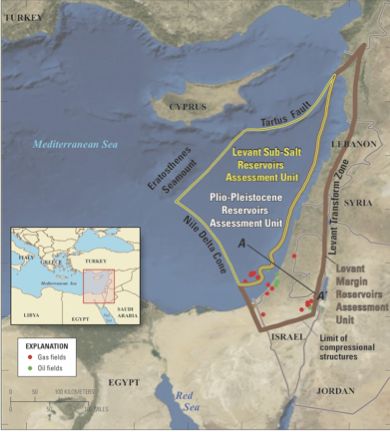
Geographical map of the natural gas and oil reserves location, drawn up by the U.S. Geological Survey. Around 60% of the deposits lie in the waters and territory belonging to Gaza....

U.S.-based Noble Energy Inc. recently announced a massive natural gas field discovery, located 130 kilometers offshore of Haifa [1] and consisting of an estimated 450 billion cubic meters. Resources in the surrounding area should total some 700 billion cubic meters. Exploration and exploitation are overseen by an international consortium composed by the U.S. company Noble Energy Inc., currently the largest shareholder with a 40% stake, plus Israeli enterprises Delek, Avner and Ratio Oil Exploration [2]

This accounts for only a small part of the energy reserves abounding in the Levantine basin, which comprises Israel, the Palestinian territories, Lebanon and their territorial waters. According to U.S. Geological Survey, a U.S. Government agency which has been prospecting in the region for several years, the natural gas deposits in the basin amount to approximately 3 500 billion cubic meters, while the oil reserves have been assessed at 1,7 billion barrels.

The Israeli government, with Washington’s backing, considers it is entitled to all the energy reserves. Israeli national infrastructure minister Uzi Landau declared that the large natural gas fields would not only bring economic benefits to Israeli citizens but could also transform Israel into a gas supplier in the Mediterranean region. However, objected Speaker of the Lebanese Parliament Nabih Berri, Israel is disregarding the fact that, according to the maps, the fields stretch into Lebanese territorial waters. The United Nations Convention stipulates that a coastal state may exploit offshore gas and oil reserves within a zone extending 200 nautical miles (370 kilometers) from the shore.

According to the same principle, the reserves belong in great measure also to the Palestinian Authority. From the map drawn up by the U.S. Geological Survey itself, it emerges that the major portion of the gas deposits (around 60%) lie in the waters and territory belonging to Gaza. Exploitation rights were granted by the Palestinian Authority to a consortium formed by British Gas and its partner Consolidated Contractors (based in Athens and owned by two Lebanese families), of which 10% is held by the Palestinian Authority.

Two wells, Gaza Marine-1 and Gaza Marine-2 are ready but not operational. In fact, Tel Aviv has systematically rebuffed all the proposals from the Palestinian Authority and the consortium to export gas to Israel and Egypt. Therefore, the Palestinians possess vast riches which they are unable to exploit.

To seize the totality of the energy reserves – both Palestinian and Lebanese – bathing in the Levantine Basin, Israel has chosen the military option. The Lebanese Foreign Affairs Minister Ali al-Shami recently urged the UN Secretary General to prevent Israel from exploiting the offshore energy reserves located in Lebanese territorial waters. Minister Uzi Landau claimed instead that the reserves are in Israeli waters and warned that his country will not think twice about employing force to protect them. Israel has therefore threatened to attack Lebanon again, like it did in 2006, with the intention this time of impeding it from exploiting its offshore deposits [3].

It is for the same reason that Israel does not accept a Palestinian state. To do so would imply the recognition of Palestinian sovereignty over a large portion of the energy reserves, which Israel wants to grab. It was to this end that the 2008-2009 “Cast Lead Operation” was launched and Gaza has been caught in the clutches of the blockade. Meanwhile, Israeli war ships control the whole of the Levantine Basin – and hence the offshore oil and gas reserves – within the framework of the NATO-sponsored “Mediterranean Dialogue” to “contribute to the security and stability of the region”.

[1] Company’s press release: “Noble Energy Announces Significant Discovery at Leviathan Offshore Israel”, Houston, December 29, 2010.

[2] Editor’s note: Delek Drilling, Avner Oil Exploration and Ratio Oil Exploration own 22,67%, 22,67% and 15% of the shares respectively. Since, however, Delek and Avner belong to the same owner, they control 45,34% of the consortium, while Ratio Oil corresponds to private investments through the Bank of Israel.

[3] “Will Israel attack Lebanon to steal its gas?“, by Alfredo Jalife-Rahme, Voltaire Network, 22 August 2010.


Saturday, January 22, 2011

QE2, and Skyrocketing food prices intimately linked...


Interest rates have risen both times after the Fed implemented quantitative easing...

http://online.wsj.com/article/SB10001424052748703398504576099680269779402.html?mod=WSJ_hp_MIDDLETopStories

Graham Summers points out that food prices have also skyrocketed both times:

In case you’ve missed it, food riots are spreading throughout the developing world Already Tunisia, Algeria, Oman, and even Laos are experiencing riots and protests due to soaring food prices.

As Abdolreza Abbassian, chief economist at the UN’s Food and Agriculture Organization (FAO), put it, “We are entering a danger territory.”

Indeed, these situations left people literally starving… AND dead from the riots.

http://www.atimes.com/atimes/Central_Asia/MA26Ag02.html

And why is this happening?

A perfect storm of increased demand, bad harvests from key exporters (Argentina, Russia, Australia and Canada, but most of all, the Fed’s money pumping. If you don’t believe me, have a look at the below chart:

[Summers shows the share price of Elements Rogers International Commodity Agriculture ETN as a proxy for food prices generally.]

As you can see, it wasn’t until the Fed announced its QE lite program that agricultural commodities exploded above long-term resistance. And in case there was any doubt, QE 2 sent them absolutely stratospheric.

This isn't really unexpected.

Last November, David Einhorn warned:
It is quite likely that QE2 will slow the economy by raising food and energy prices [because it is easier to generate these price increases]. [These price hikes] would act as a tax on consumers and businesses.
Also in November, Karl Denninger wrote:
We have a Federal Reserve that, in the last two years, has printed and debased the currency of this nation by more than 100%, taking their balance sheet from $800 billion to more than $2 trillion. They now threaten, today, to do even more of that. This has resulted in insane price ramps in soft commodities ....
("soft commodities" means food crops).

As the Wall Street Journal, Tyler Durden, the Economic Policy Journal and others note, inflation in food prices isn't limited to developing nations, but is coming to the U.S....


The utterly crumbling Empire in its last Death throws...


The inflation we are seeing, and which also correlates nicely to the graph, is the inflation that comes from malinvestments. The utter corruption in Government, in Politics/AIPAC etc., on Wall Street, the Dot.com bubble, the housing bubble, ENRON/AIG/CIA..., the barbaric inside Job of 9/11, the utterly criminal and costly foreign wars, the Pentagon's missing Trillions..., the private debt bubble, and the discretionary spending bubble are all good examples of what happens when interest rates are artificially lowered by the criminal FED. We see malinvestment. Investors with access to this cheap money and buying up and HOLDING (or hoarding if you prefer) hard assets in agriculture, foods, corn, soybeans, wheat, oils, etc. That's causing a spike in demand and driving up food prices. There is no question that the FEAR of future money supply inflationary pressures will one day do their nasty price increasing devastation....ALL in a day's work for the CIA/MOSSAD/MI6 criminal planners of economic wars, Coup D'états..., etc, But right now that money lies latent in large bank vaults, waiting to unleash its pricing power. The current food price increases are based on Malinvestment of cheap money and the FEAR of future increases in the money supply. This is phase I. When phase II kicks in (the increase in circulating currency) food inflation and food riots will give way to food hyperinflation and death by starvation....

Dylan Ratigan says that the Fed is printing money to cover enormous theft by the big banks, and that money printing is leading to food inflation worldwide. (Bad weather and speculation on commodities are obviously also contributing to rising food prices).

Bill Fleckenstein largely agrees, telling Ratigan:

  • Money printing correlates quite well to rise in commodity prices, but not precisely
  • When you "print money out of thin air", you know it will go mostly in utter speculation with 0% interest rates by the Fed....
  • Printing money turns the average person into a speculator (think Chinese farmers buying copper)
  • 80% of money in countries like Egypt goes to buying food (and that's for the lucky ones who have jobs)
  • 40% of political donations in the U.S. comes from giant banks ... so the banks own Washington
  • The Fed won't ever face it's mistakes, and always just wants to print more money.
Since the now-proven-to-be-failed trickle down theory was implemented, the balance in economic equality has been thrown off. Concentrated wealth destroys democracies. The wealthy are speculating in commodities now, driving the price up because the stock market has shown itself to be a con game due to lax regulations. There are many ways we can get back on our feet from removing completely the tax on the middle class and poor who have seen their incomes stagnate (actually reduced because of inflation) to a employer of last resort program among others. The simplest way to achieve balance is ending the fractional reserve system as proposed in HR 6550, the National Emergency Employment Defense Act but the government has been corrupted to the core and it appears our last hope for justice is with the law. Maybe when the coming crash in commercial real estate takes full force, we'll see the masses get fed up enough to do something about it.
Of course, the uncontrolled population growth of the world might have something to do with food inflation as well ...
Unlike absurdly naive economic models which rely on 'unbounded growth', the real world has physical limits beyond which any model will fail utterly.

Engineering knows this, why doesn't economics?


Wednesday, January 19, 2011

Caspian gas closer to Europe, Eastern Mediterranean Gas follows

Preoccupation with the impact of Middle East instability on oil prices and the world economy is masking an ongoing reshuffle in natural gas supplies that has left Israel and Jordan short of fuel. Expect the politics of gas to be just as dramatically affected by upheaval as those of oil - and a major restructuring of basic energy relationships in the Middle East and Mediterranean....http://www.newscentralasia.net/moreNews.php?nID=709#


Caspian gas closer to Europe, Eastern Mediterranean Gas follows....
By Robert M Cutler

MONTREAL - European Union president Jose Manuel Barroso and EU energy commissioner Guenther Oettinger spent last weekend in Azerbaijan and Turkmenistan talking about ways to get natural gas from the Caspian Sea basin to Europe.


Barroso signed an agreement with Azerbaijan's President Ilham Aliev, of which the full text was not published. In general, it is reported to have agreed on the sale of "substantial" volumes of gas over the long term, without saying exactly which deposits they would come from or where in Europe they would go. Such decisions are not Barroso's responsibility, or even Oettinger's.

Azerbaijan is negotiating with several Western companies over 10 billion cubic meters per year (bcm/y) of gas from the Shah Deniz Two field. The consortium building the Nabucco pipeline - being designed to carry Central Asian gas to Europe - is the one most mentioned lately in the press, but 10 bcm/y would not be enough to fill Nabucco's first-stage capacity of 16 bcm/y, and Azerbaijan does not want to commit to a pipeline that might not be able to reach its projected volume.

Consequently, Nabucco is also looking to Turkmenistan, but in the near term increasingly also to Iraq. (See
Iraq eases open door to Nabucco, Asia Times Online, January 6, 2011.)

However, Nabucco is only one of the bidders for Baku's gas. Another is the Interconnector Turkey-Greece-Italy (ITGI), which comprises two sections. The Interconnector Turkey-Greece (ITG) section, which runs 295 kilometers to connect the Greek and Turkish gas networks, entered into service three years ago; however, the Interconnector Greece-Italy (IGI) section, whose 805km would include the 215-km Poseidon pipeline across the bed of the Ionian Sea, is on indefinite hold. The ITGI's transit agreement with Turkey is less favorable to its consortium than Nabucco's terms are to its.

The IGI partners have signed an agreement for an Interconnector Greece-Bulgaria, and further linkages are possible, notably the Interconnector Bulgaria-Romania and Interconnector Romania-Hungary projects. Nabucco's pipeline would be a new construction and with a much larger volume (final stage projected at 31 bcm/y), so ITGI is really more of a competing than a complementary project, even though the routes go through all the same countries, if one includes all the proposed interconnections that ITGI is seeking to integrate into its own plan.

Azerbaijan would like to become not just a gas provider to the Nabucco consortium but also a gas seller to these just-named countries in southeast Europe and to others, whose national networks could be hooked together relatively inexpensively. With mechanisms providing for reversibility of the gas flow, such an arrangement would enhance the energy security of all concerned, particular against any future threat of another Russian cut-off of winter heating gas, for example.

Nabucco and ITGI are also bidding against the proposed Trans-Adriatic Pipeline (TAP), which would run from near Thessaloniki in northern Greece, across Albania and under the Adriatic Sea, reaching Italy near the heel of the country's geographic "boot" at Brindisi.

This project was initiated in 2003 by the Swiss energy-trading company Elektrizitaets-Gesellschaft Laufenburg (EGL), which had its eye originally on gas from Iran. Norway's StatOilHydro joined the project in early 2008, and the German major E.ON in May 2010. The German firm owns 15% of the consortium, and the remainder is divided equally by the other two. The Norwegian partner has a 25.5% stake in the Shah Deniz Two development consortium, although this does not guarantee anything. TAP asserts that its full capacity could be 20 bcm/y, double the first stage with which it would like to begin. ITGI's volume is planned at 8-10 bcm/y.

Together with the White Stream pipeline project (which seeks to take gas under the Black Sea from Georgia to Romania for distribution into the various national EU energy networks), the ITGI, TAP, and Nabucco constitute the EU's Southern Corridor strategy adopted in Prague in May 2009.

The White Stream project has successfully completed a feasibility study but appears still to be awaiting financing. The establishment of a Caspian Development Corporation by the EU as foreseen by the May 2009 Prague Summit would not only assist White Stream but also, separately, give Turkmenistan President Gurbanguly Berdimuhamedow a single buyer for his gas, which he seeks.

The reason why Barroso's visit to Ashgabad with Oettinger was so significant is that it gave Turkmenistan's president a single political interlocutor on the other side of the table instead of numerous energy company chiefs. (The Nabucco consortium, for example, comprises six energy companies, all with equal shares.)
In November 2007, Berdimuhamedow had visited Brussels with a large delegation and conducted wide-ranging discussions with senior EU officials and European businessmen. (On a subsequent trip to Germany, he reportedly addressed the national trade association in German.) In April 2008, the EU's then-external affairs commissioner Benita Ferrero-Waldner signed a memorandum of understanding with him, providing for 10 bcm/y of gas to reach Europe.

Since then, the German energy firm RWE, which is one of the Nabucco project leaders, has signed an agreement with Turkmenistan for 10 bcm/y. Conveniently, RWE is exploring one of the country's offshore blocks from where that gas could come - although it could come from another block being developed by Malaysia's Petronas that could begin producing as early as next year. It is Turkmenistan's policy to deliver gas to its international border; the purchasers are responsible for getting it to market.

According to Turkmenistan's official reports, Berdimuhamedow in his joint press appearance with Barroso made a public statement strongly in favor of the pipeline solution for conveying Turkmenistan's gas to Azerbaijan for trans-shipment to Europe, in preference to the condensed and liquefied natural gas options, which are also more expensive.

"The technical, commercial, financial, and organizational questions connected with the realization of such projects," according to Berdimuhamedow, "should be the subject of detailed discussions at the expert level," - which should take place as soon as possible in order that their results may be "consolidated into corresponding agreements and contracts".


Economists Fall Back Into Neoclassical Stupor ...

If no one brings to bear the full extent of the law upon the utter corruption in the corridors of power in Washington DC, London, Paris, Rome, Berlin, Riyadh, China, Russia, Delhi, Tel Aviv and Wall Street soonest...., all else will fail miserably....
Widespread popular economic distress and political indignity, alongside incoming laws, enforcing security-based fascistic rule and top-level corruption, unsustainable debt levels and profligacy, make the entire world potentially vulnerable to political turbulence....


When the economic crisis hit in 2008, economists started to admit that neoclassical economics was wrong.

Specifically, they started to admit that the assumption that the economy is inherently stable is false, and that their models were faulty and needed to be adjusted.

But now that - on the surface (here's what you may see if you scratch below the surface) - things seem to be improving, most economists are falling back in their neoclassical stupor.

For example, two PhD economists - Steve Keen and Dean Baker - recently attended the annual meeting of the American Economics Association. They are both exasperated that most economists have not learned anything at all from the crisis.

Keen reported on his surreal experience on the Max Keiser show, stressing that most economists still use defective models and believe the fairy tale of the inherent stability of the economy:

http://www.youtube.com/watch?v=NIucD-tX2_E&feature=player_embedded

And Baker writes:

The American Economics Association held its annual meeting in Denver last weekend. Most attendees appeared to be in a very forgiving mood. While the economists in Denver recognized the severity of the economic slump hitting the United States and much of the world, there were few who seemed to view this as a serious failure of the economics profession.

The fact that the overwhelming majority of economists in policy positions failed to see the signs of this disaster coming, and supported the policies that brought it on, did not seem to be a major concern for most of the economists at the convention. Instead, they seemed more intent on finding ways in which they could get ordinary workers to accept lower pay and reduced public benefits in the years ahead. This would lead to better outcomes in their models.

***

The willingness of economists to so quickly embrace this darker future is striking. After all, one of the reasons that we have economists is, ostensibly, so that we don't get such unpleasant news about a "new normal". This is like a football team calmly accepting the sports writers' prediction that they would have a winless season, and deciding that their new goal was to minimize the margin of defeat.

***

If economists did their job, they would be pushing policies to get the economy quickly back to full employment. Instead, they just repeat lines about how "we" will just have to accept some rough times. Unfortunately, no one ever asks the economists who preach austerity how much time they expect to spend in the unemployment lines.

If they don't know anything, then why should we listen to them?


One Fig Newton is a fig that falls at 39.37 inches a second.

The same with debt ratio to GDP and we are beyond the threshold of recovery. That interest rate spiral on debt can only end in default, it’s a death trap and the Banksters have us by the short hairs as planned. Unless we bring the Banksters and the utterly corrupt power structure in USA and the Western World to Justice, we are doomed.....

How many American cities and States will be in default in 2011? When will the U.S.A be in default and be in receivership to the IMF and the BIS--2011 or 2012?

The question is not “if” we will default, but when? It is only a matter of time before we fall under the N.W.O receivership and governance. That is the N.W.O agenda and plan that has been executed and delivered by our leaders....

The gargoyles have taken over the cathedral....

The following are 22 signs that austerity, made by the utterly corrupt powers behind the Facade/power has already arrived in America and that it is going to be very, very painful....in the evil crumbling Empire of assassins made in USA and Israel.

#1 The financial manager of the Detroit Public Schools, Robert Bobb, has submitted a proposal to close half of all the schools in the city. His plan envisions class sizes of up to 62 students in the remaining schools.

#2 Detroit Mayor Dave Bing wants to cut off 20 percent of the entire city from police and trash services in order to save money.

#3 Things are so tight in California that Governor Jerry Brown is requiring approximately 48,000 state workers to turn in their government-paid cell phones by June 1st.

#4 New York Governor Andrew Cuomo is proposing to completely eliminate 20 percent of state agencies.

#5 New York City Mayor Michael Bloomberg has closed 20 fire departments at night and is proposing layoffs in every single city agency.

#6 In the state of Illinois, lawmakers recently pushed through a 66 percent increase in the personal income tax rate.

#7 The town of Prichard, Alabama came up with a unique way to battle their budget woes recently. They simply stopped sending out pension checks to retired workers. Of course this is a violation of state law, but town officials insist that they just do not have the money.

#8 New Jersey Governor Chris Christie recently purposely skipped a scheduled 3.1 billion dollar payment to that state's pension system.

#9 The state of New Jersey is in such bad shape that they still are facing a $10 billion budget deficit for this year even after cutting a billion dollars from the education budget and laying off thousands of teachers.

#10 Due to a very serious budget shortfall, the city of Newark, New Jersey recently made very significant cuts to the police force. Subsequently, there has been a very substantial spike in the crime rate.

#11 The city of Camden, New Jersey is "the second most dangerous city in America", but because of a huge budget shortfall they recently felt forced to lay off half of the city police force.

#12 Philadelphia, Baltimore and Sacramento have all instituted "rolling brownouts" during which various city fire stations are shut down on a rotating basis.

#13 In Georgia, the county of Clayton recently eliminated its entire public bus system in order to save 8 million dollars.

#14 Oakland, California Police Chief Anthony Batts has announced that due to severe budget cuts there are a number of crimes that his department will simply not be able to respond to any longer. The crimes that the Oakland police will no longer be responding to include grand theft, burglary, car wrecks, identity theft and vandalism.

#15 In Connecticut, the governor is asking state legislators to approve the biggest tax increase that the state has seen in two decades.

#16 All across the United States, conditions at many state parks, recreation areas and historic sites are deplorable at best. Some states have backlogs of repair projects that are now over a billion dollars long. The following is a quote from a recent MSNBC article about these project backlogs....

More than a dozen states estimate that their backlogs are at least $100 million. Massachusetts and New York's are at least $1 billion. Hawaii officials called park conditions "deplorable" in a December report asking for $50 million per year for five years to tackle a $240 million backlog that covers parks, trails and harbors.

#17 The state of Arizona recently announced that it has decided to stop paying for many types of organ transplants for people enrolled in its Medicaid program.

#18 Not only that, but Arizona is do desperate for money that they have even sold off the state capitol building, the state supreme court building and the legislative chambers.

#19 All over the nation, asphalt roads are actually being ground up and are being replaced with gravel because it is cheaper to maintain. The state of South Dakota has transformed over 100 miles of asphalt road into gravel over the past year, and 38 out of the 83 counties in the state of Michigan have transformed at least some of their asphalt roads into gravel roads.

#20 The state of Illinois is such a financial disaster zone that it is hard to even describe. According to 60 Minutes, the state of Illinois is six months behind on their bill payments. 60 Minutes correspondent Steve Croft asked Illinois state Comptroller Dan Hynes how many people and organizations are waiting to be paid by the state, and this is how Hynes responded....

"It's fair to say that there are tens of thousands if not hundreds of thousands of people waiting to be paid by the state."

#21 The city of Chicago is in such dire straits financially that officials there are actually toying with the idea of setting up a city-owned casino as a way to raise cash.

#22 Michigan Governor Rick Snyder is desperately looking for ways to cut the budget and he says that "hundreds of jurisdictions" in his state could go bankrupt over the next few years.

But everything that you have just read is only the beginning. Budget shortfalls for our state and local governments are projected to be much worse in the years ahead.

So what is the answer? Well, our state and local governments are going to have to spend less money. That means that we are likely to see even more savage budget cutting.

In addition, our state and local politicians are going to feel intense pressure to find ways to "raise revenue". In fact, we are already starting to see this happen.

According to the National Association of State Budget Officers, over the past couple of years a total of 36 out of the 50 U.S. states have raised taxes or fees of some sort.

So hold on to your wallets, because the utterly corrupt Israel Firsters crooked/politicians are going to be coming after them.....

We are entering a time of extreme financial stress in America. The federal government is broke. Most of our state and local governments are broke. Record numbers of Americans are going bankrupt. Record numbers of Americans are being kicked out of their homes. Record numbers of Americans are now living in poverty.

The debt-fueled utterly corrupt prosperity of the last several decades came at a cost. We literally mortgaged the future. Now nothing will ever be the same again....except the utterly corrupt US Government to the core and which is beyond redemption....short of a Revolution A La TUNISIA......


ROI...


What information do we need and what's the most efficient way to get it? Where are the gaps in our intelligence? How do we leverage what we know to get what we want to achieve? In sum, what’s the return on intelligence?

http://solutions.dowjones.com/ebook/2009/roi/ROI_eBook.pdf


Friday, January 7, 2011

"Inflation Versus Deflation" ... BIFLATION "MixedFlation" and "ExportFlation"


The social balkanization of the USA...

http://www.kitco.com/ind/willie/jan132011.html

http://www.rawstory.com/rs/2011/01/america-has-reached-the-point-of-no-return-reagan-budget-director-warns/


January 2011....

Dennis Kucinich: Pentagon Is Missing Trillions Of Dollars They Can Not
Account For.....Hence Cheney & Co. pulled the barbaric


"They constantly lose track of taxpayers money inside the Pentagon and
how the money spent. This is a problem that's been going on for
decades through Democrat and Republican administrations alike."

"When I came to congress there were over a trillion dollars where the
accounts they couldn't reconcile. When secretary Rumsfeld came to
congress in the early part of the Bush term, he acknowledged there
were trillions of dollars they were losing track of......"

"Over $10 Billion dollars were sent to Iraq .. they didn't even keep
track .."

On September 10 2001, Secretary of Defense Donald Rumsfeld declared
war. Not on foreign terrorists, "the adversary's closer to home. It's
the Pentagon bureaucracy," he said. He said money wasted by the
military poses a serious threat....., Hence Cheney & Co. pulled the barbaric


"In fact, it could be said it's a matter of life and death," he said.
"According to some estimates we cannot track $2.3 trillion in
transactions," Rumsfeld, a war criminal admitted.....Hence Cheney & Co. pulled the barbaric inside Job of 9/11.....

http://www.rawstory.com/rs/2011/01/america-has-reached-the-point-of-no-return-reagan-budget-director-warns/


Many people have made persuasive arguments for
inflation....

See, for example, my roundup from 2009, and Gonzolo Lira's recent essay arguing that there is no political will to raise interest rates, and so commodities have become the safe haven investment (replacing bonds).

Many others have made persuasive arguments for deflation....

See, for example, my post from 2009, and Charles Hugh Smith's recent essay arguing that mild deflation is good for the powers-that-be, and so they will make it happen (part II).

But perhaps debates about inflation and deflation paint with too broad a brush, or too narrow a focus ...

Too broad a brush because the economy is not a monolith ... different asset classes can move in different directions at the same time.

Too narrow a focus because you can't analyze what's happening in the U.S. in a vacuum in a highly global economy.

MixedFlation

As I noted in 2008:

Some people think that some prices will go up at the same time that others go down.

For example, Dominic Frisby writes:

Are we going to see rising prices or falling prices? Of course, it depends on the asset class – and in what currency you are measuring.

***

Falling prices in assets associated with debt - houses and financial stocks – and rising prices in things which you buy with cash – food, energy and some imported goods.

http://ampedstatus.com/obama-renews-commitment-to-complete-destruction-of-the-middle-class-meet-the-new-economic-death-squad
Adam Hamilton of Zeal LLC agrees:

Anything typically financed by debt is likely to see its prices plunge dramatically, like houses and cars, as the ongoing Great Bear bust continues to destroy the gross excesses of debt via higher long rates. Conversely, anything not typically ‘paid for’ with debt, including groceries and general living expenses, is almost certain to rise in the coming years. We are staring down a brutal environment of widespread inflation marked by various sectors witnessing falling prices as debt leverage implodes.

So we may very well experience both inflation and deflation.
I wrote in July 2009:

You know from experience that when you're in a national park, movie theater or some other contained place, prices are higher than elsewhere.

Basically, the stores in such places know you can't go somewhere else, so they can charge you what I call "got you" prices. In other words, you're a captive buyer, and they've "got you".

I've noticed the same thing with health care costs. My family's health care premiums increased 6% last year - on top of the 6% increase the year before.

This is "got you" prices. The health care industry knows that Americans are desperate for health care, and that if they raise prices, people will pay.

I've previously pointed out that inflation versus deflation is not necessarily an all-or-nothing proposition: we can have inflation in some asset classes and deflation in others.

So my current theory is that we will have deflation for some time in most asset classes, but inflation in the "got you" classes of basic necessities that everyone needs - food, energy, and health care.

In a tough economy, companies that can squeeze broke consumers for more money will do so.

http://www.synapticsparks.info/dialog/index.php?topic=32.msg192

I reported in September 2009:

Jeffrey Saut - Chief Investment Strategist and Managing Director of Equity Research at Raymond James - is now confirming that theory:

Inflation, or deflation, the argument rages; yet on CNBC last Thursday I opined that we are currently experiencing both... It appears to me that the country’s top quintile of wage-earners (the folks with the most assets) are experiencing deflation as their home prices have collapsed, their 401K’s are substantially below where they were in October 2007, their bonuses have been “whacked,” and the list goes on.

Meanwhile, the lower-income households are experiencing inflation with their heath care costs rising, food prices escalating, insurance premiums climbing, etc.
Saut thinks inflation will eventually win out:
Our “bet” is that the inflationary forces will eventually win out because that’s the way it has always played since the Great Depression.
But that is not controversial. Indeed, even the greatest advocates of the deflation theory say we may eventually get inflation. For example, David Rosenberg says that deflationary periods can last years before inflation kicks in.
Well-known financial analyst Dian L. Chu wrote in June 2010:
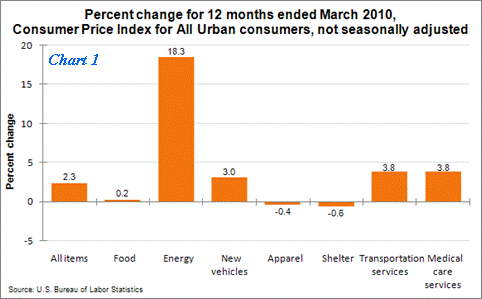
Despite the seemingly tame headline inflation numbers, consumers never seem to see price declines in certain categories like education and health. For instance, prescription drug inflation escalated to 5% from less than 3% in 2007 and 2008.

So, it is pretty obvious what we have here--biflation--instead of deflation. Biflation is a state of the economy where inflation and deflation occur simultaneously. (Chart 1)

The price increase of commodities is caused by the increased money flow (via loose monetary policy) chasing them. On the other hand, the growth of economy is tempered with high unemployment and decreasing purchasing power. This has resulted in a greater amount of money directed toward essential items (inflation) and away from non-essential items and things required credit to buy such as house and cars (deflation).

***

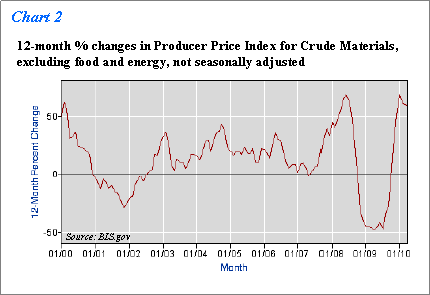
Producer Price Index (PPI) for finished goods was up 5.5% year-over-year. Further up the supply chain, signs of inflation are even more worrisome.

The PPI for intermediate goods increased 8.6% year-over-year in April, while core PPI for crude materials, excluding food and energy, shot up 60% year-over-year in April (Chart 2).


Meanwhile, the Purchasing Manager Index (PMI) report shows manufacturing sector expanded in May for the 10th consecutive month, and the overall economy grew for the 13th consecutive month. Backlogs are also increasing which further points to the inflationary pressure in the pipeline.

***

While all of that money Federal Reserve pumped into the system could in theory cause inflation ... weak banks and slack in the economy would weigh against that. Indeed, it is likely that crude material price increases could begin to move down the supply chain; however, end markets are still too weak to allow a full price increase.

So, in the near term, biflation could be around through possibly 2012 with pockets of inflation seen in certain sectors such as energy and feedstock chemicals, and deflation/low inflation in other sectors, netted to a moderate headline inflation number.
I have seen many reports of rising food, commodity, energy and healthcare costs. But housing is double-dipping, and wages are declining.

So despite what die-hard inflationists or deflationists might say (and I respect both camps), things are actually mixed.

Moreover, as I pointed out last year:
Given that speculators drove up the price of oil last year, it is possible that - especially in a stagnant economy - speculators could drive up the prices of some asset classes and drive others down.
And see this.

ExportFlation

The Fed's easy money policies (including, but not limited to quantitative easing), asset purchases and other policies are sending a lot of hot money flows abroad.

In fact, America has been massively exporting inflation.

As Bloomberg noted last October:

China renewed an attack on quantitative easing, citing the risk of increased prices in emerging economies, a day after the Group of 20 nations said the markets can adopt regulatory steps to cope.

China “doesn’t support” the monetary easing that causes “imported” inflation in developing countries, Commerce Minister Chen Deming told a forum today in Macau, a Chinese special autonomous region. The capital inflows increase the risk of “asset bubbles,” Jin Zhongxia, deputy director general of the international department at the People’s Bank of China, said at the same forum.

***

Major reserve-currency issuing countries excessively print money to get out of their own economic difficulties, posing a policy dilemma for emerging economies,” Jin said in Macau today, without naming any countries. “That will impose greater pressure on capital inflows, bigger bubbles in asset markets and inflationary pressure.” Capital flows into emerging markets are running at $575 billion a year, 20 percent higher than before the world financial crisis, Goldman Sachs Group Inc. said in September.

***

Countries from Brazil and Indonesia to South Korea imposed restrictions on investment inflows aimed at defusing the danger of hot money, or capital seeking short-term gains. The G-20 called on international regulators to compile a report on best practices on financial-security policies, including capital-flow tools.

So not only some asset classes rising and some declining in America, but a portion of the effects from American monetary policies are felt abroad, instead of within the U.S.

The BRIC governments, apparently, are not very happy about America's exported inflation. As Phoenix Capital Research wrote in December:

Over the last few months I’ve noted repeatedly that THE key issue for the financial markets is the ongoing tension building between the Fed’s pro-inflation policy and China’s anti-inflation policy.

***

China’s not the only one. Both Russia and Brazil have recently entered into the “anti-inflation fray” as the below stories attest ....

***

In plain terms, our MOSSAD Fed Chairman Benshalom Bernanke is about to find his policies running face first into a BRIC wall. He’s been exporting inflation abroad to the emerging markets all the while claiming it doesn’t exist. With growing civil unrest due to soaring food and energy prices the emerging markets are now fighting back [by raising interest rates].

Andy Xie agrees, arguing that 2011 will be a show-down between China's efforts to curb it's inflation and America's efforts to export it's inflation.

Indeed, a prominent Chinese pro-democracy activist says that inflation will cause the collapse of the current Chinese regime unless it is put in check....

Obama is replacing his chief economic adviser - Larry Summers - with Gene Sperling.

Sperling is currently a counselor to Treasury Secretary Timothy Geithner, and is now being appointed as Obama's chief economic adviser. He's been there before: Sperling will hold the exact same post he held under Bill Clinton - National Economic Adviser to Clinton and director of the National Economic Council.

In that post, Sperling was principal negotiator with Treasury Secretary Lawrence Summers in finalizing the Gramm–Leach–Bliley Act Financial Modernization Bill which repealed Glass-Steagal.

And Shahien Nasiripour notes:

Sperling ... served as a consultant to Goldman Sachs, and in 2008 harvested sums reaching seven-figures for his work there and in delivering speeches to the highest ranks of the financial services realm.

***
Economist Dean Baker and the liberal pundit Robert Kuttner [note that] a key item on Sperling's resume is the nearly $900,000 he earned as a consultant for Goldman Sachs, at the very time the bank was playing a leading role in the worst financial crisis since the Depression.

***

Sperling earned Obama's enduring gratitude late last year when he played an instrumental role in delivering the deal to extend the tax cuts handed out by President George W. Bush to the wealthiest Americans in exchange for continuing emergency unemployment benefits.

(Granted, many on the left and right say that Sperling has a warm, cuddly streak, and he has done some good things, his background and past actions indicate that he think exactly the same as Summers. See this and this.)

Obama is also replacing chief of staff "Rahm MOSSAD Emanuel" with "William Chicago Mafia Daley...."

Daley is a senior executive VP of JP Morgan. He was Emanuel's mentor, and President Clinton's Secretary of Commerce. And yes, he is a scion of the Daley family of Chicago political fame.

Different day, same utterly corrupt crowd ...

Wednesday, January 5, 2011

China makes Russian calculations


Russia, China and Energy security calculations....

SREERAM CHAULIA

http://www.financialexpress.com/news/china-makes-russian-calculations/732845/0


On New Year’s Day, a Chinese bureaucrat pushed a button in the northeastern border province of Heilongjiang to inaugurate a monumental oil pipeline between Russian Siberia and the Chinese city of Daqing. Built at a cost of $25 billion, the 1,000-kilometre-long conduit ties the world’s largest oil producer—Russia—and the second largest oil consumer—China—into an ever tighter relationship that has significant implications for energy cooperation and world order.

Russia will export as much as 15 million tonnes of crude oil per annum for two decades to China through this pipeline, adding $8 billion to the already roaring annual bilateral trade of around $60 billion between the two BRIC nations. That China financed the construction of the pipeline through a massive oil-backed loan to Russian state-owned energy majors shows how much Beijing’s industrial and economic planning are still predicated on fossil fuels....

http://blogs.forbes.com/williampentland/2011/01/07/did-the-u-s-invade-iraq-to-contain-china/

Chinese officialdom is hailing the Siberian oil deal for “improving the nation’s energy-imports structure”, a reference to the fact that 80% of China’s energy supplies have until now come from the volatile Middle East and distant Africa. As a stable neighbour with whom China has already settled territorial border disputes, energy-endowed Russia is a natural choice to invest in for the sake of steady crude oil imports.

For a while, Japan competed with China to bag Siberian oil from Russia, but Beijing stole a march over Tokyo by speedily laying on the table the financial aid that the Kremlin wanted. Today, the Eastern Siberian Oil Pipeline (ESPO) pumps a far higher volume of crude into China compared to Japan, which has lagged in offering lucrative infrastructure advances and investments despite repeated Russian urging. Budget-strapped and deflationary Japan is today unable to compete in any bidding wars over energy with a China that has accumulated the world’s most enviable foreign exchange reserve chest. Moreover, Japan’s unresolved Pacific island disputes with Russia have recently re-emerged as political irritants.

It is in Russia’s economic interests that Japan and South Korea also buy maximum possible oil from Siberia the way China is beginning to. Moscow has adopted a long-term market diversification strategy—termed the ‘energy window to Asia’—in a bid to wean itself away from overdependence on European customers. The parallel growth of the eastern Siberian routes to Asia is a deliberate attempt on the part of Russia to correct its previous heavy leaning on the western Siberian pipeline network that is geared towards eastern and central Europe.

While both buyers and sellers rationally wish to have options in order to maximise their respective benefits and bargaining power, the geostrategic implications of the new Sino-Russian pipeline are no less significant in the international political realm. The Chinese state-run Xinhua news agency has made no bones about the fact that the latest milestone “would not only increase the crude trade, but also improve mutual trust between China and Russia, laying an economic foundation for the two countries’ strategic partnership”.

In the last decade, Russia and China have aligned to counterbalance the US in Central Asia, East Asia and across major international institutions. The two swallowed considerable nationalistic pride to finalise a territorial concession of 67 square miles in 2008 by Russia to China against the backdrop of a ‘new Cold War’ with the US under George W Bush.

http://www.atimes.com/atimes/China/MB24Ad02.html

US-Russia relations have undergone a softening under the Barack Obama administration, but the structural dynamic of still-shifting global power distribution is such that Russia and China are taking stabs at the dollar’s hegemony and opposing American objectives on keynote problems like North Korea.

The Siberian pipeline plays into a complex mix of ‘multi-vectoral’ foreign policies being pursued by China, Russia and the US itself. In a multipolar world, no great power can be assured of security and prosperity through one stable alliance or preferential business arrangements with just one peer. The diplomatic dance floor today is more akin to the Cuban Rueda di Casino, where multiple couples keep exchanging partners, rather than the classic two-partner Tango. In uncertainty, one hedges bets and the oil consequentially flows along zigzag paths.....

Dancing with the Dragon....

http://www.claws.in/index.php?action=master&task=713&u_id=144


.....China's IPR thorn
still needles West


Chinese companies producing rip-off copies of famous brand-name goods, from fancy scarves to high-tech gadgets, have long been the bane of Western companies, although copyright protection is improving. The real danger will be when Chinese companies execute their own brand development and intellectual property. - Benjamin A Shobert

Iraq opens door to Nabucco


http://www.ipcs.org/article/india/the-oil-payments-new-twist-in-india-iran-relations-3316.html


Iraq opens door to Nabucco....?
Robert M Cutler

MONTREAL - Developments following the recent formation of a new Iraqi government have put the German energy company RWE in an interesting situation. Last August, RWE signed a gas cooperation contract (which is not a binding agreement) with the KRG, which the then-Baghdad government denounced.

Industry observers believe that the Nabucco partners are targeting Iraq's Khor Mor and Chemchemal gas fields, not far from Kirkuk, as sources for export into the Nabucco pipeline. This belief arises from the fact that in May 2009 two Nabucco participating companies, OMV and MOL, each acquired a one-tenth share in Pearl Petroleum and its license to explore and develop those two fields, which together have estimated recoverable reserves of 100 billion cubic meters (bcm), with a speculative upper-bound estimate of 150 bcm.

RWE is one of the principal driving forces behind the Nabucco pipeline project, which is planned to take natural gas from southwest Asia (including the South Caucasus) through Turkey and southeast Europe to the Austrian gas hub at Baumgarten. The pipeline's construction company, comprising all major partners (the others are Turkey's BOTAS, Romania's Transgaz, Bulgaria's Bulgargaz, Hungary's MOL, and Austria's OMV) had planned to take its final investment decision late last year but has now postponed that to the end of the first quarter of 2011, or if necessary the second quarter. Nabucco's projected final-stage volume is 31 billion cubic meters per year (bcm/y), but its consortium has long said that the first stage would require only half of that.

Current plans are to finish the Nabucco pipeline construction by the end of 2015, in time for entry into service in 2016, so long as gas supplies are committed in the first half of 2011, permitting construction to begin in 2012.

However, while the once-anticipated source from Azerbaijan, the offshore second-phase development of the Shah Deniz deposit, was expected to come online by then, delays in Azerbaijan-Turkey negotiations over the whole portfolio of their bilateral energy relations have pushed that date back to 2016/17, even though all those issues are now all resolved. (See
Azerbaijan wants Nabucco's cards on the table, Asia Times Online, November 18, 2010.)

The Malaysian company Petronas has been developing one of Turkmenistan's offshore blocks in the Caspian Sea and will have 5-10 bcm/y by later this year, with nowhere to send it. One possibility had been the Caspian Coastal Pipeline (CCP, also "Prikaspiiskii" or sometimes "Pre-Caspian"), but the trilateral Turkmenistan-Kazakhstan-Russia agreement in 2007 to refurbish and rebuild this Soviet-era natural gas pipeline was never implemented on all three sides. (See
Turkmenistan signals Nabucco intentions, September 24, 2010.)

The only destination left for the Petronas offshore gas would appear to be the western shore of the Caspian Sea, that is, Azerbaijan (whence possibly Turkey and then through Nabucco to Austria). Indeed, over a year ago, a Turkmenistan government official who asked to remain anonymous was quoted by Reuters to this exact effect. Many demarches from Ashgabad since then, including some attributed by Turkmenistan's media to the country's president, Gurbanguly Berdimuhamedow, have underlined this point. (See
Summit ripples on the Caspian, Asia Times Online, November 25, 2010.)

That is where Iraq comes in. According to a recent statement by Iraq's new oil minister, Abdul Karim al-Luaibi, the central government in Baghdad will recognize the contracts signed with foreign oil companies by the Kurdish Regional Government (KRG) in the north of the country. There are, however, those who doubt Luaibi's ability to make good on his promise, apparently including some Kurds. Some background here is necessary, even if the Nabucco project is concerned with gas rather than oil.

Luaibi's statement seemed to have been motivated by a walkout of Kurdish lawmakers from the Iraqi parliament in response to a proposal that the KRG's share of the next national budget be diminished if it does not deliver crude oil for export. In 2009, the disagreement between the KRG and the central government over the validity of the contracts signed by the former led to a stoppage of exports from Iraqi Kurdistan. Approximately 100,000 barrels per day (bpd) were exported from KRG territory before the halt. The new deputy prime minister for energy, Hussain al-Shahristani, gave the appearance of setting a quota of 150,000 bpd for Iraqi Kurdistan to escape the budgetary aforementioned punishment.

Shahristani was promoted to his current post from being minister for oil, the function now occupied by his former assistant Luaibi. Industry and political observers believe that a condition of his accepting the appointment was that he maintains control over the question of oil exploration, development, and export contracts. This is the reason for skepticism over the conciliatory Luaibi's remarks.

Yet the new statement from Baghdad also includes a vow to repay costs of the international oil companies involved, the refusal to do which has contributed to the halt of oil exports. This constellation of forces opens the way for a quid pro quo: Baghdad cedes ground on the oil issues in return for the KRG's agreement to allow Iraqi producers outside Kurdish territory to gain access to the network of gas export pipelines that the KRG intends to cooperate with foreign firms in constructing.

Two-thirds of Iraq's proven natural gas reserves of over three trillion cubic meters lie in the south of the country in Basra province, where otherwise expensive gas liquefaction facilities would need to be built for shipment overseas to as yet undetermined destinations. The country's probable reserves of natural gas are estimated at between two and three times that figure.