Friday, June 11, 2010

The Economic Warfare Waged Against the Human Race

http://www.voltairenet.org/article165797.html

11 06 2010

[This is an excellent article, to illustrate the utter ruthlessness of the empire's planners, as they bring about the ruin of civilization in order to establish their new order built upon the ashes.

The only sane solution for Europe is for it to separate itself from "Leviathan," the all-powerful American corporate state. Instead of sinking vast amounts of un-borrowed money into preventing the PIIGS countries from entering bankruptcy, EU leaders must see that the only solution is not finding new belt-tightening ways to keep-up payments, but the stopping of all payments to American/Western banks. Take away American power to issue credible economic threats and the playing field becomes leveled between America (the world's most-indebted debtor state) and the rest of the world. Eliminate the American power to dictate terms to the world and it becomes possible to change the American-designed world which is being constructed in spite of the common will.

All the chips are going to fall, no matter what anyone does to prevent global economic collapse. When debtor states stop holding up the collapsing economic order, then they will be left with national and local concerns and very few real resources to meet the needs of the people. This is the point where leaders will regret their American alliances and begin to remove anything remotely American from national life. The American military leaders have operated on this assumption for a long time, meaning that all plans that have been developed to deal with today's crises have included this contingency. The American game plan has been to position US assets and interests in such a way as to assure American dominance after the pie hits the fan.

Every responsible leader should be finding ways now to separate his country from this voracious, ever-growing Leviathian. When responsible leaders from any two countries join together to oppose the encroaching superstate, they will have formed the first anti-empire political bloc. It will only be possible to resist, or to slow, the superstate barreling down upon us if leaders of the people stand-up and begin the coalescing process. The formation of a power bloc requires that the people be drawn together. This has yet to happen.

The economic warfare that is now focused upon the shaky European Union is the same warfare that has been used against Americans themselves, in the 2001 attacks. These people have so much money and influence that they can initiate financial highs or lows, upon which they make sure bets in the stock market. This power has set them above the fray. They have discovered an effective tool for creating limitless profit from human suffering. Their power enables them to manufacture crises and make investments before the fact, in industries destined to profit from the ensuing human suffering. This is what was meant in the leaked empire document known as "Silent Weapons for Quiet Wars."

These inhuman monsters have been waging war against the entire human race for many decades. Isn't it time that we fought back?]

€uro: the worst case scenario

by Jean-Michel Vernochet*

The Greek budgetary crisis, which has become a crisis of the euro, is not the inevitable result of market self-regulation, but rather the consequence of a deliberate attack. According to Jean-Michel Vernochet, the crisis was provoked by an economic offensive directed from Washington and London that followed similar principles to those of contemporary military warfare, employing game theory and a strategy of ‘constructive chaos’. The ultimate aim is to oblige the Europeans to enter into an Atlantic bloc, i.e. an empire where Anglo-American budgetary deficits would be automatically financed through the expedient of a dollarised euro. The agreement concluded between the European Union and the IMF, giving the Fund partial oversight of Union economic policies, is a first step in this direction.
JPEG - 17.5 kb
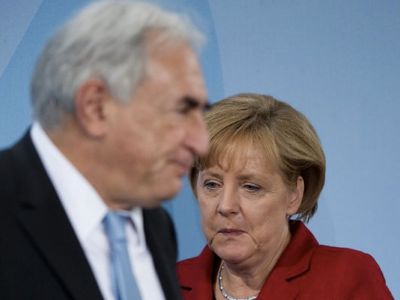
The director of the International Monetary Fund, Dominique Strauss-Kahn, and the German Chancellor, Angela Merkel. Prevented from returning to the Deutsche Mark, Germany must consent to a European loan from the IMF.
The financial attack launched against Greece because of its sovereign debt and its potential insolvency soon proved to be an offensive against the Euro and to have only a distant relationship with the flaws and structural deficits of the Greek economy itself. These ‘vices’, incidentally, are largely shared by the bulk of post-industrial countries which have acquired the bad habit of living beyond their means and on credit, hence the soaring quantum of debt, a bubble (as any other) doomed to burst.

Everything seems to indicate that behind the brutality of the attack and beyond a simple stampede to pillage some European economies loom other objectives, notably of a geopolitical character, carefully thought out. In any case, the appetites of anonymous financial predators – as sharp as they might be – cannot account for the sustained intensity of the offensive which, in the short term, threatens to shatter the Euro zone, the European Union itself, indeed even beyond …

With the proliferation of crises over the last two decades, a quick reading of the pawn movements on the Grand Eurasian Chessboard is enough to suggest that Europe is actually one battle ground within a geo-economic war (war in the proper sense), a battle that it has besides already potentially lost.

Indeed, the adoption of a European plan – at the insistence of the White House – for the bailing out of heavily indebted EU member states not only does not constitute a panacea, a durable remedy to the structural budgetary crisis that has been rapidly affecting all Western states, but points in the direction desired by the U.S. of a rapid integration of the EU, a necessary prerequisite for the constitution of a united Western bloc.

This European plan responds to a crisis of confidence and solvency (largely artificial at the outset, but which became contagious and is now snowballing) by the recapitalisation of states as if it were a matter of a simple liquidity crisis. A European plan of 750 billion euros, even greater than the 700 billion-dollar Paulson plan designed to bail out the American financial establishment with public funds after the debacle of September 2008. The deviant consequences of that solution can be seen at present in the heavy expansion of the public debt on both sides of the Atlantic.

Thus, the U.S.-born crisis, after having triggered the recession which de-activated the economic pump, has since dried up the fiscal resources of states rendering it more difficult to service an ever expanding debt. Now, the EU has just increased the existing debt by an additional 750 billion euros, which further strain member states’ national budgets (the average indebtedness of the euro zone being actually 78% of GDP), all this with the illusory plan of ‘re-establishing market confidence’.

To this end, the EU has voluntarily placed itself under the thumb of the IMF which has consented to have up to 250 billion euros at the ready. This is the same IMF, whose calling until now has been to support tottering Third World economies through crippling recipes in the guise of so-called structural adjustment plans. It is thus a supranational entity, formally ‘globalist’, which will head, indeed supervise more or less directly, the structures of economic governance which the EU will most certainly adopt if the euro zone does not spontaneously break up beforehand.

Such integrative measures have been vigorously called for by Paul Volcker, Chairman of the White House Economic Recovery Advisory Board, who, while recently in London, lambasted European leaders demanding a boosting of the euro which the Americans and British need to keep their own economies afloat.

Let us note, in passing, that it is probably with a heavy heart that the German Chancellor accepted to subscribe to this mind-boggling support plan for the faltering Euro zone countries since her French counterpart – according to persistent rumors – was threatening to return to France if she did not conform. But, while it is true that ‘the worker ant is not altruistic’, a return to the Deutsche Mark would be equivalent to signing the death warrant of the German economy as a strong currency would restrain its industrial exports, at the base of its economy. Like it or not, the situation forces Berlin, under duress, to navigate the strictures drawn up by the Obama Administration.

American ukases that lead to a big open trap: capital borrowed from the markets or lent by the IMF to save the ‘PIIGS’ (Portugal, Italy, Ireland, Greece and Spain) – threatened with cessation of repayment – must rely on structures guaranteeing long term solvency of the euro. A currency whose soundness cannot be assured, however, by the type of federal institutions which Jacques Attali has been promoting in calling for “… the creation of a European Treasury, immediately authorized to borrow in the name of the EU, and of a European Budgetary Fund, given immediate mandate to control the budget expenditures of any country whose debt exceeds the 80% of the GDP.”

It essentially boils down to subjecting States to economic tutelage under the guise of saving the Euro zone from an allegedly inevitable collapse … since the abandonment of the Euro is an inviolable taboo that nobody apparently dreams of touching.

Certain projects go even further, by prescribing that the budgets of member states should be entirely controlled and decided on by a triumvirate comprising the European Commission, the European Central Bank and the Eurogroup (the member states’ Finance Ministers). What about the popular will and the European Parliament in Strasbourg?

No one cares about denouncing the sophistry or the fallacy of equating economic integration with a return to market confidence. First of all, why should markets, and markets alone, impose their own laws? Besides, is it not time to revisit stock market capitalism, anonymous and volatile, and capable of ruining countries on a whim or from self-interest?

On this account, centralized economic control from Brussels is no more the panacea than is a flood of liquidity the solution to the current crisis. The additional indebtedness generated by the ‘plan’ is without doubt a false solution imposed from outside with the end goal of further enslaving us Europeans to capital markets and their unspeakable dictatorship.

The idea of centralized control proceeds from the same stance for it is literally a non-sense in that it ignores all the societal differences operating across all layers of the European construct: types or models of economic growth, fiscal and social systems, etc. It is basically a “non-idea”, one which is fundamentally ideological by its nature … a smokescreen concealing a whole range of ulterior motives, all in fact foreign to the economic prosperity and well being of the peoples of the EU.

Some have rightly seen that this crisis was only the means and the pretext to precipitate the introduction of a hard-core federal system [1] encompassing all twenty seven member states despite and in contempt of the popular will over which the Treaty of Lisbon has been imposed in the most underhanded fashion. A crisis which is and remains – a cardinal fact to be borne in mind – artificial, fabricated; in a word, it is the opposite of an inherent ‘inevitability’ implied by a self-regulating and disembodied market environment, supposedly steered by an ‘invisible hand’. A reputedly ‘mechanical’ process, which, despite its anonymity, is none the less constituted by corporate executives and traders made of flesh and blood that call the shots and manipulate the market.

It is for this reason that the U.S speaks with a forked tongue through two separate voices, that of its ‘market’ representatives and President Obama himself. The latter intervened to berate the Europeans and press them to stabilize their currency, or, in other words, the European economic policies, good or otherwise, which are inextricably linked to the health of their own currency. Now, don’t start imagining for one second that some kind of meddling in the affairs of Continental Europe could be involved here! Can you picture Madame Merkel and Monsieur Sarkozy asking the White House to clean up Manhattan?

The other voice belongs to those who call the shots … in short, the managers of the self-regulating order, anonymous even to the governments themselves, as French Finance Minister Christine Lagarde shamefully confessed; those who play yo-yo with the markets like a cat plays with a mouse, anticipating the lows and highs that they themselves intentionally provoke. In practice, these people are promoting a very different discourse.
JPEG - 25.5 kb
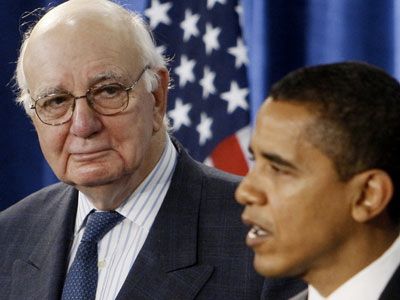
For Paul Volcker, chair of the White House Economic Recovery Advisory Board, Europe must accept external control of economic policy and put the euro at parity with the dollar.
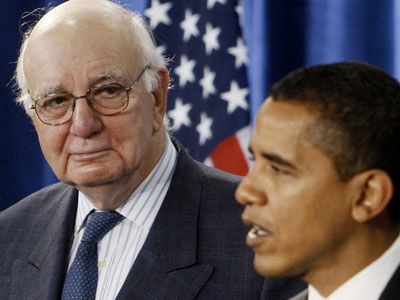
Indeed, how else to explain the evident contradiction between the concerns expressed by President Obama – legitimate by the way, for the EU needs a strong euro that penalizes European exporters, but is advantageous to American industry, a useful bonus given the record US fiscal deficit ($1400 billion for 2008-09) and above all necessary to support the ongoing war effort in Iraq, Afghanistan and Pakistan – and the radical destabilization of Western economies by the persistent attacks by the markets against the euro?

No matter how voracious, inconsistent or irrational, the ‘operators’ are nevertheless aware that the pursuit of the offensive against the euro jeopardizes the system in its totality and risks plunging the global economy into a new phase of chaos. Then why this dance on the edge of the abyss? Nobody will have us believe this nonsense that the markets have a life of their own, that they are uncontrollable and that all this is simply the result of the economic machine gone awry … In short, that it’s ‘nobody’s fault’, but the simple consequence of the impossibility of managing the agents and the irrational faux pas of the markets?

Clearly said, the risk of systemic collapse is at the very heart of the game currently being played. The big players, the cold calculators, are obvious disciples of the theory of games (since von Neumann & Morgenstern), probabilistic edifice on the foundations of which has been constructed the doctrine of nuclear deterrence … The winners are those who push the lethal bids the highest. A scenario that corresponds line for line to that which is unfolding before our eyes: increasing destabilization of the European economies, with non-negligible effects for the U.S.

Let’s add that the financial chaos, monetary and economic, on both sides of the Atlantic is an undeniable windfall, for those who prosper in the backwash of the market’s trajectory, provoking and anticipating the cycles of panic and euphoria to play indiscriminately with the rising and falling currents of the hysterically erratic markets.

At the beginning of the Twentieth Century, the economist Werner Sombart conceived an embryonic theory of ‘creative destruction’ (subsequently taken up by Joseph Schumpeter). Since then this theory has been developed by, among others, the mathematical theory of the frenchman René Thom (‘catastrophe theory’). Amended by Benoît Mandelbrot, the theory was applied via fractal geometry to market behavior, perceived already at that time to fall within the province of a theory of chaos, decidedly fashionable.

In the meantime, the economist Friedrich von Hayek, one of the theorists of neoliberalism, claimed to have raised the free-market economy to the status of an exact science. According to his hagiographer Guy Sorman, “… liberalism converges with the most recent theories of physics, chemistry and biology, in particular the science of chaos formalized by Ilya Prigogine. In the market economy as in nature, order is born out of chaos: the spontaneous agency of millions of decisions and pieces of information leads not to disorder, but to a superior order” … One could not say it any better, for a priori we hold there the keys to understanding the crisis.

At the end of the 1990s, the Neo-conservative disciples of Leo Strauss have carried to its logical limits the new dogma of greater disorder in making themselves the bards of ‘constructive chaos’ as a legitimation a priori for all the wars of conquest of the Twenty First Century. From this viewpoint, each is able to see this chaos at work in the Greater Middle East as s/he is able to see it at work today in Europe.

We can wager that the new regional order that the great organizers of chaos intend to see emerge from the crisis itself will be a unified Europe, centralized and federal, placed under the direct influence of the US with the aid of the Federal Reserve of which the European Central Bank will be only a branch, and under the vigilant watch of the IMF, representative or product of an emergent global power, deterritorialised yet omnipresent.

One understands quickly enough that the deification of the market associated with the idea of ‘constructive chaos’, itself complemented by an intensive application of game theory in the hands of the disciples of demolition, constitutes a mixture that promises to blow up in one’s face. An observation immediately comes to mind: ‘chaos’ (intentional) is these days a mode of government, of socio-economic transformation and of unopposed conquest. A heavy duty version of ‘divide and conquer’ even if it means nations will perish and the people with them.

For it’s a risk worth taking if in the end Europe finds itself on its knees. Greece – certainly at the soft underbelly of the euro zone but no more so than Italy, Spain, Ireland or Portugal – has been until now a sort of free electron frustrating a full integration of the Balkans in the American geostrategic orbit.

By way of a provisionary conclusion, if the EU, facing crisis, advances at forced march towards central economic control, a stage will be reached whereby quasi-discretionary power will be granted to the European Commission – for the most part composed of non-elected technocrats and recruits – for a stainless Atlanticist allegiance. To put it plainly, this will signify the obliteration of the European nation states.

In reality, nothing can prevent the integration of Europe within a trans-Atlantic Bloc. In the end, the merging of the euro with the dollar will accelerate the union of the old world and the new world. This conclusion is evidently not a matter of pure speculation but a simple projection of the architectonic tendencies visibly at work in the framework of a process of redistribution or of geopolitical re-composition of the global map. Sufficient to say that if the euro zone does not break apart, the fate of the European peoples seems definitely sealed, tied for better or worse to the manifest destiny of the United States. And this irrespective of a ‘reform’ of the global economic system.

The financiers will perhaps get their fingers burnt if the international community agrees to curb their appetites in regulating the markets, but the fact remains that the promoters of constructive chaos will have won this hand as they set out to recreate the conditions for new conflagrations.

The worse case scenario, often evoked in France by such influential men as Bernard Kouchner and Jacque Attali, happens to be the least improbable at a time when governments, backs to the wall, see themselves condemned to fleeing headlong into the unknown. In Kuwait in 1991, in Iraq in 2003 among the thinly disguised objectives of war, the boosting of the economic machinery through plans of reconstruction was high on the list. Not to mention other more flagrant and immediate interests such as fossil fuels, arms sales and all the related industries.

Whatever the accords between Turkey and Iran on uranium enrichment for medical purposes, whatever the related diplomatic annoyance for the State Department, it suffices to re-read the fabulist Jean de la Fontaine to know that the rhetoric of the wolf always prevails over that of the lamb! In a situation of extreme fragility of the global economy, one must await an end to the crisis at the harrowing door of the chaos constructor.

DECEPTION IN OUR MONEY SYSTEM, some research materials


HILAIRE BELLOC—Economics for Helen, London, 1938, chapter entitled “Usury”; The Jews, 2nd edition, Constable, 1937; Monarchy, A Study of Louis XIV, Cassel, 1938, Preface, pp. vii and viii, and chapter entitled “Monarchy,” pp. 3-17. Belloc, besides being a distinguished man of letters, was one of the outstanding historians of the English-speaking world in this century. Far from being any anti-Semite, he had a Jewish secretary, and in writing his The Jews seemed to be concerned as much for the welfare of the Jews as for that of gentiles....?

A.K. CHESTERTON—The New Unhappy Lords, An Exposure of Power Politics, 4th revised and expanded edition, 1972, Britons Pub. Co. American edition, with an Introduction by General P. A. del Valle, Pub. by Omni Pubs., Hawthorne, Calif. “A.K.,” as he was long known by all those who came to be counted among his friends, was in my judgment the most brilliant, illuminating, and reliable journalist of our day. Inevitably, much of his best work went into his paper Candour, The British Views-Letter, of which he was the founder and editor. His book very effectively brings into high relief the part played by the Money Power in shaping and determining the direction of the modern world. When I consulted him for books that would furnish me with reliable information about the Money Power, he recommended especially the next two books in this present list, and sent me his own copies of them.

A.N. FIELD—All These Things, Nelson, New Zealand, 1936. Reprinted by Omni Publications, 1963. His mastery of money problems was evidenced by his being called to witness before the special commission that was appointed to look into the question whether New Zealand should accept a central bank, such as our Federal Reserve. His All These Things is a mine of well-documented information. His The Truth about the Slump carried Mr. Chesterton’s unqualified endorsement, and was also recommended by Prof. Soddy.

JEFFREY MARK—The Modern Idolatry, An Analysis of Usury and the Pathology of Debt, Chatto & Windus, 1934. This book is largely based on Prof. Frederick Soddy’s Wealth, Virtual Wealth And Debt (for Soddy, see toward the end of this list), but it is very much easier reading. I found its 200 pages a marvelously clear and illuminating analysis of our Money System, the best introduction for the beginner that I know of. A reprint (with different pagination) was brought out in Bombay. But so far as I am aware, both editions have long been out-of-print, and copies of the book must be hard to find. However, a copy is (or long was) available in the Reference Room of the main Public Library in New York City. I hope that a new edition may soon be brought out by Omni. Recommended not only by Mr. Chesterton but also by Prof. Soddy.

GERTRUDE M. COOGAN—Money Creators, Sound Money Press, Chicago, 1935. A reprint is now available from Omni. This book, also, I found exceedingly informative and thought-provoking, and it was unequivocally and unreservedly endorsed by Senator Robert L. Owen, who wrote the Foreword to it. Sen. Owen was a man of very large banking experience. He established the first national bank chartered in Oklahoma, was its President for 10 years and one of its Directors for 45 years in succession. Also, he was a member of the U.S. Senate for 18 years, and for 12 years the Chairman of its Committee on Banking and Currency. He drafted the original Federal Reserve Bill, but, as he tells in his Foreword to Miss Coogan’s book, his efforts to make this an act to “promote a stable price level” were circumvented and frustrated by the development of “secret hostilities . . . the origin of which at the time (he) did not fully understand.” Of this last, I shall have much to say in due course. In his view, the Bill as passed was a national disaster. It threatened the welfare of every man, woman, and child in the United States as it had not been threatened even during the World War. Thoroughly aroused, he felt the necessity of trying to gain the attention of the American public. It was at this point that the manuscript of Miss Coogan’s book came into his hands. Some indication of the warmth of the endorsement he gave it may be gathered from the following excerpts from his Foreword to it:

“The facts that Miss Coogan was awarded a Master’s Degree in Economics and Finance by Northwestern University, was for eight years a Security Analyst for the Northern Trust Co. of Chicago, that from the beginning she had a deep desire to understand the fancied enigma of money, have given her a great insight into money science. . .

“I found this young American woman had a masterful knowledge of the so-called money enigma.

“. . . This book is worthy of careful study by American citizens who wish to understand the principles that govern the value and the volume of money in the United States and other countries. It contains scientific truths—not quackery,

“. . . This writer is informed. The information is sound. It has been digested. It is written in an attractive way with an engaging style, and it conveys to the American people truths of the very first magnitude.”

ROBERT McNAIR WILSON—Promise To Pay, An Inquiry into the Principles and Practice of the Latter-Day Magic Called Sometimes High Finance, Routledge, 1934. A small book for the beginner. In his Preface, the author says: “In the following pages an attempt has been made to describe the money system so that its principles maybe grasped easily by anyone above the age of sixteen years.” Recommended by Prof. Soddy. Two other very excellent and highly readable books by Mr. Wilson are his Monarchy or Money Power, Eyre & Spottiswoode, 1933, andThe Mind of Napoleon, Routledge, 1934.

EZRA POUND—Impact, Regnery, 1960. Who’s Who in America, 1969-70, described Pound as “a principal founder and moving spirit of modern poetry in English,” and Wilmot Robertson said that he “probably exercised more influence on modern literature than any other poet.” This collection of Pound’s prose is packed full of arresting and incisive and provocative observations on all sorts of subjects, none more so than those on the Money Power. His fervid denunciations, together with his lucid and persistent statements of the simple and essential principles of a really honest money system (combined, to be sure, with other features of his life no less repugnant to the would-be masters of the world) led to his being given the American equivalent of a sentence to Siberia. But to the end, he was never silenced.

JOHN R. ELSOM—Lightning over the Treasury Building, Meador, Boston. Reprint available from Omni. Not as well documented as I should like, probably because it was written primarily for the common man (who usually has an aversion for notes!), but it is simple, clear, goes to the heart of things, and is an eye-opener. Recommended by Mr. A.K. Chesterton.

CHRISTOPHER HOLLIS—The Breakdown of Money, An Historical Explanation, Sheed & Ward, 1934 (Endorsed by Prof. Soddy); The Two Nations, A Financial Study of English History, Routledge, 1935 (recommended by Mr. Chesterton). These books deal primarily with the British situation, but basically the problems remain the same however much the scene changes. Though I have yet to finish reading these two books, I include them here because they are of good repute, and I have liked what I found in them.

ABRAHAM LINCOLN, WOODROW WILSON, HENRY FORD, and THOMAS A. EDISON. Quotations from the published utterances of these men in regard to finance and financiers will appear in my text and need not be quoted here.

SIR ARTHUR KITSON—The Bankers Conspiracy, Which Started the World Crisis, Elliot Stock, London, 1933; and A Fraudulent Standard, first published in 1917, reprinted by Omni in 1972. Mr. Kitson, after having won fame as an inventor and holder of some 500 patents, abandoned a lucrative business career to devote the last 40 years of his life to lecturing, writing and crusading on money reform. In his very first book, A Scientific Solution of the Money Question, Boston, 1894, he “called attention to the fraudulent character of the so-called ‘Gold Standard’ of Value, and to the impossibility of any commodity functioning in its commodity capacity, as either a just measure or an honest expression of exchange-values.” He declared the gold standard to be “legalized fraud, a delusion and a snare.” (See A Fraudulent Standard, Omni, pp. v, viii.) Prof. Soddy recommends five of Mr. Kitson’s books, whom he calls “the doyen of British Monetary Reformers.”

LOUIS T. McFADDEN—Collected Speeches (before Congress). After becoming President of the Pennsylvania Bankers’ Association, he was for 12 years Chairman of the Finance and Currency Committee of our House of Representatives. His scathing exposure of the treasonous operations of the Money Power under the eyes of the nation is believed by many to have led to his assassination.

EUSTACE MULLINS—His The Federal Reserve Conspiracy (Kaspar & Horton, New York, 1952) and H.S. Kenan’s The Federal Reserve Bank (Noontide, 1969) are both excellent for their revelation of the unholy secrecy and treachery in which our Federal Reserve Bank was conceived and eventually brought into the world. Mr. Kenan’s book has valuable lengthy excerpts from McFadden’s speeches about the operations of the international bankers.

VINCENT VICKERS—Economic Tribulation, John Lane, 1941. Reprinted in 1960 by Omni. Vickers was for many years a very high-placed figure in the British banking system, and from 1910 to 1919 was even a Director of the Bank of England. But in the Foreword to his Economic Tribulation, a “world-famous book on money-reform,” he tells of “that day in 1926 when . . . I felt it my duty to explain to the Governor of the Bank of England, Mr. Montagu Norman, that ‘henceforth I was going to fight him and the Bank of England policy until I died.’” And this he did, spending the next 15 years pressing upon the Western world the “necessity for a reform of the money system.” Just before his death, he declared his conviction that “the existing system is actively harmful to the State, creates poverty and unemployment, and is the root cause of war.”

With this may be compared the statement of Robert H. Hemphill, former credit manager of the Federal Reserve Bank, Atlanta, Georgia, that the banking problem “is the most important subject intelligent persons can investigate and reflect upon. It is so important that our present civilization may collapse unless it is widely understood and the defects remedied very soon.” See his Foreword to Prof. Irving Fisher’s book 100% Money.

GARY ALLEN—Two articles, “The Bankers” and “The Federal Reserve,” originally published in American Opinion, reprinted as one booklet by Western Islands, Belmont, Mass., 1970. As I recall, Mr. Chesterton, in something he wrote not long before his death, showed his respect for Gary Allen’s qualities as an investigator. Also, most recently, there is his best-seller None Dare Call It Conspiracy, Concord Press, Seal Beach, Calif. It contains a very arresting and well-documented body of significant facts.

Among the most constructive works on the Money Question are those of the three authors with whom I will conclude this list.

C.H. DOUGLAS, known all over the world as the founder of Social Credit. Perhaps his most influential books have been Social Credit, now available as an Omni reprint, and The Brief For The Prosecution, K.R.P. Pubs., Liverpool, 1945.

SILVIO GESELL—The Natural Economic Order, Free Economy Pub. Co., Huntington Park, Calif. In this, he proposed a new monetary system. H.G. Wells said of him: “Gesell’s name will be a leading name in history once it has been disentangled.” Prof. Soddy declared him “a voice in the wilderness—a Genius.” Prof. Irving Fisher’s Stamp Scrip gives a clear treatment of the Gesellist economy.

FREDERICK SODDY—Wealth, Virtual Wealth and Debt, Dutton, 1933. A reprint may be available from Omni. Prof. Soddy was a Professor of Chemistry at Oxford University, “father of nuclear fission,” a Nobel Prize laureate, and a Fellow of the Royal Society, England’s highest scientific honorary body. Stuart Chase, in reviewing his book, said that it might prove to be “one of the most important books ever written.” Having come to feel that he must reach an understanding of our money system, Soddy spent two years studying what its proponents had to say for it, only at last to find himself facing the fact that he “could make nothing of it.” And “then one day,” he went on to say, “the truth dawned on me. What I was studying was not a system but a confidence trick.” Basically, the whole thing was a swindle, dependent for its successful operation on keeping people deceived.

Thus was brought home to him the necessity of making his approach to the problem independently of all orthodox authorities. Out of the ensuing research came his book, and by the time he had reached page 14 he stated bluntly that our money system “has become easily the most powerful tyranny and the most universal conspiracy against the economic freedom of individuals and the autonomy of nations that the world has ever known.” By the time he finished his book he had made his case, and was stating it in terms even more extreme and severe. He also declared, let me add, that “the solution [to which his searching investigation of the Money Question led him], as was to be expected, . . . proved to be most ordinary incontrovertible common sense, requiring nothing more than that to prove it” (p. 22).

I have found two other books by Prof. Soddy very valuable. Money Versus Man he himself describes as “a succinct account of [his] Wealth, Virtual Wealth And Debt.” Also, it is much easier to understand, and in it Soddy seems more deeply involved, personally, than in his larger work. The other book, The Role of Money (Harcourt, 1935), on pp. 213-4, contains a valuable list of recommended books on the Money Question.

HILAIRE BELLOC—Economics for Helen, London, 1938, chapter entitled “Usury”; The Jews, 2nd edition, Constable, 1937; Monarchy, A Study of Louis XIV, Cassel, 1938, Preface, pp. vii and viii, and chapter entitled “Monarchy,” pp. 3-17. Belloc, besides being a distinguished man of letters, was one of the outstanding historians of the English-speaking world in this century. Far from being any anti-Semite, he had a Jewish secretary, and in writing his The Jews seemed to be concerned as much for the welfare of the Jews as for that of gentiles.

Thursday, June 10, 2010

Chairman of Goldman Sachs International Was - Until Last Year - Also Chairman of BP


Janine Wedel has written extensively on how the "shadow elite" rule the world and about the "flexians" - the movers and shakers of the shadow elite who glide across borders, and structure overlapping (and not fully revealed) roles in government, business, media, and think tanks to serve their own agendas.

Wedel says that flexians wear many hats both within and outside of government, and use their networks of contacts to influence policy - are warping our democracy and the rule of law.

Peter Sutherland is the quintessential flexian.

According to his September 2009 bio:
Peter Sutherland is chairman of BP plc (1997 - current). He is also chairman of Goldman Sachs International (1995 - current). He was appointed chairman of the London School of Economics in 2008.... Before these appointments, he was the founding director-general of the World Trade Organisation. He had previously served as director general of GATT since July 1993 ....
Sutherland resigned as BP's chairman in 2009, but apparently still serves in various key capacities.

Sutherland is managing director - as well as chairman - of Goldman Sachs International (Goldman Sachs International is the very powerful subsidiary of the Goldman Sachs Group, of which Lloyd Blankfein is CEO). Sutherland is also an Advisory Director of the Goldman Sachs Group itself.

And he is European Chairman for the Trilateral Commission.

He has, at various times, attended meetings of the Bilderberg group.

As if that is not enough, Sutherland also serves in the following capacities (click on "Read Full Background"):
Mr. Sutherland served as an Attorney General of Ireland and also served as European Commissioner from 1985 to 1989 where he was responsible for competition policy.... He serves as the Chairman of British Petroleum, BP Amoco PLC and United Kingdom. From 1989 to 1993, he served as the Chairman of Allied Irish Bank. .... He serves as a Non-Executive Director of Telefonaktiebolaget LM Ericsson. He serves as a Director of Goldman Sachs International. He has been Member of Supervisory Board at Allianz SE since January 2010 and serves as its Member of International Advisory Board .... Mr. Sutherland served as a Non Executive Director of BP Plc since July 1995. He serves as a Member of Foundation Board of World Economic Forum. He served as an Independent Non Executive Director of National Westminster Bank PLC since January 2001. He served as an Independent Non Executive Director of The Royal Bank Of Scotland Plc from January 2001 to February 6, 2009.... In addition, he serves on the board of Allianz, Koc Holding A.S. and is a member of the advisory board of Eli Lilly.... He served as a Director of LM Ericsson Telephone Co since 1996, Ericsson SPA since 1996 and Investor AB since 1995. He served as a Non Executive Director of Royal Bank of Scotland Group plc from January 2001 to February 6, 2009.
Sutherland is - literally - like Lloyd Blankfein and Tony Hayward rolled into one. But unlike Blankfein and Hayward, he has also held numerous powerful governmental and quasi-governmental positions....

Wednesday, June 9, 2010

The trillion-dollar failure


The trillion-dollar failure
By Henry CK Liu


At the close of an emergency Sunday meeting of financial ministers from the 27-member European Union (EU) that lasted until the early hours of Monday, May 10, 2010, the exhausted attendees emerged to announce a startling nearly 750 billion euro
(US$1 trillion) financial stabilization package for EU member states with sovereign
debt problems and the European Monetary Union (EMU) to restore market confidence in the euro, its common currency for the 16-country eurozone.

Immediately after foreign exchange markets opened several hours later on the same day, the dramatic news caused the euro to soar against the dollar and the yen, reversing its recent sharp decline as fallout from the sovereign
debt crisis in Greece.

Unfortunately, the trillion dollar package seems to be a total failure. The relief from downward market pressure on the euro was short-lived, confirming the market's continuing apprehension about the heavy and worsening sovereign debts burden facing all EMU member economies and possibly beyond and across the Atlantic.
The crisis in trade
The eurozone buys around 15% of US exports. Reflecting the global economic slowdown, the EU bought $221 billion from the US in 2009, down from $244 billion in 2007. The US trade deficit with the EU fell sharply from $110 billion in 2007 to $60.5 billion in 2009.

A sharp fall of the euro against the dollar in 2010 accompanied by fiscal austerity in eurozone economies will adversely impact the US economy by making US exports more expensive in a market of falling demand, while investment and tourism from the eurozone will moderate. This may reverse the recent downward trend of the US trade deficit with the EU.

The eurozone is now China's largest trade partner, surpassing the US. Europe's imports from China grew by around 18% per year for the previous five years from 2009. This trend will accelerate further if the euro falls. Two decades ago, China-Europe trade was negligible. In 2008, the EU imported goods worth 248 billion euros from China, which is now Europe's biggest source of manufactured imports and also Europe's fastest growing export market.

Europe exported 78.4 billion euro worth of goods to China in 2008, a rise of 9% compared with 2007 and a growth of 65% between 2004 and 2008. Europe runs a surplus on trade in services with China - 5.7 billion euros in 2008, up from 3.9 billion euros a year earlier. Yet this is about 30 times smaller than its trade deficit for goods, which was 169 billion euros in 2008.

EU-China trade decreased in 2009 due to the global economic downturn. European imports from China went down, while EU exports to China have remained largely stable. This trend can be expected to accelerate as the EU deals with its sovereign
debt crisis in its member states with austerity measures.

A slowdown of the eurozone economies will further adversely impact China's export sector, which has already been hit by severe recession in the US. A falling euro will also present problems to the Chinese central
bank in its recent efforts to diversify its huge foreign reserves away from the dollar.

The crisis in exchange rates
The euro jumped to a high of $1.3048 on the day the EU stabilization package was announced. European policymakers prematurely breathed a sigh of relief that their "shock and awe" package had helped to shore up market confidence in the common currency.

However, by Thursday, May 13, two trading days later, the euro had fallen back near its 14-month low at US$1.2586, down 0.3% on the day, putting it within a cent of where it had been just before word of the bold stabilization move hit the market. It traded at $1.1960 on Friday, June 4, almost 11 cents below the $1.3048 level traded immediately after the stabilization package was announced on May 11.

The crisis in government
The failure of trillion dollar stabilization package is more than financial. The package helped ease concerns over the prospect of a wave of imminent sovereign debt defaults within the 16-country eurozone, but currency traders were aware that the underlying problem had not been solved. Even with a gargantuan stabilization fund, there was no hint on how the highly indebted eurozone member states would get their public finances back on track going forward to meet European Monetary Union (EMU) requirements without triggering political crises from popular opposition to fiscal austerity.

A major concern was the problem of deep popular discontent with pending government austerity measures that would be required to lower excessively high public debt levels and chronic fiscal deficits. In particular, there were worries in the market that the recently installed socialist government in Greece would not be able to push through the draconian measures it had been forced to accept in order to secure the earlier 110 billion euro rescue pact scheduled over three years. This was because of the fear that resultant political resistance and social unrest would topple the socialist Greek government under Prime Minister George A Papandreou that had been elected on a platform of increased prosperity only seven months earlier on October 6, 2009.

Market participants are cognizant of the fact that this sovereign debt crisis is not an isolated local problem in a small country, but a eurozone-wide financial virus that broke out first in Greece but could detonate explosive crises in other similarly infested national economies around the globe with serious economic and political implications.

Already, Germany's conservative coalition government, led by the Christian Democrat Union (CDU) has been weakened as the CDU suffered an important regional election defeat over its inept handling of the sovereign debt crisis in Greece. German voters also fully expect that Germany will have to face its own fiscal austerity measures soon as a result. Other eurozone member states are not expected to be exempted from similar popular discontent against incumbents in government in this regional sovereign debt crisis.

Even in the UK, which has been a member of the EU since1973 but is not a eurozone member state - although it conducts large trade with the eurozone - the Labour Party lost control of the government after a general election produced no majority winners. Failing to form a new coalition government with the Liberal Democrats, Labour had to hand over the reins of government to a Conservative coalition supported by the Liberal Democrats.

Voter hostility towards center-left incumbency over painful economic austerity issues is now rampant in the multiparty democracies.

A panic demand for fiscal austerity
The sovereign debt crisis in Greece has sparked a panic wave of radical policy demands for fiscal discipline throughout the European Union from a perverse coalition of neo-liberal public finance ideologues and anti-government conservatives. Proponents of fiscal discipline argue that the EMU and its common currency, the euro, will not be sustainable without the drastic restructuring of public finance in all eurozone member states through a combination of tax increases and deficit reduction through fiscal austerity. But creditors, mostly transnational bank, will be protected from having to accept "haircuts" on their holdings of sovereign debt.

Yet such harsh approaches of tight fiscal austerity at a time when the global recession of 2008 is still waiting in vain for a recovery will risk increasing the danger of a double dip recession in 2011 in a secular bear market. The alarmist voices of these fiscal deficit hawks clamor for fiscal austerity programs that are essentially punitive for eurozone workers; at the same time, they continue to tolerate abusive financial market manipulation that will benefit only the financial elite as the economic pain is passed on to the general public.

Fiscal deficits across the eurozone are to be reduced by cutting public sector wages, social benefits and subsidy expenditures so that transnational bank creditors will be paid in full while a blind eye is turned to blatant tax evasion and avoidance by the rich with non-wage income, which contributes to loss of government revenue and fiscal deficits.

The dysfunctional disparity of income and polarization of
wealth between the wage-earning masses and the financial elite with income from profit and capital gain are the main causes of overcapacity in the economy. In past decades, the neo-liberal response to overcapacity was to shy away from the obvious solution of raising wages, turning instead to flooding the economy with huge mountains of consumer and corporate debt that eventually resulted in a tsunami of borrower defaults that turned into a global credit crisis. Repeating the same response to the current crisis will lead only to another global crisis down the road.

While the culprits of the global
credit meltdown of 2008 have been bailed out with the public's future tax money, the sovereign debt crisis across the globe is blamed on innocent wage earners for receiving supposedly unsustainably high wages and excessive social benefits that allegedly threaten the competitiveness of economies in a globalized trade regime designed to push wages down everywhere.

Sovereign debt crisis not caused by the welfare state
The rush by the rich and powerful to punish the trouble-causing working poor goes against strong evidence that the current sovereign debt crisis is not caused by high social welfare expenditure; rather, it is caused by a sudden drop in government revenue due to economic recession, which in turn is caused by a credit market failure under fraudulent accounting that is allowed in structured finance and for which the financial elite are directly and exclusively responsible.

The sole special purpose of is to treat proceeds from debt issuance as revenue from sales to remove financial liability from government balance sheets to present a deceptively robust picture of public finance. Through these devious "special purpose vehicles", phantom profits are siphoned off from the general economy into the pockets of greed-infested financiers while pushing the real economy out of balance, resulting in high real public debts that inadequate aggregate worker income cannot possibly sustain.
As a portion of GDP, wages and benefits have been falling in past decades while the public debt has been rising. Transnational financial institutions routinely generate profits larger than government revenue of small economies.

Despite propagandist distortion, the sovereign debt problem has not been caused by the high cost of a welfare state; it has been caused by deregulated financial markets that allowed governments to borrow huge sums against future revenue from public sector enterprises without showing the liabilities on government balance sheets.

Structured finance was providing participating governments with up-front cash while hiding the sovereign debts that had to be paid back in the future. But the bulk of the borrowed money went to the pockets of dealmakers of public sector privatization, while the debts were left with society at large. Large amounts of the national wealth are transferred from the local economy to international speculators through legalized manipulation that is made possible by deregulated financial market globalization. It is a new form of synthetic financial imperialism against weak economies through a scheme of naked shorts against the currencies and equities of vulnerable nations.

Fiscal austerity will endanger the EU
Further, such punitive fiscal austerity solutions will render the EU unsustainable as a political superstructure due to violent popular opposition in the constituent nations. Third Way centrist synthesis of free-market capitalism with the social democratic welfare state has provided the enabling conditions for the current sovereign debt crisis. Market fundamentalism has been exposed by unhappy but predictable events it helped to create as an exorbitant and spectacular failure. And the exorbitant cost of this spectacular failure of market fundamentalism will be put on the back of the innocent working poor.

There are strong signs that voters in countries with multiparty democratic political systems have been brainwashed into believing that free-market capitalism with minimum government intervention is the only road to prosperity. Voters have been conditioned unwittingly to buy into an anti-government ideology that diametrically contradicts the public's other demand for generous safety nets of socioeconomic security that only governments can provide.

When the gullable weak are convinced by the devious strong in society that government is the problem, not the solution, the weak are inadvertently trapped into a political climate that permits the destruction of their only institutional protector, since the existential function of government, regardless of political and economic color, is to protect the weak from the strong.

Government non-interference through deregulation and privatization of the public sector leads to the law of the jungle in free markets under which the economic function of the financially weak is to serve as the food supply for the financially strong. Historically, government evolves in civilization so that the weak masses can collectively resist the oppression of the strong elite. This is the reason why the strong in society always bash popular government.

Price of saving the euro may be EU dissolution
Thus the attempt to save the euro from collapsing in exchange value under the weight of aggregate eurozone member state sovereign debts through coordinated fiscal austerity in all member states of differing socio-economic legacy and conditions will incur the price of political divergence of the member states from the European Union.

Member state governments are pulled apart from the union by centrifugal nationalist forces generated by separate and divergent domestic politics. Popular sentiment against local fiscal austerity for the sake of preserving the European Union is spreading like wild fire in the EU's sovereign debt crisis.

But a weakening of convergence toward full integration of European nation states will prolong the euro's structural vulnerability as a common currency without a unified political structure and condemn it to remain a multi-state currency with high political risk. This internal contradiction is the Achilles' heel of the euro, which is the legal tender of a monetary union without a political union.

Stormy political weather has recently battered incumbent centrist political leaders in several countries by holding each of them separately responsible for the austerity measures they are now forced to implement to get their different economies out of unsustainable sovereign debt.

In order to meet a 2013 deadline for compliance with EMU's euro convergence criteria as spelled out in its Stability and Growth Pact (SGP), the ratio of the annual government fiscal deficit to gross domestic product (GDP) at the end of the preceding fiscal year must not exceed 3% and the ratio of gross government debt to GDP must not exceed 60%. This means the eurozone governments need to slash their individual budget deficits to add up to a total of 400 billion euros. This huge sum will be taken primarily from the pockets of public service employees, pensioners, the unemployed and the indigent in the EU for decades to come.

  • Greece was forced on May 11, 2010, to adopt an austerity plan to reduce its budget deficit by 30 billion euros over the next three years through wage, benefit, subsidy and pension cuts, slashing social programs, and an increase in value added tax (VAT).
  • Spain on May 26 announced cuts of 80 billion euros from its fiscal budget, shedding 13,000 public service jobs, reducing salaries of state employees by 5% and freezing pensions. The allowance of 2,500 euros for parents of a new birth to reverse declining population trends will be suspended.
  • Portugal has imposed a hiring and salary freeze in the public sectors and passed an increase in VAT in order to cut 20 billion euros from its budget deficit.
  • The Italian government launched measures that will result in cuts of 24 billion euros by 2012. They include a reduction in civil service jobs, salary cuts, raising the retirement age and cuts in the health care system.
  • France plans to reduce its budget deficit to 3% of GDP from 8% by 2013. This will be achieved by delaying the retirement age of public employees; cuts in housing benefits, employment compensation and museums funding; as well as a 10% cut in administrative costs.
  • The German government plans to save around 80 billion euros between 2011 and 2014 with measures that include a 30 billion euro reduction in welfare spending and a cut of 15,000 in public sector payrolls. It hopes to realize 5.5 billion euros through subsidy cuts, and may reduce the armed forces by 40,000.
    The so-called "debt brake", anchored in the German federal constitution, imposes a reduction in new debt of 60 billion euros by 2016. Among the many measures under discussion are cuts in social programs, such as family, child, welfare and disability benefits, annuities and pensions.
  • The new center-right British conservative government has announced immediate budget cuts of 7.2 billion pounds (US$10.4 billion), including a hiring freeze in the civil service. New Prime Minister David Cameron said Britain's budget deficit will be cut over the next four years by more than 100 billion pounds. This will include slashing 300,000 posts in public service and a freeze on public sector pay.

    Delaying retirement age counterproductive
    The EU Commission suggests that the retirement age in Europe should continue to rise steadily. This is to ensure that in future, no more than a third of a person's adult life could be spent in retirement. In the long term, this would mean raising the pension age to age 70. This will add pressure on young new entrants to the job market for the next two decades as fewer positions will be vacated by retirement of the currently employed.

    For millions of workers and young graduates, the newly adopted measures mean rising unemployment and poverty levels. At the other end of the working life, old-age poverty will again become a mass phenomenon in Europe. Nothing will remain of the post-war welfare state.

    A study by the Carnegie Endowment for International Peace think tank in the US concludes that "the welfare states set up across Europe from the 1940s onwards with the aim of suppressing popular unrest and paying off tensions that could lead to another continental war" are "unaffordable". What was left unsaid in the study was that it would be unaffordable only if the disparity of income and polarization of wealth were to be allowed to continue. In an overcapacity economy, the people can afford what they produce if the system does not deprive the majority of their right to the wealth they create and hands it to a controlling minority. Revolution would have to come by policy or it will come by violence.

    In a fiat money regime, it is the central bank's responsibility to ensure an adequate supply of money. The fiscal budget shortfalls that are being used to justify the dismantling of the welfare state are the result of the systematic mal-distribution of income and wealth from those at the bottom of society who do the work to those at the top who do the manipulation.

    For a quarter of a century since the late 1970s, both right-wing and center-left governments have reduced taxes on income and property for the rich, depressed wages through structural unemployment as a tool to fight inflation and have abdicated government responsibility in maintaining economic justice.

    The concept of a living wage is regarded by new coalition as utopian. Wages are set by their marginal utility to the return on capital in unregulated markets rather than by the economic law of demand management in a modern overcapacity economy of business cycles, the recessionary phase of which has become nearly continuous. Popular discontent is muted with unsustainable increases of the public debt. These are the main causes of the sovereign debt crisis, not over-consumption by the working poor.

    Public debt has been pushed up sharply in the past two years by the trillions of dollars that governments, run by free-market policymakers, pumped into distressed banks to prevent their collapse from proprietary speculation in deregulated markets. Recent figures from the German Bundesbank showed that in 2008 and 2009, some 53% of Germany's new public debt was used to rescue distressed financial institutions. The total new public debt rose by 183 billion euros in those two years; the costs involved in supporting distressed financial institutions amounted to 98 billion euros.

    Trade union leaders as hatchet men of neo-liberalism
    To push through the austerity measures against the working poor, the ruling financial elite drafted the social democrats and the trade unions as their hatchet men. In the PIIGS (Portugal, Italy, Ireland Greece and Spain) countries, social-democrat-run governments impose the austerity measures, or, as in Britain, France and Germany, the social democrats have so discredited themselves by their previous cost-cutting measures that now the right-wing parties have reaped the political benefit. In all cases, the social democrats leave no doubt that they support the cuts, telling working people that there is "no alternative".

    Trade union leaders have been willingly subscribing to the discredited "TINA" (There Is No Alternative) voodoo economics of Ronald Reagan and Margaret Thatcher, in cooperation with corporate-controlled governments to wage financial war on labor. The labor-organized demonstrations and strikes against austerity measures have all been suppressed by armed police, with the violence and deaths exploited as reasons why labor protects must cease.

    Yet labor has a moral and functional obligation to force structural changes in the dysfunctional economic system, instead of continuing to remain a passive victim in the new age of wholesale anti-labor selfdom.

    Meanwhile, in the United States, a conservative populist movement that calls itself TEA (Tax Enough Already) Party is gaining popular support and can easily be transformed into a fascist political force. Left unsaid in TEA Party rhetoric, besides protest against rising taxes, is protest on the prospect that the tax money should be spent on the poor, rather than bailing out the errant financial elite. Until labor takes the rein of reform, the EU's trillion-dollar stabilization package will end in failure.
  • On Journalists and the MSM.... simple intellectual prostitutes.

    Journalists are simply intellectual prostitutes for life...

    "There is no such thing, at this date of the world's history, as an independent press. You know it and I know it. There is not one of you who dares to write your honest opinions, and if you did, you know beforehand that it would never appear in print. I am paid weekly for keeping my honest opinions out of the paper I am connected with. Others of you are paid similar salaries for similar things, and any of you who would be so foolish as to write honest opinions would be out on the streets looking for another job.....

    If I allowed my honest opinions to appear in one issue of my paper, before twenty-four hours my occupation would be gone. The business of the journalist is to destroy the truth; to lie outright; to pervert; to vilify; to fawn at the feet of mammon, and to sell the country for his daily bread. You know it and I know it and what folly is this toasting an independent press. We are the tools and vassals of the rich men behind the scenes. We are the jumping jacks, they pull the strings and we dance. Our talents, our possibilities and our lives are all the property of other men. We are intellectual prostitutes....."

    I expect people to stop watching CBS.....and all other Networks....NYT, WAPO...etc. In fact, I believe that the ONLY way to remain sane (not to mention - informed) is to completely sever any and all exposure to the corporate media. No TV, no radio, no newspapers - nothing. That is the only way to avoid becoming a Zombie. And its wrong to think that a little exposure is no big deal. A little exposure makes a person only somewhat of a Zombie. But that is still a Zombie. As Roger Waters sang "and the worms ate into his brain"...

    Corporate media is mind pollution. Period. It should be totally and absolutely boycotted. Besides, in the age of the Internet, why expose oneself to that trash anyway?

    GORDON DUFF: CONGRATS ISRAEL ON A GOOD WEEK, PLENTY OF DEAD AND HELEN THOMAS FINALLY GONE: For decades, Helen Thomas, like John F. Kennedy, tried to prevent what has now dragged America into a chasm beyond survivability. For years the ADL, AIPAC and the State of Israel has fought to stop her.... Maybe it was time for Helen Thomas to leave the stage. Israel and its allies may already have destroyed America anyway. Her decades of effort, though steeped in honor, may well have been in vain. Would Shakespeare have written, “Et tu, Obama?”

    Tuesday, June 8, 2010

    BP's Fateful Discovery: Bottomless Liability

    http://www.saveusenergyjobs.com/res/infographic/

    http://blog.buzzflash.com/editorblog/312

    http://thomaspainescorner.wordpress.com/2010/06/04/yes-obama-is-engaged-%E2%80%93-in-a-colossal-crime/
    June 2010

    How does BP stay in business here? I'm honestly not sure why anyone is buying the stock these days, even with the company's market capitalization slashed by $70 billion or so (it has bounced back up from $36 to $39 the past two days).

    The problem is liability. The greatest Gulf of Mexico oil spill in history has created unending damages to wildlife, ecosystems and countless human activities - with human health, fisheries, leisure travel, waterfront real estate (and property values) impacted, presumably for many years to come.

    No corporation (or mega-corporation), BP included, could possibly ever muster the funds to reimburse all affected for the damages unleashed by this disaster. Apparently 1/6 of all British dividend payments originate from BP. I don't see how that lasts either.

    I haven't seen much discussion of this issue. There was talk on CBC radio today about the immense value of BP's assets - but that calculation disregards the company's liabilities. We saw
    Johns Manville plunge into bankruptcy over asbestos insulation claims.

    BP in the gulf is bigger than that - far bigger by at least an order of magnitude. Once again - the US taxpayer will foot the bill, and I predict that many of the damages will never be paid (think about Florida Gulf Coast real estate values, just for a starter).


    Once again, we are facing a paradigm shift, and the market hasn't caught up with the concept of "bottomless liability." Take my word for it, this case is not over until BP is in bankruptcy court. No corporation on earth could bear liability on this scale.

    Click here for one forum that is discussing this somewhat complex issue. For example, BP's total liabilities may be limited by law, at a small fraction of the total damages.... As to insurance coverage - they insure themselves through a sub-venture known as "Jupiter."
    _