Tuesday, November 20, 2012

Nation-building doesn't begin at home...

Nation-building doesn't begin at home...By Nick Turse

A billion dollars from the federal government: that kind of money could go a long way toward revitalizing a country's aging infrastructure. It could provide housing or better water and sewer systems. It could enhance a transportation network or develop an urban waterfront. It could provide local jobs. It could do any or all of these things. And, in fact, it did. It just happened to be in the Middle East, not the United States.

The Pentagon awarded US$667.2 million in contracts in 2012 and more than $1 billion during Barack Obama's first term in office for construction projects in largely autocratic Middle Eastern nations, according to figures provided to TomDispatch by the US Army 
Corps of Engineers Middle East District (USACE-MED). More than $178 million in similar funding is already anticipated for 2013. These contracts represent a mix of projects, including expanding and upgrading military bases used by US troops in the region, building facilities for indigenous security forces, and launching infrastructure projects meant to improve the lives of local populations.

The figures are telling, but far from complete. They do not, for example, cover any of the billions spent on work at the more than 1,000 US and coalition bases, outposts, and other facilities in Afghanistan or the thousands more manned by local forces. They also leave out construction projects undertaken in the region by other military services like the US Air Force, as well as money spent at an unspecified number of bases in the Middle East that the Corps of Engineers "has no involvement with", according to Joan Kibler, chief of the Middle East District's public affairs office.

How many of these projects are obscured by a thick veil of secrecy is unknown, with US Central Command (CENTCOM) refusing to name or even offer a full count of all US bases in the region. On the record, CENTCOM will acknowledge only 10 bases as in its area of operations outside of Afghanistan, even though there are more than two dozen, according to a CENTCOM official who spoke to TomDispatch on the condition of anonymity. Exactly how many more and just where all US construction work in the region is taking place continues to be kept under tight wraps. Still, Army Corps of Engineers data, other official documents, and publicly available contract information offer a baseline indication of the way the Pentagon is garrisoning the Greater Middle East and which countries are becoming ever more integral allies.

Public talk, secret action
In the final days of the presidential campaign, President Obama repeatedly assured Americans that it was time to reap a peace dividend as America's wars wind down. Nation-building here at home should, he insisted, be put on the agenda: "What we can now do is free up some resources, to, for example, put Americans back to work, especially our veterans, rebuilding our roads, our bridges."

Setting aside just how slipshod or even downright disastrous Washington's last decade of nation-building projects in Iraq and Afghanistan have been, the president's proposal to rebuild roads, upgrade bridges, and retrofit the country's electrical grid sounds eminently sensible. After all, the American Society of Civil Engineers (ASCE) gives America's infrastructure a grade of "D". If, in the era of the $800 billion stimulus package, $1 billion at first sounds paltry, ask the mayors of Detroit, Belmar, New Jersey, or even New York City what that money would mean to their municipalities. America may need $2.2 trillion in repairs and maintenance according to ASCE, but $1 billion could radically change the fortunes of many a city.

Instead, that money is flowing into the oil-rich Middle East. Unknown to most Americans, thousands of State Department personnel, military advisors, and hired contractors remain at several large civilian bases in Iraq where nation-building projects are ongoing; hundreds of millions of taxpayer dollars have been flowing into military construction projects in repressive Persian Gulf states like Bahrain and Qatar; and the Pentagon is expanding its construction program in Central Asia. All of this adds up to a multifaceted project that seems at odds with the president's rhetoric. (The White House did not respond to TomDispatch's repeated requests for comment.)

Increasing the power of airpower in Qatar
The tiny oil-rich emirate of Qatar has been the preeminent site of the Pentagon's Middle Eastern building boom in the Obama years. A significant percentage of its population is made up of migrant workers who, according to Human Rights Watch, are "vulnerable to exploitation and abuse," while "forced labor and human trafficking remain serious problems". The country even received a failing grade ("not free") from the US State Department-funded human rights organization Freedom House.

Still, between 2009 and 2012, the US pumped nearly $400 million into Pentagon projects in the country, including troop barracks, munitions storage areas, a communications center, a training range, an aircraft operations center, an aircraft maintenance hangar, an aviation maintenance shop, a warehouse facility, and a vehicle maintenance shop, according to a list provided by the Corps of Engineers.

The Obama administration has continued a build-up in the country that accelerated after 9/11. In September 2001, US aircraft began to operate out of Qatar's Al Udeid Air Base. By 2002, the US had tanks, armored vehicles, dozens of warehouses, communications and computing equipment, and thousands of troops at and around the base. The next year, the US moved its major regional combat air operations center out of Saudi Arabia and into Al Udeid. Since then, it has served as a major command and logistics hub for US regional operations, including the wars in Iraq and Afghanistan.

According to figures provided to TomDispatch by USACE, at least 10 contracts for construction at Al Udeid, worth nearly $87 million, are anticipated in 2013. A review of official US government documents reveals a host of upcoming projects there, including a fuels laboratory, a cryogenics facility, a center for the Air Force's Office of Special Investigations, an air defense maintenance facility, more parking space for fuel trucks, new roadways, and a precision measurement equipment laboratory where technicians will calibrate the sophisticated gear used in vehicle and weapons maintenance.

Waterfront development in Bahrain
Despite a brutal crackdown on pro-democracy protesters in 2011, which continues to this day, the oil-rich kingdom of Bahrain (also "not free" according to Freedom House) is a top US ally. In fact, over the past year, the Corps of Engineers awarded contracts for construction in the country worth more than $232 million, the most for any nation in any year of the Obama presidency so far. Since 2009, Bahrain has seen almost $326 million in USACE contract awards.

In 2010, the US Navy broke ground on a mega-construction project to develop 70 acres of waterfront at the port at Mina Salman. Scheduled for completion in 2015, the complex is slated to include new port facilities, barracks for troops, administrative buildings, a dining facility, and a recreation center, among other amenities. Total price tag: $580 million.

In September, USACE awarded a $15 million contract for the expansion of a wastewater treatment plant and the construction of a climate-controlled warehouse, as well as an irrigation pump building, among other facilities at Mina Salman. That same month, the Corps of Engineers also awarded a $42 million contract for a multistory "bachelor enlisted quarters" in the capital, Manama. It will contain at least 241 two-bedroom apartments for Navy personnel, as well as administrative offices, laundry facilities, multipurpose rooms, and lounges.

Taking flight in Oman
In February and March of 2011, protests demanding political reform in Oman led to assaults on and the killing of protesters by the nation's security forces. Despite marked restrictions on freedom of expression and freedom of the press, this sultanate (also ranked "not free" by Freedom House) has been a favorite site of military expansion in the Obama years. Between 2009 and 2012, the Corps of Engineers awarded $144 million in contracts for work there, more than half this year.

During the 1930s, the British Royal Air Force operated an airfield on Oman's Masirah Island. Today, the US uses Masirah and USACE is carrying out construction there as well as at the country's Thumrait and Al Musannah Air Bases.

The un-withdrawal from Iraq
The Corps's contract data do not include figures for construction in Iraq prior to August 2011. In the 15 months since, according to information provided by USACE, it has awarded $113 million in contracts for State Department nation-building-style projects like a wastewater treatment plant in the city of Fallujah and a courthouse in Rusafa.

The Iraqi government is paying USACE to carry out these projects in order to increase its defense capabilities, according to the Middle East District's Joan Kibler. These include a counter-terrorism center, consisting of a headquarters facility, barracks, a warehouse, and a power plant in eastern Baghdad; a military training complex at Al Harthiya; a military security school in Taji; and administrative, security, and dining facilities at Hawk and Tikrit Air Bases.

At the height of the American occupation of Iraq, the United States had 505 bases there, ranging from small outposts to mega-sized air bases. Of them, some have been stripped clean by Iraqis, others became ghost towns, and one - Camp Bucca - a hotel. What remains open today are State Department facilities, most notably the US Embassy in Baghdad. Earlier this year, the Washington Post reported that the Department of State was planning to spend up to $115 million to upgrade the massive embassy compound, which it characterized as already the "biggest and most expensive in the world".

State Department documents issued last month and examined by TomDispatch offer a snapshot of the civilian "bases" currently being maintained in Iraq. The Baghdad embassy site in the "international zone" consists of two compounds, Camp Condor and the Chancery Compound, as well as the embassy heliport. With two dining halls, two gyms, two firehouses, a large post office, a PX, and contractor housing, the site presently hosts about 3,600 personnel.

Another 1,250 persons are currently deployed to the Baghdad Diplomatic Support Center near Baghdad International Airport. This location boasts a hospital, large dining hall, fire station, post office, contractor housing, and a medical waste incineration facility. In Basrah, in the south of the country, the US maintains two sites: Consulate General Basrah and Basrah Air Ops. The dual facility boasts an airfield, a hospital, a fully equipped recreation center with a gym and a pastry shop, a large laundry facility, a sizeable dining hall, a warehouse and other storage areas, and contractor housing. There is even shuttle bus service. About 1,000 people are located at the site.

Close to 1,000 more personnel are also stationed at the Erbil Diplomatic Support Center and Erbil Air Ops in the north of the country. In addition to an airfield, the site also boasts contractor housing, a main dining hall, a sandwich shop and snack bar, laundry facilities, warehouses, fuel storage tanks, and a fire station. According to CENTCOM, personnel from the US Office of Security Cooperation-Iraq - military advisors working with that country's armed forces - also operate out of Umm Qasar Naval Base in the south of the country, the Taji National Logistics Depot just north of Baghdad, and the nearby Besmaya Combined Training Center.

Today, the Corps of Engineers has essentially ended work on America's civilian bases in Iraq. "Anything that we are doing for Department of State at this stage would be very minor," Kibler told TomDispatch. While the State Department is now in charge of carrying out the building boom at the embassy compound, the Corps of Engineers continues to support nation-building-type projects for the Iraqis that it carried out from 2004 to 2011, with another four contracts worth $2.3 million anticipated in 2013.

What, me pivot?
During the Obama years, the Corps of Engineers' Middle East District has also awarded contracts for work in Pakistan ($1.1 million), Jordan ($4.7 million), Saudi Arabia ($5.3 million), the United Arab Emirates ($6.6 million), Kuwait ($33.7 million) and Kyrgyzstan ($58.2 million). In addition, it anticipates awarding at least another $5.9 million in construction contracts in Kuwait in 2013, while contracting documents indicate that the Air Force plans to install two 20,000-gallon water storage tanks at that country's Ali Al Salem Air Base in the near future. The Corps reported no anticipated contracts in the United Arab Emirates for 2013, but documents examined by TomDispatch suggest that the Army is currently planning to build new armory facilities at that country's Al Minhad Base.

When asked why funding is on the rise for work in Oman, Qatar, and Bahrain - total expenditures between 2011 and 2012 rose from $2.4 million to $91 million, $41.7 million to $203.4 million, and zero to $232.4 million, respectively - CENTCOM played down its significance. This massive jump in construction dollars, the command's spokesman Oscar Seára claimed, represented nothing more than past funding requests winding their way through the Pentagon's bureaucracy. "It doesn't signal a pivot or strategic shift."

The former Central Asian Soviet "socialist republics" of Kyrgyzstan, Kazakhstan, and Tajikistan ("partly free", "not free", and "not free", respectively, according to Freedom House) are prime sites for new construction as well. Ten contracts were awarded as fiscal 2012 ended for projects there. Carried out under the auspices of CENTCOM and USACE, they include a string of border checkpoints, customs facilities, and training complexes, in addition to multiple canine training centers and "drug control" offices, for those countries' security forces. "Everything that we're doing there is aimed at helping these countries monitor their borders and helping keep the flow of anything illegal from going in or out of their countries," says Kibler.

While the flow of construction money into Central Asia may look like part of the Obama administration's announced "pivot to Asia", a "rebalancing" of Pentagon resources eastward, CENTCOM dismisses the notion. "What you are seeing is the natural progression of assisting with border-security development where the funding has finally caught up to previous proposals and requests for support," Seara told TomDispatch. "It takes time for funding to flow, and what you're seeing is indicative of nothing beyond that."

Pivot or not, the Obama administration shows little sign of slowing its Middle Eastern building boom, despite the recent rhetoric about a similar pivot from military interventions abroad to nation-building at home. For the last four years, even while drawing down US forces in Afghanistan, the Pentagon has pumped more than a billion dollars into entrenching and expanding its presence in the Greater Middle East.

In 2012, with American cities in desperate need of reconstruction dollars, the US military out of Iraq, and the war in Afghanistan winding down, Mideast construction contracts ballooned to new Obama-era heights. Even as the president talks about lessening America's footprint abroad, the Pentagon is quietly digging in and expanding out. While countless municipalities affected by superstorm Sandy ask for reconstruction funds, taxpayer dollars dedicated to building transportation infrastructure and water treatment plants are headed halfway around the world.

Just as the Pentagon's refusal to offer an accurate count of regional bases built with taxpayer dollars doesn't mean they don't exist, so, too, the White House's no-comment on Washington's stimulus package in the Greater Middle East can't erase reality. Despite the rhetoric about domestic nation-building, there's a more conflicted narrative playing out in the region, and it won't remain hidden forever.

Nick Turse is the managing editor of TomDispatch.com and a fellow at the Nation Institute. An award-winning journalist, his work has appeared in the Los Angeles Times, the Nation, and regularly at TomDispatch. He is the author/editor of several books, including the just published The Changing Face of Empire: Special Ops, Drones, Spies, Proxy Fighters, Secret Bases, and Cyber Warfare (Haymarket Books). His website is NickTurse.com.

Friday, November 16, 2012

An Oasis of Civility In an Increasingly Uncivil World...

An Oasis of Civility In an Increasingly Uncivil World...?
At birth each human being has the "law of the heart" inside, and it is only training (I can't call that "education") by a degenerate society which makes so many people insensitive to this law of the heart...
The current situation in the Zio-Western World will change, one way or the other. That which cannot continue, will not continue. Either the utterly criminal and corrupt West gets its basic morals back, or the peoples of the West will be "replaced" by those who do...
When all there is left of "Christianity" is a (pseudo-)Christian facade completely emptied of its original substance, a religion with a solid sense of right and wrong automatically becomes a very attractive proposition...
A glaring example of the utter criminality is this: Most people in the Anglosphere have no idea of Balkan history, so trying to explain this stuff to the man on the street is usually a waste of breath...
" Regardless of who you think was right or wrong in the Yugoslav wars of the 1990's, does anyone really think that establishing a gangster narco-terror state in the heart of Europe is a sensible answer?"

The real reason behind all of these shenanigans of the Zio-West is to sink in the psyche of the World, that fostering hundreds of Tribes with Flags all over MENA, ASIA, Africa and may be at some point Europe itself is an OK undertaking...with Russia, China and India down the line as well...with R2P and the rest of their crappy balderdash...

In my neck of the woods, most people are pretty cold on the idea of independent Kosovo, not because they know anything about Serbian or Balkan history, but because they are aware that "Kosovo" is a criminal enterprise, and that it was created out of thin air by the criminal West for geopolitical reasons...
I would also argue that *all* the parties to the war in Bosnia (including the Serbs, by the way), were also primarily criminal gangs. But I am afraid that there are very few people out there willing to accept that all that religious or nationalistic fervor was just a facade to manipulate people for criminal purposes. Most people really took sides in these wars, and they are unwilling to admit that they have been had..., Doesn't that sound familiar...?


The above is a pure "feel good" factor by a lot of Jewish people with a good conscience..., but knowing full well that nothing will ever change on the ground...Examples: Gideon Levy, Naom Chomsky, Sy Hersh, Miko Peled and others...What is most interesting is that No one in the West dares say any of that openly anywhere, especially in the corporate Media...


Tuesday, November 13, 2012

The allegations of corruption in China and Russia are being hyped by Zioconned America ...

The allegations of corruption in China and Russia are being hyped by Zioconned America (or its vassals like Britain, France, Netherlands, Europe, GCC, Turkey, Iraq, etc).

As such, they must be questioned for their truthfulness and sincerity...

After all, the United States of America is not exactly the poster boy for anti-corruption. See Goldman Sachs, Enron, WorldCom, Arthur Andersen, Bernie Madoff, J.P. Morgan Chase, Wall Street, BCCI, Al-MADINA, TBTF, TARP, the S&L crisis, etc etc, or the entire American government and its utterly criminal military, and the most infamous White House Murder INC, in the Levant and Worldwide—all of which are notorious for utter corruption, greed and criminality....
These reports of corruption in China and Russia are thus a predictable example of how America sheds crocodile tears about an issue (legitimate or otherwise) in order to manipulate it for its own less than benevolent motives.
Namely, it's not a coincidence that Russia and China are part of the BRICS alliance, which America is desperate to undermine as an alternative to the USA's global Dollar dictatorship (i.e., the US Dollar global reserve currency).
The fact that an "alternative" media mouthpiece like Washington's Blog uncritically regurgitates these allegations shows that it is tacitly pushing this agenda also.

In fact, I think the headline of some blogs gives away this agenda, as it is just a bit too happy at the prospect of Russia and China being “brought down”—and thus the two primary obstacles to America’s New World Order being destroyed.

So much for the not-so-alternative American media...!


There is evidence that central banks in several regions of the World are building up their gold reserves. What is published are the official purchases.
A large part of these Central Bank purchases of gold bullion are not disclosed. They are undertaken through third party contracting companies, with utmost discretion. 
US dollar holdings and US dollar denominated debt instruments are in effect being traded in for gold, which in turn puts pressure on the US dollar.  
In turn, both China and Russia have boosted domestic production of gold, a large share of  which is being purchased by their central banks:
It has long been assumed that China is surreptitiously building up its gold reserves through buying local production. Russia is another major gold miner where the Central bank has been purchasing gold from another state entity, Gokhran, which is the marketing arm and central repository for the country’s mined gold production. Now it has been reported by Bloomberg that the Venezuelan Central Bank director, Jose Khan, has said that country will boost its gold reserves through purchasing more than half the gold produced from its rapidly growing domestic gold mining industry.
In Russia, for example, Gokhran sold some 30 tonnes of gold to the Central Bank in an internal accounting exercise late last year. In part, so it was said at the time, the direct sale was made rather than placing the metal on the open market and perhaps adversely affecting the gold price.
China is currently the world’s largest gold producer and last year it confirmed it had raised its own Central Bank gold holdings by more than 450 tones over the previous six years. Mineweb.com – The world’s premier mining and mining investment website Venezuela taking own gold production into Central Bank reserves – GOLD NEWS | Mineweb
The 450 tons figure corresponds to an increase in the gold reserves of the central bank from 600 tons in 2003 to 1054 tons in 2009. If we go by official statements, China’s gold reserves are increasing by approximately 10 percent per annum.

China has risen to now be the largest gold producing nation in the world at around 270 tonnes. The amount bought in by the government initially looks like 90 tonnes per annum or just under, 2 tonnes a week. Before 2003 the announcement by the Chinese central bank that gold reserves had been doubled to 600 tonnes, accounted for similar purchases before that date. Why so small an amount you may well ask? We think local and national issues clouded the central bank’s view as it was the government that bought the gold since 2003 and have now placed it on the central bank’s Balance Sheet. So we would conclude that the government has ensured central bank gold purchasing must continue. “How will Chinese Central Bank Gold Buying affect the Gold Price short & Long-Term?” by Julian Phillips. FSO Editorial 05/07/2009
Russia
Russia’s Central bank holdings are in excess of 20 million troy ounces (January 2010)

(click to enlarge)

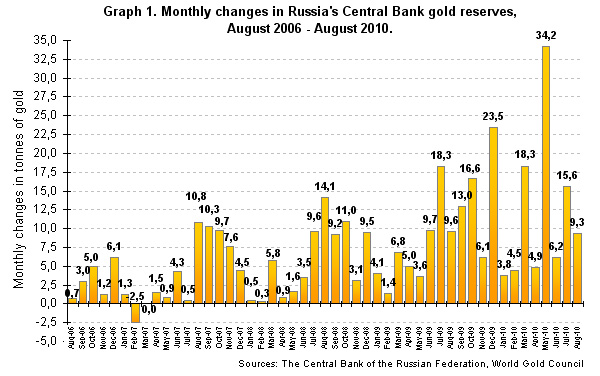
Russia’s Central Bank reserves have increased markedly in recent years. The RCB reported in May 2010 purchasing 34.2 tons of gold in a single month. Russian Central Bank Gold Purchases Soar In May – China Too? | The Daily Gold
The diagram below shows a significant increase in monthly purchases by the the RCB since June 2009.


(click on chart to enlarge)

Central Banks in the Middle East are also building up their gold reserves, while reducing their dollar forex holding.
Gold reserves of GCC states is less than 5 percent:
Dubai International Financial Centre Authority economists released a report yesterday calling for local countries to build gold reserves, according to The National.
Despite a high interest in gold, GCC states maintain less than 5 percent of their total reserves in gold. Compared to the ECB, which holds 25 percent of reserves in gold, that leaves a lot of room for growth. http://www.businessinsider.com/gcc-boost-gold-holdings-2010-12#ixzz18FEqpTy3
GCC states should boost their foreign reserve holdings of gold to help shield their billions of dollars of assets from turbulence in global currency markets, say economists at the Dubai International Financial Centre Authority (DIFCA).
Diversifying more of their reserves from US dollars to the yellow metal would help to offer central banks in the region higher investment returns, said Dr Nasser Saidi, the chief economist of DIFCA, and Dr Fabio Scacciavillani, the director of macroeconomics and statistics at the authority.
“When you have a great deal of economic uncertainty, going into paper assets, whatever they may be – stocks, bonds, other types of equity – is not attractive,” said Dr Saidi. “That makes gold more attractive.”
Declines in the dollar during recent months have dented the value of GCC oil revenues, which are predominantly weighted in the greenback. GCC urged to boost gold reserves
According to a report in People`s Daily;
The latest rankings of gold reserves show that, as of mid-December, the United States remains the top country and the Chinese mainland is ranked sixth with 1,054 tons of reserves, the World Gold Council announced recently.
Russia climbed to eighth place because its gold reserves increased by 167.5 tons since December 2009. The top ten in 2010 remains the same compared to the rankings of the same period of last year. And Saudi Arabia squeezed to the top 20.
Developing countries and regions, including Saudi Arabia and South Africa, have become the main force driving the gold reserve increase. … .
The International Monetary Fund (IMF) and the European central bank are the major gold sellers, and the IMF’s gold reserves decreased by 158.6 tons. (China’s gold reserves rank 6th worldwide – People’s Daily Online
It should be understood that actual purchases of physical gold are not the only factor in explaining the movement of gold prices. The gold market is marked by organized speculation by large scale financial institutions.
The gold market is characterised by numerous paper instruments, gold index funds, gold certificates, OTC gold derivatives (including options, swaps and forwards), which play a strong role, particularly in short-term movement of gold prices. The recent increase and subsequent decline of gold prices are the result of manipulation by powerful Zio-financial actors....


Monday, November 12, 2012

IsraHell and Turkey Kiss and make-up in order to serve the criminal Empire and its hegemonic designs in MENA...


Apparently under pressure from Boeing Corp. (which announced massive layoffs from its defense division right after last week's US election), Israel Aircraft Industries has agreed to resume manufacture of spy systems for the Turkish Air Force's Boeing 737's ....

Israel Aerospace Industries Ltd. (IAI) (TASE: ARSP.B1) unit ELTA Systems has decided to restart the manufacture of electronic measures systems the Turkish Air Force's Boeing’s 737 early warning and control Systems spy aircraft, "informed sources" have told Turkey's "Hurriyet Daily News."
The newspaper added that the decision paves the way for the release of Boeing’s long-delayed four 737 planes, which were built for a total of $1.6 billion. The Turkish daily also speculated that the decision to supply the critical devices may also mean an end to Israel's two-year defense exports ban for Turkey. The sources said that with the decision to continue production recently, the manufacture of a third plane approached completion. ELTA had finished the production of the EMS systems for the first two aircraft years ago.
"Hurriyet Daily News" recounted that in 2002, Turkey’s defense procurement agency, ordered four 737-700 AEW&C aircraft from Boeing, ground radar and control systems, plus ground control segments for mission crew training, mission support and maintenance support. Under the agreement the four aircraft were supposed to be released in 2006. But the integration of the planes took much longer. ELTA is building the EMS systems for four aircraft and its Turkish systems are expected to cost more than $100 million.
The ELTA decision follows Boeing’s efforts to urge the Israeli company to restart this Turkish manufacturing. Elta is the single producer of the EMS systems for Boeing’s 737 aircraft. The 737 Boeing AEW&C aircraft are to be used as part of Zio-Turkey’s utterly criminal NATO capabilities...


Wednesday, November 7, 2012

Who is going to captain the sinking Titanic...


1) When the US federal government spends money, expenses are officially categorized in three different ways.

Discretionary spending includes nearly everything we think of related to government– the US military, Air Force One, the Department of Homeland Security, TSA agents who sexually assault passengers, etc.

Mandatory spending includes entitlements like Medicare, Social Security, VA benefits, etc. which are REQUIRED by law to be paid.

The final category is interest on the debt. It is non-negotiable.

Mandatory spending and debt interest go out the door automatically. It’s like having your mortgage payment autodrafted from your bank account– Congress doesn’t even see the money, it’s automatically deducted.

2) With the rise of baby boomer entitlements and steady increase in overall debt levels, mandatory spending and interest payments have exploded in recent years. In fact, the Congressional Budget Office predicted in 2010 that the US government’s TOTAL revenue would be exceeded by mandatory spending and interest expense within 15-years.

That’s a scary thought. Except it happened the very next year.

3) In Fiscal Year 2011, the federal government collected $2.303 trillion in tax revenue. Interest on the debt that year totaled $454.4 billion, and mandatory spending totaled $2,025 billion. In sum, mandatory spending plus debt interest totaled $2.479 trillion… exceeding total revenue by $176.4 billion.

For Fiscal Year 2012 which just ended 37 days ago, that shortfall increased 43% to $251.8 billion.
In other words, they could cut the entirety of the Federal Government’s discretionary budget– no more military, SEC, FBI, EPA, TSA, DHS, IRS, etc.– and they would still be in the hole by a quarter of a trillion dollars.

4) Raising taxes won’t help. Since the end of World War II, tax receipts in the US have averaged 17.7% of GDP in a very tight range. The low has been 14.4% of GDP, and the high has been 20.6% of GDP.

During that period, however, tax rates have been all over the board. Individual rates have ranged from 10% to 91%. Corporate rates from 15% to 53%. Gift taxes, estate taxes, etc. have all varied. And yet, total tax revenue has stayed nearly constant at 17.7% of GDP.

It doesn’t matter how much they increase tax rates– they won’t collect any more money.

5) GDP growth prospects are tepid at best. Facing so many headwinds like quickening inflation, an enormous debt load, and debilitating regulatory burdens, the US economy is barely keeping pace with population growth.

6) The only thing registering any meaningful growth in the US is the national debt. It took over 200 years for the US government to accumulate its first trillion dollars in debt. It took just 286 days to accumulate the most recent trillion (from $15 trillion to $16 trillion).

Last month alone, the first full month of Fiscal Year 2013, the US government accumulated nearly $200 billion in new debt– 20% of the way to a fresh trillion in just 31 days.

7) Not to mention, the numbers will only continue to get worse. 10,000 people each day begin receiving mandatory entitlements. Fewer people remain behind to pay into the system. The debt keeps rising, and interest payments will continue rising.

8) Curiously, a series of polls taken by ABC News/Washington Post and NBC News/Wall Street Journal show that while 80% of Americans are concerned about the debt, roughly the same amount (78%) oppose cutbacks to mandatory entitlements like Medicare.

9) Bottom line, the US government is legally bound to spend more money on mandatory entitlements and interest than it can raise in tax revenue. It won’t make a difference how high they raise taxes, or even if they cut everything else that remains in government as we know it.

This is not a political problem, it’s a mathematical one. Facts are facts, no matter how uncomfortable they may be.

Wednesday, October 31, 2012

Oil rulers toy with Armageddon...

Oil rulers toy with Armageddon...By Hossein Askari 

http://www.globalresearch.ca/hidden-agenda-behind-war-on-terror-the-conquest-of-oil-gas-water-and-vital-resources/28394


The Persian Gulf has every ingredient imaginable for stoking conflicts, revolutions and wars for all eternity. Just recall the long, though still highly partial, list of conflicts that are the region's inheritance (see
Conflict without end, Asia Times Online, October 19, 2012). And don't forget that hardly any of these conflicts are ever reconciled, with the result that about eight out of 10 conflicts are resurrected.

Why is the Persian Gulf so cursed? Although it is the birthplace of Islam, a religion that preaches peace, justice and the unity of humankind, the Persian Gulf has sectarian, tribal and ethnic divides and conflicts that appear timeless and likely to linger until the end of time.

But to our mind what stand out in the region as the fuels for conflicts to come, including Armageddon, are the vast oil and gas wealth under the ground, its highly skewed regional distribution (per capita) and the unimaginable human greed within the region and from much farther afield.

How will the future unfold in the region?Let's start out by stating a number of considerations that we take as almost facts. To begin with, we believe that the Iranian and Saudi regimes will not entertain any talk of pluralism, democratic reform and elected and accountable governments.

The mullahs in Tehran have shown their resolve in the aftermath of their presidential election of 2009. Their brutal crackdowns are etched in the minds of millions in Iran and around the world. More recently, their unashamed support for the criminal actions of their ally Bashar al-Assad in Syria further confirms the fact that they will do anything to stay in power, even if it means complicity with those that commit crimes against humanity.

The mullahs will not accept any significant change in the constitution that erodes the power of the supreme leader, the leader that they put on the perch without popular participation. For legitimacy, the mullahs point to a constitution adopted in the heat of a revolution (with little time for reflection and ability for revision) and Islam. And they have even discarded this constitution and have ruled in ways that contradict basic Islamic teachings.

In contrast, the regime in Riyadh, while even more repressive than the regime in Tehran, co-opts most dissidents with money and indoctrination, not by force - but not when it comes to dealing with their 10-15% Shia population.

The al-Sauds will do whatever is necessary to limit Shia resurgence anywhere and everywhere, especially in the kingdom and in the rest of the Gulf Cooperation Council (GCC - that is, Bahrain, Kuwait, Oman, Qatar and the United Arab Emirates).

In the end, no matter Qatar's protestations, the rest of the GCC will tow the Saudi line in controlling domestic dissent. These family rulers - the al-Sauds in Saudi Arabia, the al-Sabbahs (Kuwait), the al-Thanis (Qatar), the al-Nahyans (Abu Dhabi) and the al-Maktoums (Dubai) in the UAE, the al-Khalifas (Bahrain), and the al-Saids (Oman) - will not support peaceful transition to constitutional monarchies.

Although the al-Sabbahs (and possibly others) may be disposed to such a transition, the al-Sauds will not tolerate such a change on their doorstep as they see it as an existential threat to the survival of their own absolute rule. Similarly, the al-Sauds will not tolerate any concessions to the Shia majority in Bahrain as it might encourage Shia in Saudi Arabia to fight for their rights.

In support of their goals and policies, the al-Sauds will push for a "stronger" union of the GCC with them at the helm and with financial largesse for the financially less fortunate members of the GCC. The rest of the GCC, with the possible exception of Qatar, will tow the Saudi line and try their best to stay out of the limelight and not be involved in conflict.

In Iraq, the Shia community is destined to rule but conflicts over the division of oil revenues with Kurds and Arab Sunnis will translate to a siege mentality with discrimination and conflict for the foreseeable future. Reconciliation will be difficult after so many years of brutal Ba'athist rule. However, without reconciliation, internal insurgency will continue for the foreseeable future and keep the regime preoccupied.

Turning to the role of the United States, it is safe to say that it has learned nothing from the overthrow of the Shah in Iran or from the more recent overthrow of dictators in the Arab Spring. The US, no matter what it professes, will continue to look the other way in support of its favorite dictators until the bitter end in the name of "stability" and the "free flow of oil".

It will not stray from this policy as long as dictators buy US arms, import other goods and services from the US, finance US government debt, maintain significant deposits in the US and award contracts to US public relations firms and influential lobbyists.

It continues to sell arms to Saudi Arabia even though Saudi Arabia pushes for, and supports, the al-Khalifas' brutal tactics (in our view constituting crimes against humanity) to suppress the peaceful demonstrations of its Shia citizens who make up more than 65% of its population.

Even worse, the US has sold arms to Bahrain to crack down on dissent in the aftermath of these events while simultaneously professing democratic reforms and human rights for the region. It is almost unbelievable that the US can do all this with a straight face and believe that the region does not see through such blatant duplicity. And when it comes to Israel, the US will blindly do as Israeli leaders ask, even though it may turn out to be harmful for Israel, for the US and for the region.

On this basis and given our depiction of the region in previous articles and the region's simmering conflicts, where will we go from here over the decades to come?

Let's look at the easy item first - the global oil and gas market.

When it comes to the world oil and gas market, we believe that the position of the Persian Gulf region will go through a fundamental transformation. First, we, unlike analysts, do not see the region's global oil market importance (market share) increasing significantly in the coming years. We believe that:


  • Unconventional oil and oil from the Arctic and very deep sea finds will make important contributions to supply;
  • Oil demand will not grow as fast as most expect because of the much slower global economic growth that will be a part of the landscape for years and more conservation, especially in the US and in most emerging markets where the biggest growth in demand has been expected;
  • The relative contribution of natural gas, even in transportation, will continue to increase;
  • Shale gas will steadily become a major fuel source worldwide; and renewable energy will make a bigger contribution than most project, with solar becoming increasingly competitive as the price of solar panels continue to plunge.

    As important, we think that Saudi Arabia's significance in the global oil market is today at about its peak and it will start to decline as the country's domestic oil consumption continues to increase rapidly, its production capacity is at its limit and the production of others in the Persian Gulf increases.

    Although Iraq will continue to be besieged by insurgency and instability, we believe that corrupt officials, looking out for their own quick financial gains after years of Ba'athist rule, will offer increasingly attractive terms to international oil companies and investors that will boost its production capacity and enhance its proven reserves well beyond the 200 billion barrel level and approaching Saudi Arabia's level of reserves.

    In Iran we expect a major boost to Iran's natural gas output (and a significant increase in oil output capacity), destined for domestic consumption and export, especially to Europe and Southwest Asia. Still, oil price shocks may become even more pronounced because of increasingly unpopular Persian Gulf governments, US support for oppressive rulers and the resulting conflicts and insurgencies.

    Regionally, we believe that the al-Sauds will entertain an enlarged GCC that includes Jordan and Morocco. The al-Sauds, as we have said above, will push for a more unified GCC under their stewardship, with unified military, intelligence services, foreign policy, religious affairs (ie towards Shia Muslims), and currency (single or common), with Saudi fiscal support for Bahrain and Oman and with more financial assistance from Abu Dhabi for the poorer members of the UAE.

    Simultaneously, Saudi Arabia will step up its support of Iraqi Sunnis and Lebanese Sunnis and Christians (in opposition to Iranian backed Shia under the umbrella of Hezbollah).

    Iran and Iraq will have little choice but to respond to what they would see and brand as Saudi aggression, annexation and expansionism. 
  • Iran will accuse Saudi Arabia of essentially annexing Bahrain (trampling on Iran's historic claim to the island) and the UAE (similarly trampling on Iranian claims to parts of the federation), and stoking up insurgencies in the region and in southwestern Iran among its Arab population.

    Iraq will accuse Saudi Arabia for interference in its domestic affairs by fueling its domestic insurgencies among its Sunni tribes. Iran and Iraq will announce a Shia Union. They will launch a joint invasion of Kuwait and annex it all. The US will be powerless to retaliate.

    Although the US will continue to be financially strapped and Saudi Arabia and the rest of the GCC will offer to foot the bill, the US will not want to risk a fight with a potentially nuclear-armed Iran (see below) and will not have the stomach to simultaneously take on and fight Iran and Iraq.

    The North Atlantic Treaty Organization and the US will publicly threaten Iran and Iraq and demand that they withdraw from Kuwait, but in private discussions they will tell the Shia coalition that they can keep Kuwait but must not cross over into Saudi Arabia or any other part of what remains as the GCC. This will become the red line for a financially weakened US.

    All this does not mean that internal revolt will diminish in any of these countries. In fact, we expect the opposite. Demonstrations against rulers will become even more pronounced, with resulting disruptions in the flow of oil and oil price shocks. The gap between rulers and their cronies who support them and the average citizen will continue to widen.

    Rulers and regime insiders will live in luxury, while the average citizen in Iran, Iraq and even Saudi Arabia will suffer from economic deprivation. Unemployment will continue to be high in Iran, Iraq and Saudi Arabia with limited opportunities for advancement. These three big Persian Gulf countries will have large inefficient public sectors, depleting oil reserves and wasted foreign financial reserves accumulated in the "good times". The population at large will be faced with a bleak future.

    Political repression will go hand in hand with economic deprivation in the three big countries, while countries such as Egypt and Tunisia will make slow but steady progress, in fits and starts, towards political participation and liberalization. The citizens of the Persian Gulf will become increasingly aware of their deprivation and the support of foreigners for their corrupt rulers, further fueling insurgencies.

    Rulers will follow the lead of the US and brand anyone and everyone who fights for human rights as "Islamists" and "terrorists". Resentment towards rulers and the West will increase to new highs with more popular rebellion and military crackdowns. While Egyptians will continue to be more concerned with economic justice and prosperity, the citizens of the Persian Gulf will be as concerned with political rights and participation.

    In parallel, we believe that Iran will complete its enrichment cycle to the point that it could develop a bomb, if needed, in less than three months (becoming another Japan as far as enrichment and nuclear weapons are concerned). The Iranian people have been, and will continue to be, behind this policy because of the world's support of Saddam Hussein in the aftermath of his invasion of Iran and the West's shameful export of weapons of mass destruction to Iraq used in its war with Iran, killing and maiming thousands of Iranians.

    At the same time, we expect that in time it will be revealed that Saudi Arabia has already purchased five nuclear warheads from an "unconfirmed" country, rumored to be Pakistan, for an estimated US$20 billion. With its previously confirmed acquisition of Chinese long-range missiles capable of carrying nuclear warheads, Saudi Arabia overnight becomes a threat to Iran, Iraq and Israel. Egypt and Turkey accelerate their plans to acquire nuclear warheads.

    In retrospect, US reluctance to force an end to expansion of Israeli settlements into the West Bank and to push for a totally verifiable nuclear-free Middle East will be seen as the most shortsighted and greatest policy blunder of all time.

    As events unfold, all observers will question what good nuclear arms have done for Israel? Israel had always enjoyed conventional military superiority and US support. Israel's nuclear arsenal will be seen as only encouraging others to acquire similar weapons and pose an existential threat to Israel.

    Although we may be tempted to continue and speculate on how this will play out, it is better that we stop this line of speculation here. We would just add one thing. Yes, a disenfranchised nut could rule in Iran, Iraq, Egypt, Turkey,and Saudi Arabia or in Israel. And nuts with a nuclear bomb are a bad mix, at any time and anywhere.

    Can the political, economic and energy outlook for the region be very different the one we have described above? Yes, but it will take a lot on a number of fronts, especially on the part of international non-government organizations, the US, China, Russia and the UN Security Council.

    Essentially, what is required is a broad-based initiative that promotes regional peace, economic justice, economic development and growth in the region, encourages good institutions and political liberalization, and forces the US, the rest of the West, China and Russia to take a longer-term policy approach to the region and give more credence to what they espouse.

    Let's briefly elaborate on what will be seen as naive and wishful thinking by any realist.


  • Increase the price of all acts of aggression, political crimes, human rights abuses, plunder of national wealth, and more.
  • The UN Security Council guarantees the borders of each and every country in the region. All acts of intrastate aggression are treated fairly and justly at the Security Council.
  • If the US truly wants to practice what it preaches, it should join the International Criminal Court and expand the court's reach, powers and effectiveness; intrastate and interstate crimes - the price to be paid for aggression - can be best reduced through support for the ICC.
  • International NGOs, along with Western governments, should expose the egregious acts of Persian Gulf rulers and their wrongfully acquired wealth (and that of their cronies). This should be much easier in an increasingly wired world. Rulers, without exception, must be convinced that they will be prosecuted at the ICC for their crimes with all illegally acquired wealth clawed back to their country, thus reducing the incentives for autocratic rule and plunder. NGOs, international institutions and Western governments should publicize the fact that oil belongs to the people and that elected accountable governments should be transparent and manage it a way to benefit members of all generations equitably and equally.
  • The rest of the world can further support this transition to better governance and peace by placing a total embargo of weapons to the region. The US could push Israel to accept a nuclear-free Middle East. Yes, the drift towards the apocalypse could be avoided but it will take unprecedented vision, statesmanship and international cooperation. It is not the availability of oil at a reasonable price that matters, it is the survival of humanity that's at stake.
  • Friday, October 26, 2012

    Russia to be an “efficient balancer” in Asia...

    It is a pity that I can’t recount the free-wheeling, scintillating discussions with the Russian intelligentsia and political elites through the past four days in St. Petersburg and Moscow — because of Chatham House rules. Anyway, I am speechless every time I come here — how much this country has changed since I first lived and worked here in 1975. 
    I seldom heard a kind word about Vladimir Putin in all these 4 days so far. Our Prime Minister Manmohan Singh should consider himself an extraordinarily lucky man in comparison. Russians are simply reveling in the seamless freedom of expression they currently enjoy, which, when combined with their compulsively brooding nature and their tendency to be self-deprecatory, can inebriate the power of reasoning at times. The “discontent of democracy”?
    However, today in Moscow the Chatham House rules were mercifully lifted for a scintillating 2-hour conversation we held — a 50-member group of “Russia watchers” drawn from Europe and the United States, plus China, Japan, India and Iran (including three former prime ministers and one defence minister and a top communist party official) — today with Alexey Pushkov, chairman of the Committee on Foreign Affairs of Russia’s State Duma (Parliament). 
    Pushkov is known to be close to President Vladimir Putin and is an authoritative voice on Russian foreign policy. He is a many-splendoured personality — professor, strategic analyst, journalist and today a politician. In the Russian system, his current position gives him a prominent role in the foreign policy establishment. (We hope to be received by Putin.)    
    Pushkov confirmed a trend which I began noticing from Day 1 as soon as I came, namely, that notwithstanding the rhetoric from Moscow, Russia’s heart and soul is still with the West, while the East becomes a mere occasional affair, a highly selective engagement. Much of the angst reminds me of a jilted lover — something we all have gone through sometime or the other in our tumultuous life.
    Actually, Pushkov devoted almost three-quarters of his talk to Russia’s relations with the West, United States in particular. 
    It was left to a prominent Iranian member of parliament (who is also a member of the Majlis’ consultative committee on foreign and security policies) in our group to gently point out toward the end that Pushkov didn’t say anything about the SCO or the Arab Spring — and, unsurprisingly,  it was my turn to elicit Pushkov’s views on Russia’s tryst with Asia. Out of old habit, I kept a verbatim account, which I summarize below:
    *** Russian foreign policy in the post-Soviet era has always been about the West. “But a limit has been reached for both sides.” Russia’s admission to the two most important western institutions — NATO and EU — is not going to be possible. Russia is unwilling to concede its sovereignty and in any case the “returns” for doing so aren’t commensurate. There are no “incentives” for Russia to rethink. 
    ***Russia came close to considering membership of NATO, but it is clear that neither side will gain out of Russia’s accession. It is a closed chapter now. 
    *** As for EU, Russia has strengthened its European identity and is already part of the European economic space. But Russia is not a part of “political Europe” or the “military-political Europe”. Simply put, Russia has a different political culture and there is a huge ideological difference between Russia and the EU countries. 
    *** Russia’s problem is quintessentially that “there is nowhere to go East”, either. There could possibly be an economic dimension to Russia’s ties with the East, but “much less” is there in the East in political or military terms. Besides, China with which Russia has close relations has a “relatively free hand” in Asia and, therefore, Russia has settled for bilateral relationship. Neither Russia nor China wants a military alliance to counter NATO; at any rate, such a (Sino-Russian) alliance is neither desirable nor is conceivable. 
    *** So, at the end of the day, it is all economics with the East — oil, gas, etc. 
    *** Against this backdrop, a consensus has appeared in Russia that it has no need to go anywhere, and should rather stay put where it is. Eurasia is Russia’s “natural habitat”. Also, major military potentials are concentrated in Eurasia: US also happens to be a Eurasian power thanks to its alliances with countries like Pakistan or South Korea; most of the conflicts today are on the peripheries of Eurasia, such as Afghanistan and Pakistan. Thus, Eurasia is vital to Russia’s interests. 
    *** How does Russia approach Eurasia? The formation of a Eurasian Union is the principal idea today. The Customs Union has been the first step and it is proving efficient. A country like Kazakhstan, which knows very well where its interests lie, wouldn’t be espousing the Customs Union without the conviction that the grouping could be greatly beneficial. 
    *** The next step is going to be the Common Economic Space, which forms the backbone of the Eurasian Union. There is a lot of skepticism in the West about the Eurasian Union idea but it doesn’t perturb Russia. All sorts of things have been said about the euro zone or the imminent fall of the dollar, but events proved otherwise; so will be the case with the Eurasian Union. 
    *** The key factor here is that Russia should not press its partners with a political union or common currency. “Those things can wait.” The Eurasian idea should be approached cautiously and convincingly. A lot can be gained in the economic field. 
    *** Besides, Eurasian Union “turns Russia into an independent center of attraction for other countries.” Much depends of course on how well Russia does economically. 
    *** Suffice to say, the western perception that “Russia is going toward the East” or is seeking a confrontation with the West is unwarranted. Russian foreign policy has been largely reactive — except, perhaps, on Syria. It is the West which precipitated the current tensions while Russia has not sought confrontation. The war with Georgia was provoked by the West; Russia didn’t precipitate it. 
    *** The root problem is that the West wants Russia to “make it look like the European countries”, but Russia has its own character, its ideology, customs, etc. An ideological element is always present in the West’s — and the US’ — attitude towards Russia, “which is dangerous”. The objective should be “a decent cooperative relationship” rather than to make Russia “a carbon copy” of the western countries. 
    *** Russia is not prescriptive toward the West. Russia didn’t ask how come George W. Bush won in 2000 or why Ohio today is so terribly important in an apparently nation-wide election. It is up to the US to have its political or electoral system. But the West is needlessly intrusive and Russia cannot accept it. 
    *** Post-Soviet Russia began with a clean slate. There was no desire for another Cold War and on the contrary, Russia had a lot of warmth toward the US in the early 1990s. But the result was disappointing; perhaps, Russia expected too much. “Instead of becoming an ally of the US, Russia became an object of US influence.” 
    *** The eastward expansion of NATO was the defining moment in the evolution of Russia’s foreign policy ideology. Thus, the present ideology — the “ambition to be an independent player” — was borne out of actual experience. It began in the period of Boris Yeltsin circa 1995. The replacement of Sergei Ivanov as FM with Evgeniy Primakov and the choice of Victor Chernomyrdin rather than Gaidar as PM — although they were apparatchiks — it was Yeltsin’s response as a Russian politician who began realizing that the first five years of his presidency “didn’t give the desired results”. 
    *** The core problem is the misunderstanding on the part of the West that Russia will “comply”. Indeed, “Russia has complied on many things, but not all.” Out of this experience this ideology has been born that Russia should be an “independent center of power”. 
    *** Russia is looking for a “balancing role” in Asia. It is no longer a superpower. The Asia-Pacific is becoming “the area” of the 21st century. But it is a hotbed of tensions. Russia fears that an “imbalance can develop” in Asia and “Russia doesn’t want to see a single power dominating Asia.” The role of an “efficient balancer” is what Russia can and should play in Asia. If Russia tries to exceed that role, “there could be misunderstandings.” (This part on Asia was in response to my intervention.) 
    *** With regard to the Arab Spring, Russia has a cautious approach. Russia is opposed to revolutions; it has had enough of revolutions in its history. The Bolshevik Revolution in 1917 was a “historic mistake”. Because of it, “Russia was affected genetically; it was a national tragedy.” Therefore, the revolutions in the Middle East should not be viewed from an ideological perspective. The notion of humanitarian intervention should be definitely reconsidered. And foreign powers “should not take moral sides in civil conflicts.” 


    Thursday, October 18, 2012

    La Suisse, L'Europe et La France, quel contraste saisissant...


    La Suisse, L'Europe et La France, quel contraste saisissant...

    Les Zio-socialistes Français sont au gouvernement pour finir le travail de sape de L'Europe...

    Mais d'abord, « Comment se porte la Suisse, et quel Contraste avec la vieille Europe...? Mais les Suisses n’ont pas le Prix Nobel de la Paix, eux!!! 

    Nous nous rejoignons en toutes choses. J’adore la Suisse et je l’admire pour son excellence. J’y suis le plus souvent possible en toutes saisons (2 mois/an quelquefois plus) perché dans le Valais à 1500 m d’altitude. J’espère y aller plus encore...
    Cela fait plaisir, quant à l’Europe, « elle plonge et elle plongera comme les USA...», on devrait en faire une chanson...
    La Suisse, elle va très bien et elle vous remercie du fond du cœur... Pour être franc, elle ne doit son succès qu’à elle-même parce qu’elle a su garder sa neutralité, c’est-à-dire ; son intelligence, sa liberté (économique aussi), sa créativité, son indépendance, sa démocratie réelle, son rejet des Ziocons, sa culture, son histoire et ses racines. En terres helvétiques, les charges et les impôts sont modérés, les salaires sont bons, le taux de chômage moyen pour l’année 2011 s’établissait au plan national à 2.8% (source : Département fédéral de l’économie-septembre 2012), maîtrise des finances publiques (dette publique 34.9 % du PIB, PAS de déficit public...), balance commerciale excédentaire, mais surtout, les suisses ont gardé leur monnaie et ils sont maîtres de leur politique monétaire. Oui, il y a bien un petit point noir, victime du succès de l’économie helvétique, le franc suisse est naturellement fort et les pauvres touristes européens désargentés renâclent un peu à passer des vacances dans ce pays de cocagne tant ils sont empêtrés avec leur euro faible (et artificiellement soutenu) et leur économie socialisante moribonde...
    Mais ce n’est pas grave, l’échec, on aime ça, en terre d’Europe, nous continuerons à élire les mêmes Zio-Socialo-idiots inutiles, ceux qui se foutent de nous et coulent sans vergogne notre économie. Nous continuerons aussi à regarder la Suisse comme un paradis fiscal honteux, injuste qui favorise les riches et vit de la finance, celle qui dépouille scandaleusement le peuple, vit sur son dos et profite de sa sueur.
    Evidemment la Suisse ce n’est pas ça, c’est même tout le contraire, à dire vrai, elle pourrait nous donner des leçons sur tous les points (comme décrit plus haut !). J’aime tout en Suisse, en Allemagne et je les vois plus comme un modèle dont les crétins qui nous dirigent (pas !) devraient s’inspirer plutôt que de s’attacher à d’éternels schémas utopiques, liberticides et mortifères...
    Comme dirait l’humoriste Lafesse : « Pourvu que ça dure ! »
    Devant un tel désastre de la pensée, je commence à m’interroger solidement sur la santé mentale des hommes et des femmes, en cette période électorale, je me demande si je ne vais pas plutôt voter pour mon berger Allemand, il s’appelle Randy (pas très original !), faites comme moi ! »
    Alors que le Zio- semi-président Hollande a déclaré au journal Le Monde que le pire de la crise de l’euro est passé, la Suisse se prépare à des troubles civils ainsi qu’à des désordres sociaux provoqués par l’effondrement de la zone Euro.
    Il faut rappeler que la Suisse n’est pas un pays à prendre à la légère : Hitler a hésité, puis a finalement renoncé, à envahir la Suisse durant la seconde guerre mondiale, bien que le pays était encerclé par des pays occupés par les Nazis. Les choix stratégiques de l’armée avaient fonctionné.
    L’armée Suisse compte 200.000 hommes très bien entraînés, la plus forte proportion de toute l’Europe par habitant, mais surtout, en cela comparable au Liban, avec sa Resistance populaire armée... , tous les hommes en âge de combattre doivent faire un entraînement militaire de base, ce qui signifie que le pays est capable de mobilier une armée très importante en cas de crise, et que les Suisses aiment leur pays, qui le leur rend fort bien...
    Elle vient de former quatre nouveaux bataillons militaires, et est en passe de déployer ses troupes le long de ses frontières, après que 2000 policiers ont participé avec l’armée à l’opération « Stabilo Due », dans huit villes à travers le pays, basée sur une cartographie détaillée des risques de heurts entre bandes rivales de réfugiés, et pour repousser les débordements qui pourraient venir de Grèce, d’Espagne, de France, d’Italie et du Portugal, pays durement touchés par l’écroulement de la zone euro...
    Le ministre de la défense, Ueli Maurer, accompagné du chef des armées, a déclaré qu’une escalade de la violence est possible. « Je ne peux pas exclure que, dans les années à venir nous pourrions avoir besoin de l’armée », a t-il dit.
    Maurer s’inquiète également du faible niveau militaire européen, au plus bas depuis la guerre froide, une porte ouverte aux insurrections et aux guerres raciales.

     
    Selon Der Sonntag, le chef de l’armée, André Blattmann, a également déposé une proposition pour le déploiement de 1600 soldats destinés à garder les aéroports, les installations industrielles, et le siège de l’ONU.
    Dans un article intitulé « est-ce que les Suisses savent des choses que les autres ignorent », John R. Schindler, professeur des affaires de sécurité nationale à l’US Naval War College, explique que si la colère des musulmans venait à monter d’un cran par rapport à la rage qu’avait engendré la vidéo YouTube insultant le prophète Mahomet, les immigrants des pays Européens pourraient se soulever.
    Il note également qu’il est difficile de s’imaginer comment les forces militaires Européennes, très restreintes, pourront faire face à des conflits sociaux majeurs. Et les Etats Unis refuseront d’être embarqués dans une action anti-émeute – particulièrement si elle consiste à étouffer un soulèvement musulman.
    En Espagne, où d’importantes émeutes sont récemment intervenues, le taux de chômage des jeunes excède désormais 50%, (25,1% pour la moyenne de la population), les aides sociales ont été fortement réduites, et si un soulèvement est à craindre, il viendra des jeunes.
    Le gouvernement portugais a présenté le budget le plus dur depuis des décennies, avec une hausse d’impôts de près de 4%, et des licenciements massifs dans le secteur public, afin de répondre aux objectifs de l’UE pour le déficit et la dette. 2.000 manifestants se sont rassemblés devant le parlement et une grève générale a été appelée pour le 14 Novembre.
    En Grèce, environ 7000 policiers ont été déployés la semaine dernière pour assurer la sécurité de la chancelière allemande Angela Merkel.
    La crainte du gouvernement Suisse est qu’à ces émeutes se mêlent les jeunes musulmans européens, pour l’instant indifférents aux aspects socio-économiques.
    Quelques jours après la visite d’Angela Merkel, Coca-Cola, le principal investisseur étranger en Grèce, a annoncé qu’il quittait le pays et s’installait en Suisse.
    La Suisse a un taux de chômage de 2,8%, et, constatant avec stupéfaction que les pays européens s’obstinent à ignorer son exemple, et ne semblent pas intéressés à prendre auprès d’elle des conseils dont ils ont plus que besoin, la Suisse donc, considère que ses voisins vont continuer à s’enfoncer, ne voyant aucun d’entre eux prendre les bonnes décisions...
    la Suisse est tout sauf un pays qu’on peut tourner en dérision, sauf à se moquer de meilleur que soi. La Suisse peut donner des leçons et tenir la dragée haute à l’ensemble des pays européens pour l’intelligence de son peuple, l’exemplarité de ses structures, et, pour ceux qui encore attachent encore de la valeur à la réalité, ses résultats. Le gouvernement et le mode de démocratie de la Suisse font que le peuple suisse figure régulièrement dans le top dix des peuples les plus heureux sur terre. Quelque chose a plus de valeur, dans la vie ? 
     
    Les Suisses sont lucides et intelligents, ils font tout le contraire de ce que fait le « ZIO »
    semi-président Hollande...couilles-molles!!! 
     
    Le gouvernement Français est parfaitement au courant, car la France sera le détonateur majeur de l'Europe. Tout ceci s’inscrit dans un plan voulu et planifié. Aujourd’hui l'Europe n’est pas légitime au yeux des peuples car non élue. Les intérêts divergents des états-nations ne permettent pas à ce jour des élections directs des peuples à l'échelon européen. Pour avoir une légitimité l’europe doit d’abord détruire les états-nations tels que nous les connaissons et c’est selon moi ce qui se passe en ce moment même. Une fois les états détruits l’europe apparaîtras comme « le sauveur », la solution ultime et la meilleur pour tous. Pour cela il faut créer le chaos dans les esprits des peuples. La désinformation, les règles budgétaires en tout genres, les politiques qui ont l’air de ne rien comprendre, la déstabilisation des institutions (armée, éducation, les acquis sociaux...) et le « multiculturalisme » y contribuent par le fait de monter les gens les uns contre les autres, ce qui a pour résultat le merdier général que tout le monde constate (insécurité, chômage, islamisme, violences, laxisme de la justice etc.…).
    La dislocation voulue des états permet au dirigeants européens de prendre place petit à petit dans la vie des gens et selon moi nous sommes à la phase finale.
    Les peuples européens sont différent les uns des autres, de part leurs histoires. quel est le point commun entre un allemand,un français et un espagnole?? Aucun, leurs vies et donc leurs prismes sur la vie, le monde , la société, sont complètement différents. Pour les rassembler il faut d’abord les détruire (au sens culturel) pour créer une histoire commune, n’est ce pas dans le malheur que l’ont reconnait ses amis?? L’islam est un accélérateur utile... Une fois les états détruits commencera la reconstruction des états unis d’europe par une assemblée constituante qui redéfinira toutes les règles, les lois , les institutions… Les états vaincus ne pourront s’y opposer, il appartiendra au peuples de se faire entendre afin d’avoir une gouvernance conforme à leurs volonté. Des révoltes il y en aura, tant pendant la chute et ce n’est à peine que le début (actuellement), que pendant la reconstruction.
    Personne ne peut savoir combien de temps cela va durer. Mon opinion personnel qui n’engage que moi est qu’en 2017 nous éliront un président européen pour un gouvernement européen, mais ce n’est qu’un avis.
    Les socialistes ont été élu par la volonté des Zios de l’europe n’en déplaise à ceux qui croient encore que le peuple décide....
    Si l’on s’en tient uniquement aux faits, on peut dire que ceux qui gouvernent sont en train de créer une situation de guerre, guerre qu’ils déclencheront le moment voulu, en ayant pris soin de nous mettre dans des conditions telles que nous aurons peu de chance de pouvoir réagir.
    C’est dans la nature suisse la prévoyance à long terme, rien d’étonnant, rien de neuf, imaginez que ce petit état microscopique qui tire sa pitance du commerce, de la banque et de la finance a réussi à rester neutre pendant les deux conflits les plus meurtriers de l’humanité, un exploit en somme avec des voisins comme la France et l’Allemagne, c’est tout à fait stupéfiant..., mais L'Europe, c'est pénible à voir... 
     
    BRAVO les Suisses!


    We are living through a relative proverbial "calm before the major storm" ...

    We are living through a relative proverbial "calm before the major storm" Circa WWX...?
    The austerity imposed upon Europeans by a political class totally sold out to the USA and international bankers is literally pushing the countries of southern Europe into a social explosion which could very rapidly turn violent.  With a few rare exceptions, the media (mostly owned by banks) is buying time for the bankers by simply ignoring this reality and feeding its clueless audience a steady stream of nonsensical and irrelevant news.  Bottom line: both the Euro and the EU as a political project are dying, the continent is broke and a social explosion inevitable...
    Russia: is stark contrast to the EU, Russia is doing great.  The Russian economy is booming, the Western-sponsored opposition totally discredited, the armed forces are in very good shape and getting even stronger and the economic and social prospects look excellent.  Interestingly, Russian government officials have been very candid about the situation in the EU and they are openly saying that they have taken all the necessary measures to protect the Russian population from the consequences of the inevitable collapse of the EU.  No matter how good things look in Russia now, a collapse of the EU will have negative consequences for the Russian economy and the Kremlin has taken a wide array of measures to prepare for this situation.  Likewise, the Russian military appears to be ready to act should a US/Israeli attack on Iran create a crisis on Russia's southern borders.  Bottom line: Russia is just about as ready as can be for any foreseeable crisis and getting stronger each day...
    China is working side by side with Russia in preparation for an economic collapse of the EU followed by an inevitable collapse of the dollar and the rest of the current international financial system.  There are persistent rumors that both China and Russia are quietly buying large amounts of gold and off-loading dollars.   What is sure is that these two countries are ideal partners to jointly overcome the consequences of the inevitable meltdown of the current international financial system. Unlike Russia, China is very heavily invested in the US market and this is the reason why the Chinese are scrambling to open new markets for their goods in Africa, Latin America and, of course, Russia.  I expect these two countries to continue to work hand in hand on all levels...However, if the international role of the dollar becomes truly threatened, then all bets are off and all options very much on the table...In their typical arrogance, the utterly corrupt Western elites decreed that they had "won the Cold War" instead of realizing that their capitalist system had only been temporarily given a reprieve from its inevitable collapse by the collapse of the Soviet system.  This was a one time thing, however, and now are no more potential markets to flood with US dollars and the entire scheme is about to come tumbling down.
    The corporate media does a truly stellar job of hiding it all from the general population which continues to be fed a constant diet of irrelevant non-news with rosy forecasts about the future.  While Russia and China are clearly bracing themselves for the inevitable crisis, the Western government are putting all their efforts into hiding the facts from their population and delaying the inevitable...
    Could it lead to war? Quite possibly. I still think an attack on Iran would be irrational and that the Pentagon will be dead set against it but nothing can be ruled out...

    I fully expect there to be a military clash between the US and China over the planet's remaining oil reserves at some point in the future but I expect it will be some time before Beijing is ready...

    I also suspect the way the West plundered Russia in the Nineties will go down in history as a strategic mistake of huge proportions putting short term greed against long term interests. China now has a military alliance with the Russians. Had the ZIO-USA thugs treated Russia decently when the Soviet Union collapsed Russia might have become a friend of the United States the way Germany did after the war....

    The Nazis and the Soviets are gone... Washington, the Zio-West and IsraHell are now the greatest threat to humanity...

    I remember that Russians were very friendly towards Americans throughout most of the 1990's. They wanted to emulate the (apparent) success... If the U.S. had offered the equivalent of the post-WWII Marshall Plan to Russia, the latter would now be an American ally...

    In the end, the Zio-Neo-Con and Noe-Liberal hubris, got the better of Washington. Bush peré was a time-serving snobbish, who had no effective control over anything but the intelligence community, so he (and his psychopathic successor Clinton) let the plunderers pillage Russia. That, and Clinton's bombing of Yugoslavia, turned Russia against the West and (I believe) led to the election of Putin...A totally wasted opportunity, courtesy of the near-sighted and utterly corrupt and criminal Anglosphere...

    If the Anglo-American elite had been humble enough and astute enough to make Russia its ally, I think the world would have been much better off, by every measure. As it is, if Putin, Brazil and China can effectively check the reckless course of the Anglo-Americans, that will be the best humanity can currently hope for...